


How Much Do Barbers Make After Rent, Fees, and Taxes?

Key Points to Know About Barber Earnings
- Use published wages as a starting reference: BLS places the median employee barber wage at $18.37 an hour for May 2025. At 2,080 hours, that translates to approximately $38,210 a year. Employee tips and commissions are included, while self-employed earnings are outside the wage survey.
- Work out what remains after deductions: The amount customers spend is only the beginning of the calculation. Commission shares, chair rental, supplies, payment fees, and taxes affect the money available for personal use.
- Compare rental costs with the commission you would give up: In an example where the barber keeps 60% of service sales and renting adds $400 in weekly expenses, both arrangements produce the same pretax amount at $1,000 in weekly service sales, assuming equal tips and otherwise comparable conditions.
- Budget taxes from business profit: The standard self-employment tax rate is 15.3%, generally calculated on 92.35% of net self-employment earnings. The Social Security earnings cap and possible Additional Medicare Tax can change the final calculation.
- Improve the economics of each working week: Repeat customers, pricing that accounts for appointment time, profitable product recommendations, and controlled expenses can support stronger earnings alongside a realistic workload.
Reading Barber Wage Statistics Without Overestimating Your Pay
Federal wage figures offer a useful reference when you are exploring barbering as a career. For anyone researching barber yearly salary, the U.S. Bureau of Labor Statistics Occupational Outlook Handbook reports a median wage of $18.37 per hour for barbers in May 2025. Applying that hourly figure to 40 hours a week over 52 weeks gives approximately $38,210 annually.
That annual calculation assumes 2,080 paid working hours. A part-time schedule, unpaid time away, or fewer hours during quieter periods will produce a different yearly total.
A median identifies the midpoint of the workers represented in the data: half earn above it and half below it. The arithmetic mean is a separate measure. Neither tells you the maximum income you could eventually earn.
Survey coverage also matters. The BLS explanation of its Occupational Employment and Wage Statistics survey states that wages include employee tips and commissions. However, the survey excludes self-employed workers and owners or partners in unincorporated firms. Barbers operating genuinely independent booth-rental businesses are therefore outside these employee wage estimates.
For a renter, customer payments are business receipts from which operating expenses must still be paid. For an employee, compensation is the wage or commission received from the shop, plus applicable tips. Comparing the renter's total receipts with an employee's paycheck would mix two different financial measures.
The exclusion of independent businesses also does not prove that self-employed barbers earn a particular percentage more than employees. Their results depend on customer demand, pricing, costs, and how consistently they fill appointments.
Use the government figures to understand employee pay, then prepare a separate budget for the arrangement you intend to pursue. To include education expenses in that plan, read our guide to barbering college tuition, tools, and the time needed to graduate.
Turning Appointment Prices Into a Realistic Revenue Estimate
Estimating income requires more than choosing a haircut price and multiplying it by a full calendar. You need to consider completed visits, spending per appointment, service duration, and the expenses associated with the work.
What a Higher Service Ticket Really Adds
When asking how much do barbers make per cut, distinguish the customer's payment from the barber's compensation. A $35 haircut creates $35 in service sales. Under commission, only the agreed share belongs to the barber. Under rental, the full payment enters the business, but rent and other expenses still have to come out.
Local competition, service complexity, and the type of shop influence pricing. Reviewing current menus from comparable nearby businesses provides a more useful planning reference than assuming one price applies nationwide.
An additional service can raise the average ticket, meaning the amount spent during a visit. For example, a hypothetical $30 haircut plus a $15 beard trim produces a $45 ticket. The extra revenue is useful only when considered alongside the additional time and cost.
A 30-minute haircut priced at $30 generates $60 per service hour before expenses. A haircut-and-beard appointment priced at $45 and lasting 45 minutes also generates $60 per service hour. Although the second client spends more, the hourly service revenue remains unchanged.
Evaluate each service by its price, duration, supplies, and contribution to profit. A larger ticket alone does not establish that an appointment is more profitable.
Estimating the Number of Visits You Can Complete
There is no universal answer to how many cuts does a barber do a day. Detailed styles, consultations, cleaning and disinfection, breaks, and booking demand all affect capacity.
Imagine an eight-hour shift with one hour allocated to breaks, cleaning, and administrative work. The remaining seven hours provide 420 minutes for appointments. At 45 minutes per visit, that allows approximately nine completed appointments.
This is a scheduling example rather than a daily production standard. Shorter services may create more openings, while more involved work may require a smaller appointment count. Make sure the schedule also allows appropriate cleaning and disinfection between clients.
Available slots and paid visits are different numbers. No-shows, cancellations, and unbooked periods reduce actual sales, so base your budget on the appointments you reasonably expect to complete.
Calculating Daily Receipts Across Your Full Shift
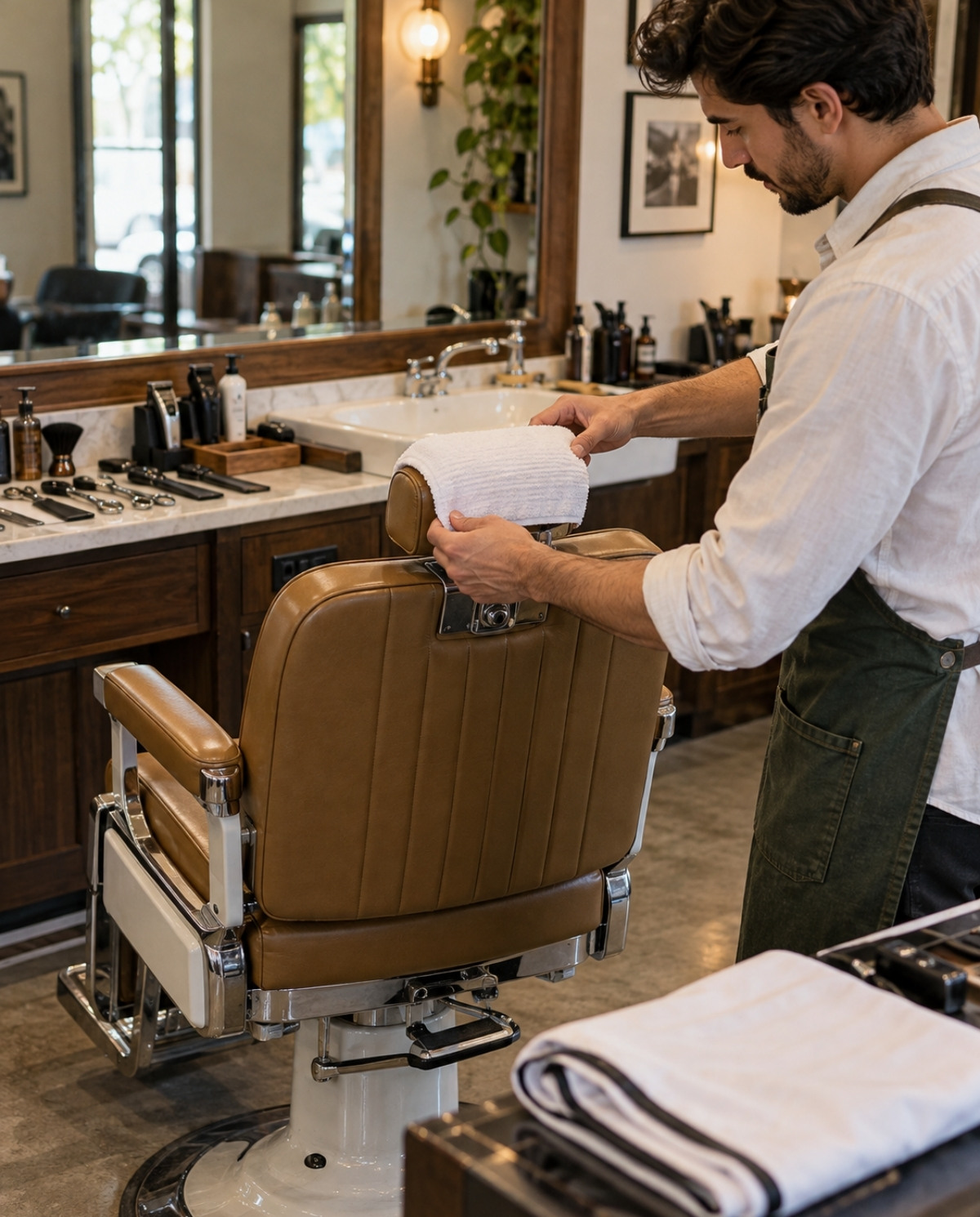
To illustrate how much does a barber make a day, assume ten completed appointments with an average service ticket of $35. Those visits generate $350 in service revenue.
If tips total a hypothetical 15% to 20% of service sales, they add $52.50 to $70. Combined daily receipts would be $402.50 to $420 before commission deductions, operating expenses, and taxes. The tip percentage is a planning assumption, not a verified amount that every barber or client follows.
For anyone calculating how much do barbers make an hour, include the entire working shift. Over eight hours, the example produces approximately $50.31 to $52.50 an hour in gross receipts. It does not represent an hourly take-home wage.
Recording paid visits, average spending, and total working hours helps you measure what your schedule actually produces.
Finding the Income Left After Business Expenses
Service sales and product revenue show how much money enters the business. They do not show how much is available for your personal spending.
A self-employed barber starts with service receipts, tips, and retail sales, then deducts business expenses. These may include chair rental, supplies, payment processing, booking software, insurance, and equipment costs. The result is business profit before applicable personal taxes, including self-employment tax.
An employee starts with the compensation paid by the employer, whether that is hourly pay, commission, or another agreed structure, along with applicable tips. The shop's total customer receipts are not the employee's income.
These separate calculations make it easier to compare offers. A rental chair bringing in more customer payments can still leave less money after expenses than an employee role with dependable bookings.
Comparing Commission Work With an Independent Rental Chair
Commission compensation and chair rental are two possible arrangements. Other shops may provide hourly wages, salaries, or a combination of payment methods.
- Commission arrangement: In an example 60/40 service split, the barber receives $60 from each $100 in service sales, with $40 going to the shop. The agreement should identify how tips are treated and which costs the shop pays, such as products, towels, booking systems, and advertising.
- Independent chair rental: The barber pays an agreed fee for space and generally operates a separate business. Service payments and tips belong to that business, while responsibility for supplies, software, processing fees, insurance, and other costs depends on the rental agreement.
Receiving commission does not, by itself, establish whether someone is an employee or an independent contractor. Likewise, calling an arrangement “rental” does not settle worker classification. The IRS guidance on employee and independent-contractor status considers behavioral control, financial control, and the nature of the relationship.
Before accepting an arrangement, clarify who controls prices and schedules, which expenses are included, how clients are assigned, and how tips are handled. For the licensing steps needed before professional practice, see our guide to barbering license requirements and state board preparation.
Working Out Your Rental Crossover Point
A rental payment remains due during a slow week. Moving into that arrangement before sales become dependable can therefore reduce the amount you keep.
Start by identifying the expenses renting would add compared with the commission role. Under an example where the barber keeps 60% of service revenue, the shop's 40% share is the amount available to offset those additional rental costs.
If the additional expenses are fixed, divide them by 0.40 to estimate the sales level where both arrangements produce the same pretax result. With an illustrative $400 in added weekly costs:
$400 ÷ 0.40 = $1,000 in weekly service sales.
At $600 in service sales, renting leaves $200 after those costs, while the 60% commission share produces $360. At $1,500 in sales, renting leaves $1,100, compared with $900 under commission.
These figures assume identical service sales and tips under both arrangements, with the $400 covering all additional rental expenses. They exclude personal taxes and other differences between the roles.
If processing fees or supply costs rise with sales, account for those variable expenses separately. Employee benefits, different tax obligations, and access to customers supplied by the shop may also affect the comparison.
There is no single sales target that makes renting the right choice for every barber. Build the decision around dependable revenue and the actual terms offered to you.
Keeping Tax Money and Operating Money Separate

Self-employed barbers generally owe self-employment tax alongside applicable federal and state income taxes. According to the IRS explanation of self-employment tax, the standard rate combines 12.4% for Social Security and 2.9% for Medicare, totaling 15.3%.
Generally, 92.35% of net self-employment earnings is subject to the calculation. Net earnings are determined after subtracting ordinary and necessary business expenses, rather than applying the rate directly to total customer payments.
The Social Security portion has an annual earnings cap, while Additional Medicare Tax may apply above specified income thresholds. One-half of self-employment tax is generally deductible when calculating adjusted gross income.
Maintain records of service income, product sales, cash payments, tips, and business expenses. The IRS publication for the cosmetology and barbering industry discusses independent rental businesses, income reporting, and recordkeeping. Use current IRS guidance for applicable tax-year rules and filing requirements.
Setting money aside for taxes and future equipment purchases helps prevent business funds from being mistaken for disposable income.
Expanding Earnings Through Products and Market Awareness
More appointments are one route to additional sales, but they are not the only option. Suitable product recommendations, carefully priced specialty services, and an understanding of local demand can also improve business results.
Specialty services may require additional appointment time. Evaluate their hourly revenue and costs before assuming they increase earnings without extending the working day.
Measuring Your Return From Product Recommendations
Pomades, beard oils, and shampoos can help customers maintain their results at home. Selling an appropriate product can add revenue without scheduling another full haircut appointment.
The amount sold is still different from the amount you earn. Four products priced at $20 each generate $80 in retail sales. With a hypothetical 10% retail commission, the barber receives $8. Repeating that sales level across 20 working days produces $160 in commission.
For barbers who buy and resell their own stock, profit depends on wholesale prices, processing fees, and other selling expenses. Products that remain unsold or become damaged can reduce the return.
The Grand View Research report on men's grooming products projects a global market value of $506.7 billion by 2033. Its coverage extends across multiple product categories and retail channels, so the forecast does not measure barbershop service income or establish what an individual barber will earn.
For practical planning, track the commission or margin from your own sales and recommend products suited to each customer's needs.
Assessing a Location Beyond Its Haircut Prices
Higher menu prices can create an opportunity for stronger revenue, but local rent, competition, and customer demand influence how much remains. Living costs also affect the purchasing power of your personal income.
The Best Cosmetology Programs barber salary guide lists May 2025 median annual employee wages of $61,150 in Washington, $30,750 in Georgia, and $25,640 in Arkansas. Those figures refer to employed barbers, rather than the sales or profits of independent businesses.
The BLS wage tables for states and metropolitan areas provide a direct starting point for local comparisons. Keep the occupation, survey year, and wage measure consistent. A statewide median does not predict the earnings of a beginner or a particular neighborhood shop.
Before choosing where to work, examine:
- Comparable service menus: What nearby businesses charge for similar appointments.
- Expected paid visits: Likely customer demand after allowing for quiet periods and cancellations.
- Expenses attached to the chair: Rental charges, supplies, payment fees, insurance, software, and marketing.
- Convenience for returning customers: Whether clients can reach the shop easily and maintain their appointment routine.
Experience and a strong reputation may support higher prices. The useful financial measure, however, is the profit those prices produce after accounting for time and expenses.
Choosing Training That Prepares You for Shop Work
Technical skill supports the financial side of barbering. Consistent results, safe practices, effective consultations, and good time management help create the service experience customers return for.
When comparing programs, look beyond the completion date. Ask how students practice client interactions, prepare for licensing, and learn about professional responsibilities.
Our guide to becoming a barber and entering the profession explains the broader path from initial interest to career preparation.
Training areas worth reviewing include:
- Reliable practical skills: Accurate cutting, safe equipment use, and organized work habits that allow appropriate consultations and disinfection.
- Relationships with returning clients: Understanding preferences, producing repeatable results, and discussing suitable maintenance schedules.
- Preparation for business decisions: Service pricing, product recommendations, work arrangements, expense records, and the boundaries of licensed practice.
Licenses do not permit identical services in every state. As one example, Georgia's barber training regulations provide separate curricula for Master Barber and Barber II training, with chemical services included in the Master Barber curriculum.
For Georgia-specific requirements, consult the Georgia State Board of Cosmetology and Barbers licensing guide. If you plan to work elsewhere, verify the permitted services and qualifications with that state's licensing authority.
Education provides a foundation. Your subsequent earnings will also reflect experience, local demand, returning customers, and the decisions you make about costs and working arrangements.
Questions About Income and Everyday Barbering Work
How much can tips contribute to a barber's earnings?
Tip income varies between customers and appointments. As a hypothetical example, a 15% to 20% gratuity on a $30 haircut adds $4.50 to $6. Ten appointments would generate $45 to $60 in tips if every customer tipped within that range.
Do not assume that result will repeat every day. Record tips separately, and remember that BLS employee wage figures already include them. Adding another tip percentage to those published wages would double-count that component.
What size client base supports a regularly booked schedule?
There is no dependable timetable for building a full roster. Location, access to walk-ins, availability, service quality, and repeat visits all influence progress.
A numerical target can still help with planning. Ten appointments a day over five days requires 50 weekly visits. If each regular customer returns every two weeks, approximately 100 active clients would support that volume. With four-week return intervals, the comparable roster is approximately 200 clients.
Those calculations assume appointments are distributed evenly and nobody cancels. Monitor actual return intervals, rebooking, and completed visits to see whether your client base supports the schedule you want.
What physical demands should a future barber expect?
Long periods on your feet and repeated movements of the hands, wrists, and arms are part of the work. The BLS description of the occupation identifies physical stamina as an important quality because much of the shift is spent standing.
Appropriate chair height, suitable equipment, changes in posture, and breaks can help manage strain. Persistent pain or numbness should be evaluated rather than accepted as an unavoidable part of the profession.
How do barbering and cosmetology licenses differ?
Barbering generally concentrates on haircuts, beard and mustache grooming, and shaving. Cosmetology usually includes a wider combination of hair, skincare, and nail services.
However, those general descriptions do not define the legal scope of every license. Some barber licenses permit chemical hair services, and the boundaries vary by state and license category. Check the relevant board's rules before selecting a program or offering a new service.
Explore Your Barbering Education at Aiken
A professional barbering career begins with practice, instruction, and preparation for working with clients. At Aiken School of Cosmetology and Barbering, the school's focus on developing “Salon Ready” graduates connects hands-on education with career preparation.
The barbering program offers practical training in haircutting, trimming, shaving, grooming, and styling. Its listed learning areas also include salon business and client retention, helping students explore responsibilities beyond performing a service.
Visit our Enrollment page to learn about the next steps and request a campus tour. You can also use the contact form below to arrange a visit, meet the team, and ask how the program fits your professional goals.