


How Much Do Beauty School Instructors Make? Salary, Jobs, and Career Paths Explained
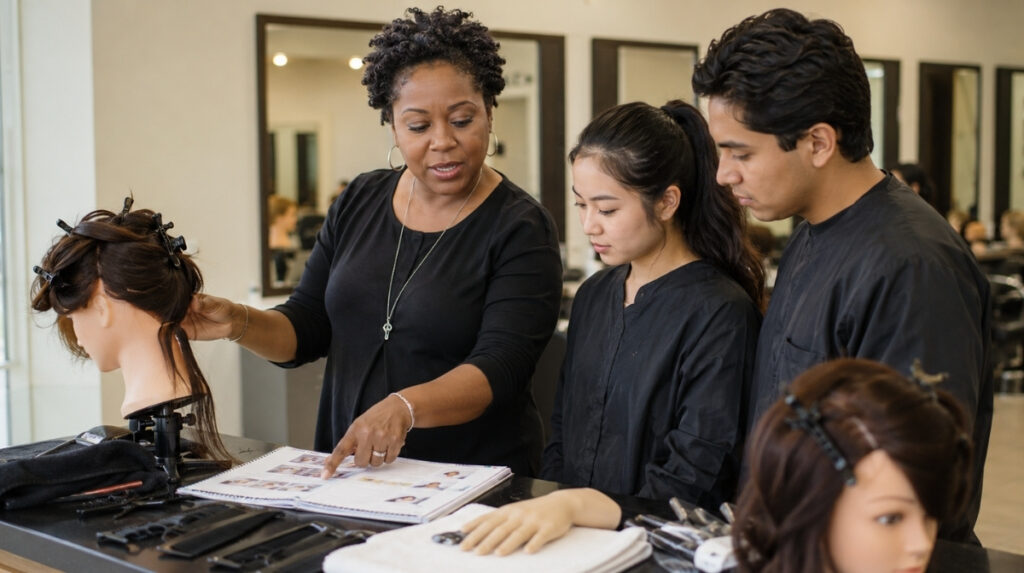
Working behind the salon chair is incredibly rewarding, but it can take a serious toll on your body after a few years. Standing all day, dealing with repetitive motions, and breathing in intense salon chemicals are real challenges that wear down many talented stylists. According to reports by NIOSH, nail care pros can face frequent muscle strain, awkward positions, repetitive motions, and chemical exposures, while OSHA warns that some hair-smoothing products may contain or release formaldehyde during salon use, especially when heat is applied.
Beyond the physical stress, relying on commissions or booth rentals creates a lot of financial worry when client numbers fluctuate. If you are looking for a more stable path that preserves your health and allows you to share your hard-earned wisdom, transitioning into education is a smart move. To see what the day-to-day work looks like, you can read our overview on the beauty culture instructor meaning, duties, and career path explained to help map out your next professional goal.
Key Takeaways
- Financial Stability: Moving into the classroom can replace unstable salon commission models with steadier hourly wages or salary options, especially in full-time school roles.
- Competitive Wages: Data from the U.S. Bureau of Labor Statistics shows that career and technical education teachers earned a median annual wage of $62,910 in May 2024, with postsecondary CTE teachers at $61,490 and secondary CTE teachers at $63,910.
- Specialized Job Demand: Rapid growth in areas like advanced skin therapies and strict local rules make specialized training backgrounds highly valuable to academies.
- Streamlined Workloads: Modern online portals and digital school systems can help manage daily administrative paperwork and support hybrid theory instruction, although hands-on clinic supervision usually remains in person.
How Much Do Beauty School Instructors Make?
If you want to know how much a beauty education specialist can expect to bring in, the general market numbers show a level of steady baseline pay that regular salon jobs do not always offer. Working as an academy faculty member can provide a consistent beauty school instructor salary that is not tied directly to how many clients book appointments on a given day.
Exactly how much beauty school instructors make depends on your specific region, your active license, and whether you take on a full-time position, part-time position, adjunct role, or contract role. Private training institutions, local community colleges, and public vocational tracks all handle their payment plans a bit differently. Still, trading client-dependent income for a structured teaching schedule can create a much more reliable financial routine.
Calculating how much a beauty instructor makes over an entire year requires looking at the total employment package rather than just a basic hourly rate. Unlike independent booth renters, many school educators are hired as employees. Full-time positions may include benefits such as paid time off, health insurance, retirement plans, or other employer-sponsored benefits, though these vary by school and employment status.
Understanding Your Total Compensation Package

In a salon, an empty chair means you may not be earning money. In a classroom environment, you are usually compensated for all your scheduled hours, including direct teaching, clinic floor supervision, lesson prep, and administrative tracking. This clear structure takes away the constant worry of unpaid gaps in your workday. Completing your training path gives you the skills in curriculum management and student coaching that academies look for. To see how to get started on this journey, take a look at our comprehensive guide on how to become a beauty instructor.
The Bureau of Labor Statistics Occupational Outlook Handbook groups beauty school teachers under the broader heading of career and technical education teachers. Within this broader category, the median annual wage was $62,910 in May 2024. Postsecondary career and technical education teachers had a median wage of $61,490, while secondary career and technical education teachers had a median wage of $63,910. High earners in the top 10% of this educational bracket earned more than $101,510 per year.
It is wise to look at these statistics with context. Government tracking does not separate every beauty discipline into one perfect salary category, and BLS projects overall career and technical education teacher employment to decline slightly from 2024 to 2034. This does not mean academies are freezing their hiring processes. Instead, the strongest job opportunities may come from normal staff retirements, instructor turnover, replacement needs, and the ongoing need for teachers who have strong compliance training and up-to-date technical skills.
Breaking Down Cosmetology Instructor Income and Pay Structures
Your baseline cosmetology instructor salary varies depending on your city, the type of school you choose, your employment status, and your state board requirements. Even so, occupational reports show that technical education can offer a stable cosmetology instructor income path for veteran stylists who want to escape seasonal slowdowns and the constant stress of client retention.
If you are trying to calculate the average salary for cosmetology instructor roles in your local area, or wondering about overall cosmetology instructor pay scales, keep the size of the institution in mind. Large, multi-location school chains may offer highly structured pay lines with clear performance updates and raises. Smaller schools might rely on hourly instructor positions, while public colleges typically link your cosmetology instructor income to standard public education step systems.
BLS also shows that pay varies by industry. In May 2024, career and technical education teachers working in private technical and trade schools had a median annual wage of $58,860, while those in state and local junior colleges, colleges, universities, and professional schools had a median annual wage of $63,920. These broader numbers are useful for setting a baseline expectation, but your actual job offer will depend heavily on your personal license background, past instructional experience, and your specific technical specialty.
To position yourself for the highest possible starting pay grade, you need to navigate the certification process required by your local board. To see exactly how this transition works, check out our resource explaining what beauty instructor training actually teaches you to prepare for the classroom.
Specialized Tracks: Esthetics and Nail Educator Salaries
The expansion of specialized services across the beauty market has created dedicated training paths that can shift your earnings compared to a broad cosmetology course. Your personal earning potential relies on where you decide to direct your technical focus. While a general cosmetology background offers a large number of cosmetology instructor jobs, focusing on a niche helps you stand out as a valuable specialist.
Advanced Skin Care Instruction

The growth of advanced skincare and non-invasive med-spa services has made deep skin knowledge highly sought after by modern schools. This does not mean an esthetics instructor salary or an esthetician instructor salary will always automatically beat a general cosmetology wage, but having deep experience helps you when schools need instructors who can teach advanced procedures, sanitation safety, and legal boundaries.
When tracking a standard esthetics teacher salary, veteran educators often find that strong offers go to people who know how to connect practical hands-on training with strict client safety protocols. Teachers on this track guide students through complex topics like microdermabrasion, advanced skin analysis, contraindications, sanitation, and protecting the delicate skin lipid barrier.
This market demand is supported by impressive global numbers. According to Fortune Business Insights, the medical aesthetics market was valued at $28.49 billion in 2025 and is expected to grow from $31.96 billion in 2026 to $89.59 billion by 2034. Because services such as lasers, injectables, chemical peels, and other medical-aesthetic procedures are regulated differently from state to state, schools value instructors who understand safety limits, documentation, and when medical oversight may be required. The American Med Spa Association also notes that med spa laws vary by state, including rules around who can fire a laser, who can inject fillers, and who can own or operate a med spa.
Precision Nail Care and Hair Education
Focusing on detailed nail artistry offers another option for experienced techs who want to minimize the physical strain of back-to-back salon bookings. Whether you check out a specialized nail instructor salary or a traditional nail tech instructor salary, teaching the craft gives you a different daily rhythm than sitting hunched over a nail station for long hours.
Corporate or regional nail educator positions often carry different payment setups than traditional schools, particularly if the role involves traveling, running product workshops, or earning brand commissions. Instructors in this field divide their time between teaching nail anatomy, product chemistry, chemical safety, technique refinement, and infection control. Agencies like NIOSH emphasize that nail technicians can handle dozens of workplace chemicals and can face repetitive-motion strain, making safety-first instruction especially crucial for new students.
At the same time, traditional hair instructor jobs are changing quickly. Institutions look for experts who can confidently teach diverse hair textures and inclusive client consultations. Modern education systems, like Milady Standard Cosmetology, describe their current educational platform as including targeted exam-prep tools aligned to national theory exam frameworks developed by NIC or PSI, while newer curriculum materials place stronger emphasis on diversity, inclusion, and all hair types.
Navigating the Job Market: Positions and Remote Roles
When looking through active cosmetology instructor jobs, you will find openings across private academies, corporate school networks, public vocational programs, continuing education providers, and brand training teams. Securing stable cosmetology instructor employment comes down to matching your active license, salon history, instructor training, and technical specialty to what the school needs. A local cosmetology instructor vacancy usually opens up due to program expansions, staff retirements, schedule changes, instructor turnover, or a sudden demand for specialized technical skills.
The overall employment market includes diverse paths:
- Open listings for cosmetology instructor hiring value versatile pros who can comfortably teach cutting, coloring, sanitation, infection control, and state safety rules.
- Active cosmetology instructor positions or a specific vocational cosmetology instructor job may offer structured benefits and reliable schedules, depending on the employer and employment status.
- Available esthetics instructor jobs or esthetician instructor jobs favor experts who understand skin safety, advanced modalities, contraindications, and state licensing laws.
- Niche paths like nail instructor jobs, nail tech instructor jobs, or corporate nail educator jobs allow you to work closely with school programs, continuing education workshops, or major product distributors.
Can You Teach Beauty From Home?

While searching for online cosmetology instructor jobs work from home options sounds appealing, finding a role that is entirely remote is still rare. This is because teaching hands-on skills, managing sanitation checks, supervising student services, and grading live student work usually require in-person oversight.
However, hybrid teaching structures are becoming more realistic for theory-heavy classes. Instructors may be able to support digital lectures on human anatomy, product chemistry, infection control, business marketing, state board prep, and professional development from a home office. These remote tasks can involve grading digital student portfolios, tracking online attendance, updating lesson modules, and maintaining compliance documentation.
According to the AACS / Pivot Point Technology and Beauty Schools white paper, beauty schools are exploring tools such as AI-supported instruction, automated administrative systems, digital learning platforms, virtual classroom tools, interactive compliance systems, and digital portfolios. These updates can reduce administrative work and make hybrid theory teaching smoother. Still, these digital platforms should be viewed as support systems, not replacements for live technical coaching, hands-on practice, and supervised student clinic work.
No matter if you teach online or in person, keeping your credentials active is non-negotiable. To make sure you never miss a critical deadline, check out our guide on beauty instructor license requirements and state board exams for a smooth renewal process.
Summary: Designing Your Career Move
Stepping into the world of beauty education is not about leaving your passion behind; it is about evolving it. It is a smart, calculated choice to trade salon burnout and commission stress for a more structured, reliable professional life. By stepping into the classroom, you get to protect your physical health, build steadier income potential, and directly mold the next generation of beauty pros.
Success in this rewarding field depends heavily on where you choose to plant your roots. Working with an academy that prioritizes compliance, modern classroom tools, and thorough teacher training can help make your transition from stylist to respected educator smoother, more realistic, and sustainable for the long haul.
Ready to Build Your Legacy?
Making the leap from a high-stress salon floor to a stable, respected teaching role requires the right school partner. At Aiken School of Cosmetology and Barbering, we are dedicated to helping passionate beauty professionals protect their physical health, secure stronger career structure, and step into their power as industry mentors. We don't just train students; we build the future leaders and educators of our beauty community.
Our educational philosophy bridges the gap between hands-on salon artistry and modern classroom workflows, ensuring you walk away with the curriculum management and leadership skills that strong academies look for. Whether your heart is set on cosmetology, barbering, esthetics, nail technology, or instructor training, our institution gives you the support, community, and resources to elevate your career.
You have spent years perfecting your skills behind the chair—now it is time to share that incredible knowledge without sacrificing your physical well-being. We would love to show you our educational community in action.
Take the next step toward a sustainable, fulfilling career in beauty education. Simply head over to our Enrollment page to find out more details. Don't hesitate to fill out the brief contact form we leave right at the bottom of this page so an admissions advisor can reach out, answer your questions, and help you start building your professional legacy today.
Frequently Asked Questions
Do I need to give up my current salon clients if I take a teaching job?
Not at all. A lot of educators maintain a hybrid schedule, teaching at an academy during the week while taking care of their favorite clients on weekends or evenings. This gives you the best of both worlds: a stable instructor paycheck and a creative salon outlet. The right balance depends entirely on your school hours, employer policies, state rules, and personal workload.
What is the main difference between a school instructor and a brand educator?
School instructors teach a structured, state-approved curriculum designed to prepare students for foundational skills and state board licensing exams. Brand educators are employed directly by product manufacturers, distributors, or professional beauty companies to travel, run specialized workshops, and teach licensed professionals how to use specific product lines or advanced technical trends.
How long does it take to get certified to teach beauty courses?
The timeline varies completely by state. Some states let experienced salon pros qualify for instructor roles based partly on their years of active work experience, while others require you to complete a set number of instructor training hours covering educational psychology, lesson planning, classroom management, testing, and student supervision. Always verify the current requirements with your specific state board.