


Nail Technician Station Setup Guide: Tables, Ergonomics, Ventilation & Salon Costs
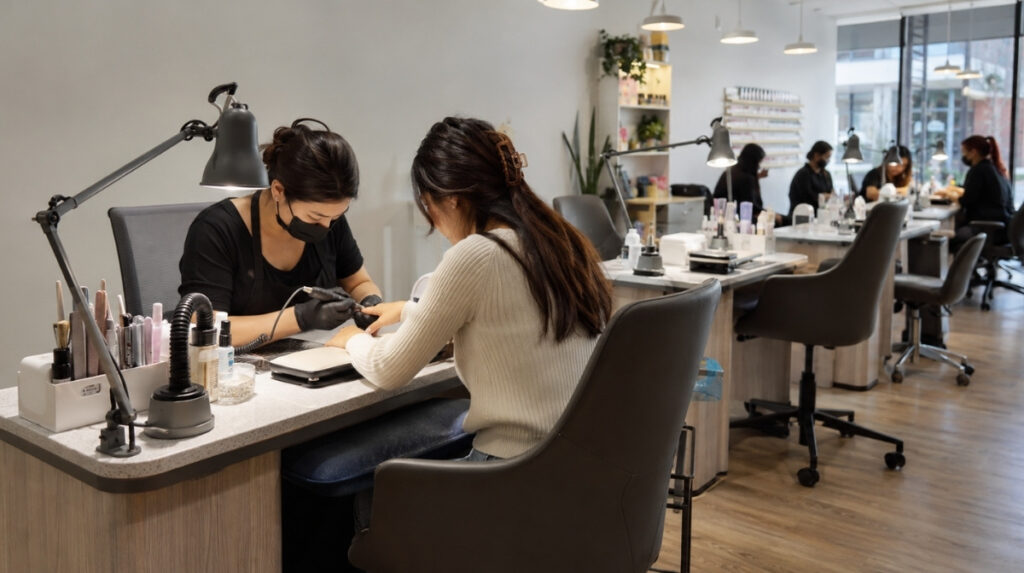
What to Know Before Setting Up Your Nail Station
- Protect Your Body: Repetitive hand work and sustained forward bending can contribute to musculoskeletal problems. In a 2022 study of 80 female nail technicians, 63.8% reported neck pain, highlighting the value of supportive seating, better client positioning, padding at hard contact points, position changes, and regular breaks.
- Control Airborne Contaminants: A NIOSH-approved N95 respirator can filter certain airborne particles but does not protect against chemical gases or vapors. In Aiken, the adopted 2021 International Mechanical Code framework includes source-capture exhaust requirements for manicure and pedicure stations, including at least 50 CFM per station.
- Design Around Your Routine: Placing commonly used equipment within a comfortable reach and arranging cords around your natural workflow can reduce unnecessary reaching, repositioning, and interruptions during appointments.
- Budget Beyond Weekly Rent: Published booth-rental estimates vary broadly, with figures around $100 to $500 per week depending on the market and rental arrangement. Independent technicians may also need to account for supplies, insurance, software, payment processing, marketing, licenses, business costs, and applicable self-employment taxes.
- Check the Rules Where You Plan to Work: Nail technology education requirements differ significantly by state. South Carolina's nail technology school curriculum totals 300 hours, compared with 525 hours for Georgia's complete nail care curriculum and 600 hours for Arkansas's manicure curriculum.
Creating a professional nail workstation involves much more than choosing a stylish desk and organizing polish colors. Once you begin serving paying clients, your furniture, ventilation, sanitation practices, and daily workflow all affect how safely and efficiently you can work. Whether you are preparing to enter the industry or reviewing our guide to nail technician licensing requirements, costs, and state rules, building a thoughtful workspace can make the transition into professional nail services much easier to manage.
Create a Workstation That Works With Your Body
A nail table becomes the center of nearly every appointment, so furniture choices should support your posture as well as your equipment. Spending hours performing detailed work from the same seated position can place unnecessary strain on the neck, shoulders, arms, wrists, and back when the setup forces you to lean or reach repeatedly.
Adjust the Client and Furniture Instead of Constantly Leaning
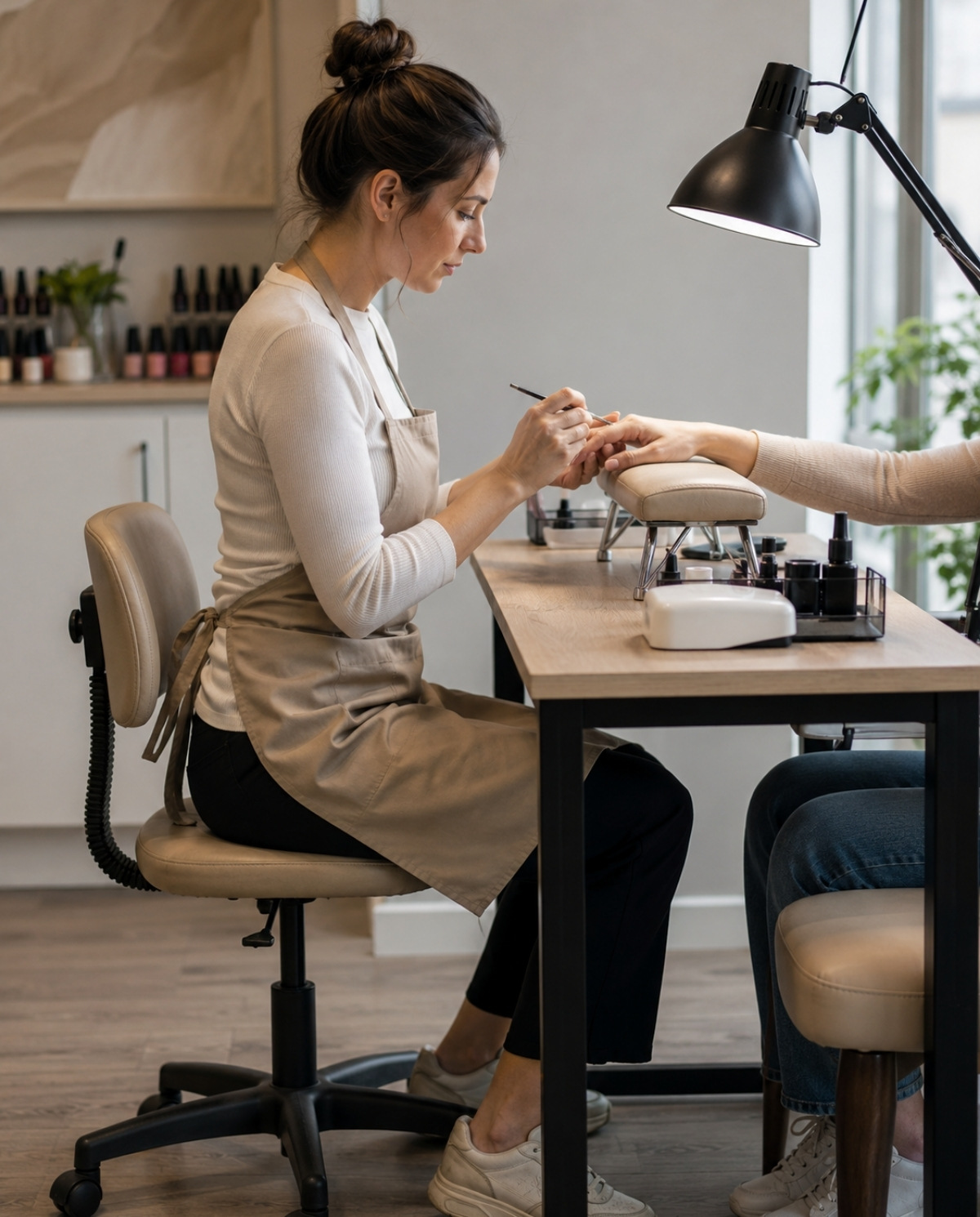
There is no universal table height or chair position that fits every technician. The Occupational Safety and Health Administration's nail salon ergonomics guidance recommends an adjustable chair with back support, keeping the feet supported, improving lighting, and repositioning the client's hand or foot so the technician does not need to bend forward excessively. OSHA also recommends adding padding where a technician's arms come into contact with hard table edges.
The physical demands of nail work are supported by occupational research. A 2022 ergonomics study involving 80 female nail technicians found that 63.8% of participants reported neck pain, which was the most commonly reported musculoskeletal complaint among the body areas examined. The study does not mean that the same percentage applies to every nail technician population, but it does demonstrate that musculoskeletal symptoms are an important occupational concern.
Furniture alone cannot eliminate these risks. Raising the client's hands or feet to a more comfortable working level, changing positions between tasks, taking short breaks when practical, and stretching periodically can all be incorporated into a more body-conscious work routine.
Select Furniture and Storage That Match Your Services
The best table configuration depends on where and how you work. A permanent salon station may benefit from sturdy construction and integrated storage, while technicians who provide house calls, bridal services, or event appointments may need a folding table that can be transported and set up easily.
Storage also has a direct sanitation function. Under South Carolina Board of Cosmetology sanitary and safety rules, disinfected non-electrical, nonporous implements must be kept in a clean, dry, covered container such as a clean drawer or cabinet. Implements that have been used or otherwise soiled must remain in a closed receptacle labeled "soiled" or "items to be disinfected" until they are properly processed.
Your station should therefore provide enough room to keep disinfected implements physically separate from used tools and disposable materials. If you are still deciding what equipment belongs in your professional setup, review our guide to essential nail technology procedures, tools, and starter kit equipment.
Whatever table style you choose, make sure there is enough working depth for comfortable client-hand placement, a curing lamp, your e-file, and the tools required for the service without forcing you to repeatedly reach across the active work area.
Manage Filing Dust and Chemical Exposure at the Source
Professional nail services can generate more than one type of airborne contaminant. Filing and shaping may create particulate matter, while products such as removers, adhesives, primers, polishes, and artificial nail products can release chemical vapors. Because these hazards behave differently in the air, one device or protective measure should not automatically be assumed to control every exposure.
Know What a Dust Collector Can and Cannot Do
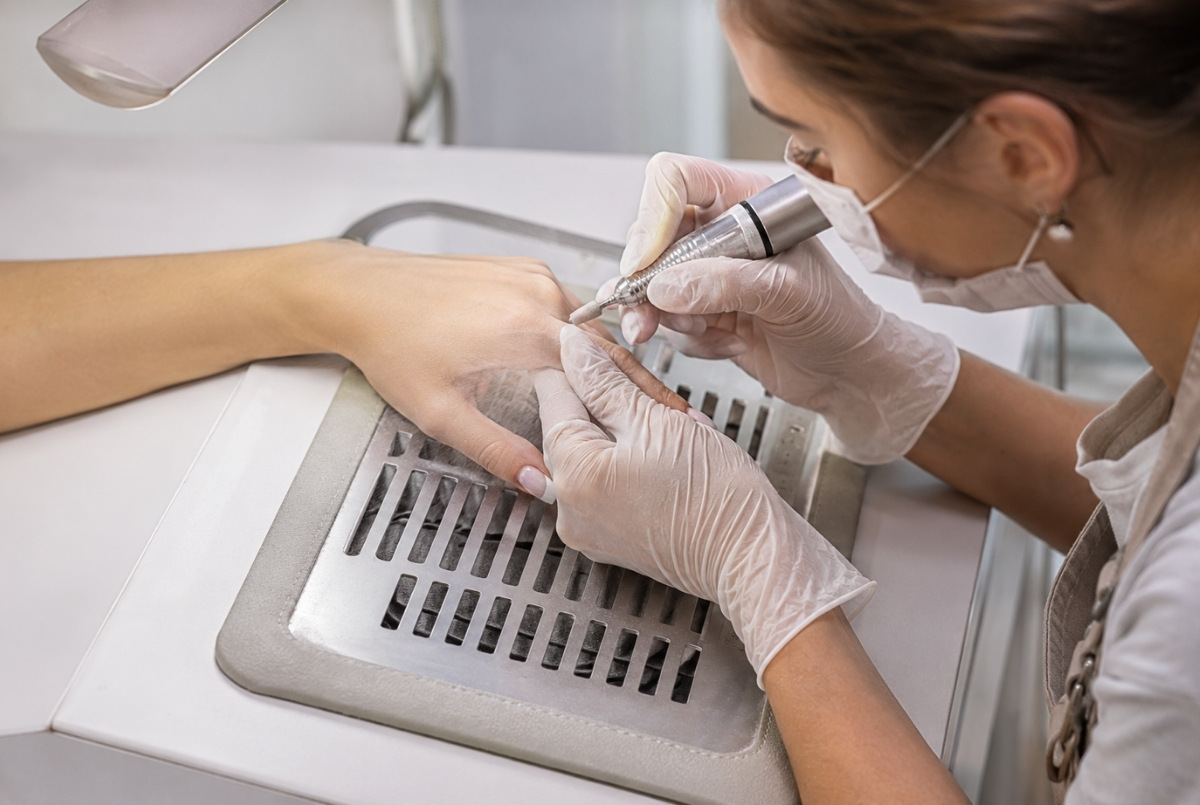
A tabletop dust collector may help capture particles produced during filing, but that does not necessarily make it equivalent to a complete local exhaust ventilation system. Some devices capture particles through filters and return the filtered air to the room, while other ventilation systems are designed to capture contaminants near their source and exhaust the contaminated air away from the work area.
The CDC and NIOSH guidance for nail technicians identifies local exhaust ventilation controls that can include downdraft ventilated tables and portable ventilation units. The performance of any particular system depends on factors such as airflow, inlet location, filtration or exhaust design, maintenance, and how closely the capture point is positioned to the work.
For that reason, a nail table advertised with a built-in fan or extractor should not automatically be assumed to provide the same protection as a source-capture system required by an applicable mechanical code. Salon owners should review the equipment specifications and local code requirements before relying on a particular unit for ventilation compliance.
Use Masks and Respirators for the Hazards They Are Designed to Address
Standard surgical or procedure masks are not respirators and should not be treated as protection against chemical gases or vapors. A properly fitted, NIOSH-approved N95 respirator can help filter certain airborne particles, including particulate matter generated during filing or buffing, but an N95 does not provide protection against hazardous chemical gases or vapors.
The OSHA guidance on chemical hazards in nail salons emphasizes ventilation as an important way to reduce airborne chemical concentrations. When respiratory protection is required for a specific workplace hazard, the respirator must be appropriate for that hazard and used in accordance with applicable occupational respiratory-protection requirements.
Daily chemical-handling habits matter as well. Useful controls include:
- Keeping chemical containers securely closed when products are not in use.
- Using appropriate dispenser containers that limit unnecessary evaporation.
- Reviewing the Safety Data Sheets for the professional products used in the salon.
- Maintaining ventilation equipment and replacing or cleaning filters according to the manufacturer's instructions.
These practices complement effective ventilation rather than replacing it.
Plan Ventilation Around the Codes Used in Aiken
Ventilation should be considered before a manicure table or pedicure station is permanently installed. The City of Aiken's adopted building-code information states that the 2021 International Mechanical Code is among the mandatory codes adopted for use in South Carolina and enforced by local jurisdictions.
Under the 2021 International Mechanical Code ventilation provisions, nail salons must provide each manicure and pedicure station with a source-capture system capable of exhausting at least 50 cubic feet per minute, or CFM, per station. The related 2021 IMC exhaust requirements specify that when a manicure table or pedicure station does not have a factory-installed exhaust inlet, the exhaust inlet must be located no more than 12 inches horizontally and vertically from the point where chemicals are applied. The station exhaust system must also have controls that operate it continuously while the space is occupied.
A room's general HVAC system or a small recirculating filing-dust fan should therefore not automatically be treated as a replacement for required source capture. Anyone planning a salon build-out, private suite, or permanent nail room in Aiken should verify the current code edition, permits, system design, and inspection requirements with the local building authority before construction or lease commitments are finalized.
Organize the Station for a Repeatable Service Routine
An efficient workstation is one that allows you to perform the same sequence of tasks without continually moving equipment around. Good organization can reduce clutter, keep cords away from the active service area, and make sanitation procedures easier to repeat between clients.
Keep High-Use Equipment Inside a Comfortable Reach
Arrange tools based on how you actually perform a service rather than trying to copy one standard layout. If you use an electric file with your dominant hand, place the control unit so the handpiece cord can move freely without crossing over the client's hands or tangling with other equipment. Position your curing lamp where the client can enter and remove each hand without disturbing implements that are currently in use.
Frequently used tools should be close enough to reach without repeated twisting or leaning. There is no reliable evidence that one universal right-handed or left-handed station design saves a fixed number of minutes per appointment, but a consistent layout can reduce unnecessary reaching, equipment repositioning, and interruptions.
Give Clean, Used, and Disposable Materials Their Own Places
A professional setup should make it difficult to accidentally mix disinfected implements with items that have already been used. South Carolina's sanitation rules provide a useful framework for organizing these categories:
- Disinfected Implements: Store properly processed nonporous tools in a clean, dry, covered container, such as a clean drawer or cabinet.
- Items Awaiting Disinfection: Place used or soiled implements in a closed receptacle labeled "soiled" or "items to be disinfected" until they can be cleaned and disinfected.
- Porous Single-Use Materials: Porous supplies that contact a client and cannot be disinfected, including nail abrasives and buffers, must be discarded in a covered waste receptacle after use or when the service is completed.
South Carolina requires reusable non-electrical, nonporous implements to be cleaned and then treated with an appropriate EPA-registered disinfectant according to the product's concentration and contact-time instructions. Autoclaves are subject to an additional restriction: under the state's rules, autoclaves and autoclave packaging of tools are prohibited unless regular spore testing is performed by a contracted laboratory at least once per month, with no more than 30 days between tests.
Chemical products should also remain in clean, closed, properly labeled containers and should not be stored in a way that could contaminate disinfected implements. For a closer look at infection-control routines and client care, read our guide to nail technology hygiene, infection prevention, and aftercare.
A station that follows the same setup and breakdown routine for every appointment makes professional habits easier to maintain. It also allows technicians to focus more attention on service quality without sacrificing sanitation or workspace organization.
Plan the Financial Side Before Renting Your Own Space
Moving into a booth, suite, or private nail room can offer more control over your working environment, but it also changes the financial and legal responsibilities attached to your career. National data from the U.S. Bureau of Labor Statistics projects 7% employment growth for manicurists and pedicurists from 2024 through 2034. Building an independent business around that opportunity requires understanding the full operating cost rather than focusing only on weekly rent.
Inspect the Space Before You Commit
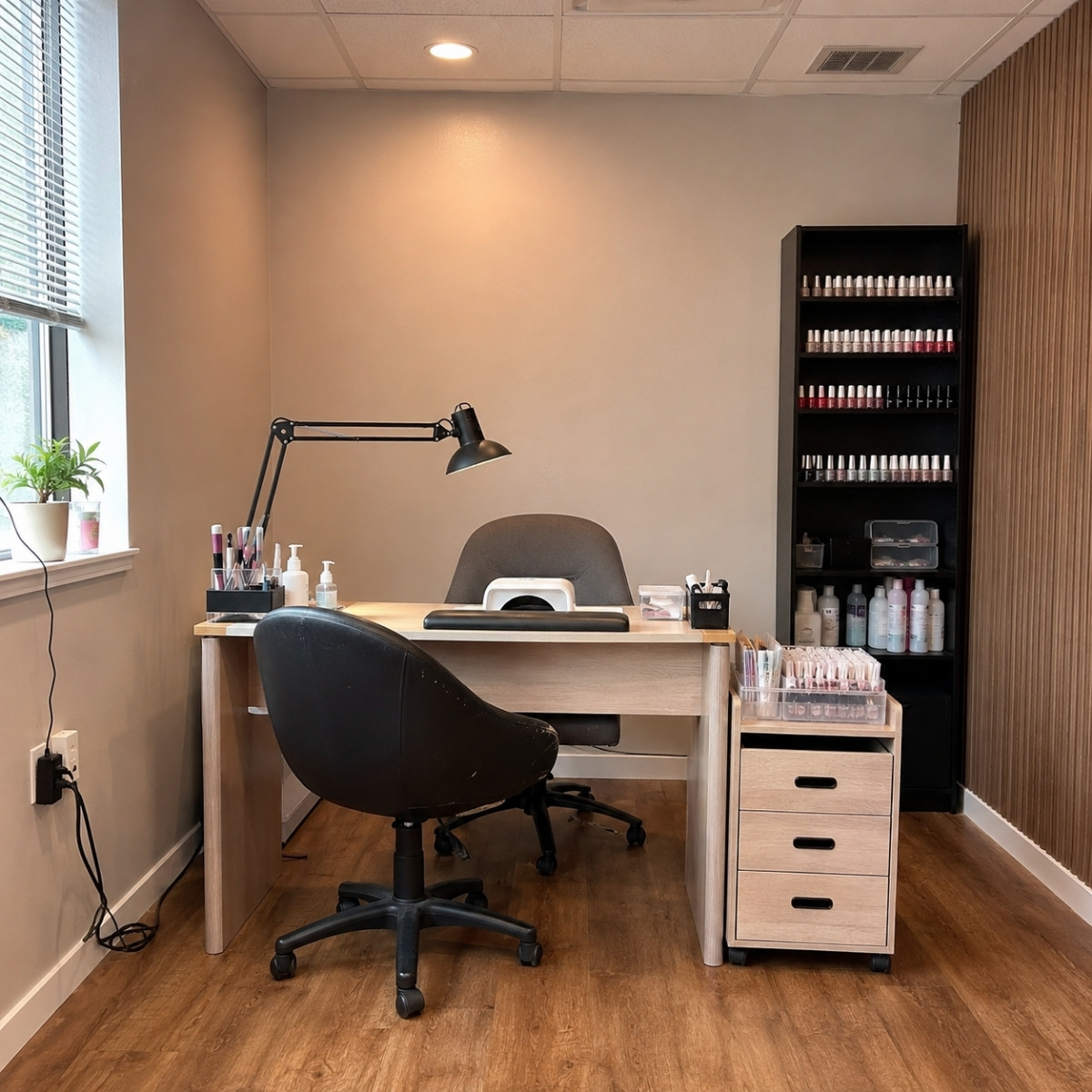
When considering a nail technician room or salon suite, look closely at the physical infrastructure. Confirm that the space has suitable electrical service for your equipment, adequate task lighting, and access to required plumbing and sanitation facilities.
South Carolina's salon and school sanitation rules require hot and cold running water as well as toilet and hand-washing facilities. Depending on the property and business arrangement, additional state, local, building, plumbing, electrical, and mechanical requirements may also apply.
Ventilation deserves particular attention. A room that looks ready for a manicure table may still require mechanical work to meet source-capture exhaust requirements. Installing ductwork and other permanent ventilation components after a space is finished can be more complicated than incorporating them during the initial design.
Before signing an agreement, determine exactly what the rent includes. Utilities, Wi-Fi, laundry, waste disposal, common-area cleaning, reception, booking services, repairs, and equipment maintenance may be included in some arrangements and charged separately in others.
Calculate Your Costs Beyond the Rental Rate
Rental prices differ widely between markets and business models. The ZipRecruiter booth rental overview gives a broad estimate of approximately $100 to $500 per week, depending on location and the salon arrangement. This should be viewed as a general range rather than a national average or a guaranteed price in any particular city.
Your total operating expenses may include:
- Recurring Costs: Rent, insurance, software subscriptions, licenses, business registrations, advertising, and other regular fees.
- Service-Driven Costs: Nail products, disposable supplies, laundry, payment-processing fees, and materials that increase as appointment volume grows.
Technicians who are legitimately operating as self-employed workers may also have tax obligations associated with self-employment and estimated taxes.
A practical way to evaluate a rental opportunity is to calculate how much each appointment contributes toward your overhead after service-specific product costs are deducted. Comparing that amount with your recurring monthly expenses can help estimate the number of appointments required to reach your break-even point.
Understand the Rules That Come With Independent Work
The BLS Occupational Outlook Handbook reports that 28% of manicurists and pedicurists were self-employed in 2024. However, paying booth rent does not by itself establish that someone is legally an independent contractor.
The Internal Revenue Service guidance on independent contractors explains that worker classification depends on the actual relationship and the degree of control over how the work is performed. Workers who are properly classified as independent contractors are generally considered self-employed and may be responsible for applicable self-employment and estimated taxes.
Education requirements are also specific to each state. The South Carolina State Board of Cosmetology regulations establish a 300-hour curriculum for a school of nail technology. Aiken School of Cosmetology and Barbering's current student catalog also lists its Nail Technician program as a 300-clock-hour program.
Requirements differ elsewhere. Georgia's complete nail care curriculum totals 525 hours, while the Arkansas cosmetology school rules prescribe a 600-hour manicure curriculum. These differences are why prospective students should verify the current requirements for the state in which they intend to become licensed.
An individual professional license may also be only one part of opening an independent workspace. Depending on the location and business arrangement, technicians may need to address salon or establishment licensing, local business registration, taxes, insurance, zoning, building and mechanical codes, and lease restrictions before serving clients independently.
Build Professional Habits Before You Work Independently
Learning nail techniques is only one part of preparing for professional salon work. Safe product handling, sanitation, workstation preparation, client positioning, and efficient breakdown procedures all become part of the daily routine once appointments begin.
Structured nail technology education gives students an opportunity to practice these habits alongside technical services. It can also help students understand the relationship between sanitation rules, workplace safety, professional procedures, and the training requirements that must be completed before pursuing licensure.
For students planning to work in South Carolina, the state's nail technology curriculum includes 300 hours covering areas such as sanitation and safety, anatomy and physiology, nail services, artificial nails, power equipment, and state law. Building these foundations during training can make the transition from student practice to a licensed professional environment more manageable.
Explore Nail Technician Training at Aiken
A professional nail career starts with more than buying equipment and finding a table. At Aiken School of Cosmetology and Barbering in Aiken, South Carolina, the Nail Technician program includes hands-on nail training along with areas such as salon business, client relations, professional development, and career preparation.
To learn more about getting started, visit the school's Enrollment page. You can review the enrollment process, submit your information, ask questions, and request a campus tour to explore the program in person.
Common Questions About Nail Stations and Booth Rental
How much table space do I need in a compact nail room?
There is no single table dimension required for every technician. Many compact commercial nail tables are approximately 36 to 42 inches wide and 16 to 20 inches deep, but the right dimensions depend on your equipment, available floor area, client positioning, ventilation design, and your own posture. Make sure there is enough room for the equipment used during the service without forcing you to lean forward or reach excessively.
When should a nail-table ventilation filter be changed?
Follow the maintenance instructions for the specific ventilation system because filters and equipment designs vary. For applicable ventilated tables that use charcoal filters, OSHA's nail salon guidance recommends replacing charcoal filters at least monthly and cleaning the catch basin at least weekly. Heavier use may require more frequent maintenance. Changing a filter does not, by itself, make a recirculating dust collector equivalent to a source-capture exhaust system required by local mechanical code.
Should a new nail technician choose commission work or booth rental?
The better option depends on the specific salon agreement, your client base, and how prepared you are to manage business expenses. A commission position may reduce certain upfront responsibilities and, depending on the employer, may include access to clients, supplies, equipment, training, or other salon resources. Booth rental can provide greater independence but generally shifts more responsibility for rent, products, insurance, taxes, marketing, client acquisition, and operating expenses to the technician. Review the actual terms of either arrangement before deciding.
What insurance should an independent nail technician consider?
Independent technicians commonly consider professional liability coverage for claims connected with professional services and general liability coverage for broader risks such as certain injuries or property damage. The exact coverage you need depends on your services, business structure, location, landlord requirements, and rental agreement. Review the insurance provisions in your lease or booth agreement and select coverage based on the risks and requirements that apply to your business.