


Can You Become a Licensed Cosmetologist Without Attending Beauty School?

Main Points to Remember
- Licensing Is Controlled by Each State: The United States does not issue a federal cosmetology license. Depending on the state, applicants may qualify through an approved school, a registered apprenticeship, or another pathway recognized by the licensing board.
- Salon Training Can Take Longer: Apprenticeship requirements may substantially exceed school requirements. Georgia requires 3,000 apprentice hours instead of 1,500 school hours. California requires 3,200 hours of on-the-job training plus 220 hours of related instruction, compared with 1,000 hours at an approved school.
- Testing Outcomes Are Not Consistent: Certain California reports have recorded lower written-exam pass rates for cosmetology apprentices than for school-trained applicants. These figures vary by reporting period, examination, license category, language, and candidate group.
- Moving Between States Requires Research: Apprenticeship training does not automatically prevent license transfer, but a destination state may consider your license status, education, examinations, employment history, or documented training before granting a license.
- Online Courses Have a Limited Role: An approved hybrid program may offer theory instruction online, but online coursework alone generally cannot replace the supervised practical training required for initial cosmetology licensure.
Starting a career involving hair, skin, and nails can be exciting, but tuition expenses and demanding schedules may make traditional training difficult for some students. It is understandable to look for a more affordable or flexible path into the beauty industry.
Training in a salon may be an option, but it does not eliminate education, supervision, or licensing requirements. Whether you can use an apprenticeship instead of attending beauty school depends on the laws of the state where you plan to become licensed.
When Beauty School Is Not the Only Legal Route
Cosmetology licensing is handled separately by each state. State boards establish the services covered by each license, the required training hours, examination rules, approved education providers, and any alternative routes to eligibility.
Before committing to a program, review the applicable cosmetology license requirements by state. The licensing authority in the state where you intend to work ultimately decides whether your training qualifies you to take the required examinations.
Completing a state-approved cosmetology program remains the standard route. Some states also recognize registered apprenticeships completed under qualified supervision. Availability, registration procedures, required hours, approved occupations, and supervision standards differ considerably.
Georgia and Arkansas illustrate these differences:
- Georgia: Under rules issued by the Georgia State Board of Cosmetology and Barbers, the school route for Master Cosmetologists requires 1,500 hours completed over at least nine months. The state's separate apprenticeship rules require 3,000 hours completed over at least 18 months.
- Arkansas: Information published by the Arkansas Department of Health Cosmetology Section requires 1,500 hours at a licensed cosmetology school for the standard initial-license route. Its current licensing information does not list a salon apprenticeship that replaces those school hours.
Therefore, learning how to get a cosmetology license without school does not mean entering the profession without regulated training. In a state that recognizes apprenticeships, it means completing the required education and practical experience through an approved workplace-based program.
What Salon-Based Cosmetology Training Involves
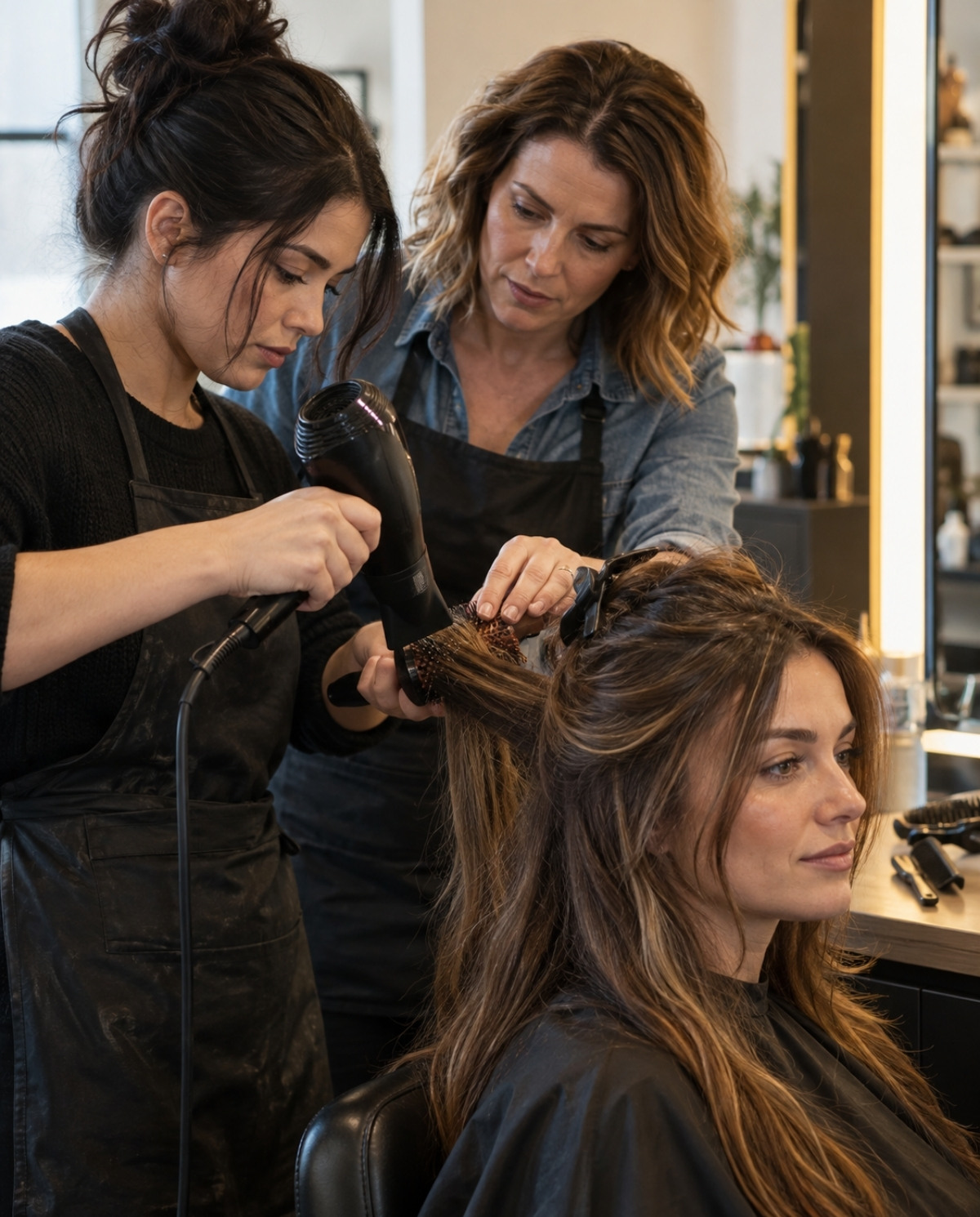
A cosmetology apprenticeship allows a candidate to receive supervised training in an operating salon rather than completing most instruction in a school classroom and student clinic.
An apprenticeship should not be confused with an ordinary salon-assistant position. Depending on state rules, the apprentice, supervising professional, salon, and program sponsor may need to be registered or approved before hours can count toward licensure. Work completed before the required registration is active may not receive credit.
Apprenticeship programs can also include formal instruction away from the salon floor. The California Board of Barbering and Cosmetology, for example, requires at least 3,200 hours of on-the-job training over two years. Cosmetology apprentices must additionally complete at least 220 hours of related instruction supplied by the approved program sponsor.
Skills You Can Develop in an Operating Salon
Salon-based training provides direct exposure to the routines of a working beauty business. Apprentices may observe how appointments are organized, consultations are conducted, services are timed, products are recommended, and client concerns are handled.
Depending on the applicable regulations and the apprentice's stage of training, approved services may be performed under the level of supervision required by the state and program.
The U.S. Department of Labor describes registered apprenticeship as a model that combines paid on-the-job training with classroom instruction. A legitimate registered apprenticeship may therefore allow participants to earn wages while developing occupational skills. Actual wages, schedules, benefits, fees, and employment conditions depend on the employer, program, and applicable laws.
Problems Prospective Apprentices Should Consider
The quality of workplace training can depend heavily on the program sponsor, curriculum, salon environment, and supervising professional. Technical talent does not automatically make someone an effective instructor, and a busy salon may not always provide lessons as predictably as a structured school.
Routine workplace duties also should not be mistaken for approved instruction. Cleaning stations, preparing supplies, and observing appointments may be part of salon operations, but licensing boards commonly require documented training across designated subjects and services.
Exam preparation is another important consideration. Candidates may need knowledge of infection control, anatomy, product safety, chemical services, hair and scalp conditions, skin and nail fundamentals, client protection, and state law. Before enrolling, applicants should determine how these subjects will be taught and how the program will prepare them for licensing examinations.
Questions to ask a prospective program include:
- Which parties must receive approval before my training hours can begin?
- Who maintains my practical and theory records?
- How frequently are completed hours submitted to the licensing authority?
- What happens to my records if the trainer leaves or the establishment closes?
- Can documented hours continue with another approved salon or program?
- How will sanitation, chemical safety, theory, and state regulations be taught?
- Are textbooks, scheduled classes, or examination-preparation materials included?
- Which wages, instructional charges, registration costs, examination fees, and tool expenses apply?
- How much of the weekly schedule is assigned to recognized training activities?
Procedures for changing trainers or establishments vary by jurisdiction. Georgia, for example, requires a new application when an apprentice changes the supervising professional or salon. A notarized transcript of accumulated hours must also be submitted within the required period. Georgia does not allow apprentice hours to be combined with school hours.
Interpreting Apprentice Examination Statistics
Official reports from certain periods indicate that apprentices can experience different written-examination outcomes from school-trained applicants. However, the results must be read within their original scope.
In one collection of California Board apprenticeship meeting materials, cosmetology apprentices recorded lower written-exam pass rates than school-trained candidates during the periods examined. The results were not identical across years, examinations, occupations, languages, or candidate groups.
These statistics do not establish a permanent pass rate for California and cannot be treated as a national apprenticeship average. They also do not identify the reason for the difference. The data alone cannot prove that salon training caused deficiencies in theory, chemistry, sanitation, or examination preparation.
Before choosing a sponsor, ask for recent program-specific results and determine whether the reported figures cover first-time candidates, all examination attempts, or a limited group. Our cosmetology state board exam checklist provides additional information about written and practical testing.
How Online Education Fits Into Cosmetology Licensing
Students balancing employment, childcare, or other responsibilities may look for online cosmetology options. Distance learning can make parts of a program more accessible, but it should not be mistaken for a complete licensing route.

Subjects That May Be Offered Remotely
Some state-approved schools provide hybrid programs that deliver a portion of their theory curriculum online. Depending on the program and state rules, distance-learning subjects may include anatomy, infection control, chemistry, product knowledge, business practices, and professional regulations.
Online hours count only when they are part of a program accepted by the relevant licensing authority. Documentation requirements vary, but an approved school may need to monitor participation, completed coursework, assessments, attendance, or other evidence required by the state.
Before paying for a hybrid program, confirm that:
- The school and program are approved by the appropriate licensing authority.
- Graduates of that particular program qualify for the required licensing examinations.
- The state permits the advertised portion of the curriculum to be delivered remotely.
- The program provides all required supervised practical instruction.
- The curriculum satisfies the rules of the state where you plan to apply.
Training That Still Requires Supervised Practice
Cosmetology requires practical experience with sanitation procedures, client protection, tools, hair cutting, styling, chemical applications, and other services within the state's legal scope of practice.
A standalone online certificate should not be treated as a cosmetology license or as evidence that a candidate completed an approved licensing program. Unless a licensing authority expressly recognizes another arrangement, practical training must be completed through an approved school, registered apprenticeship, or other authorized pathway.
Online beauty courses may still provide legitimate continuing education, product instruction, business education, or test preparation. Their certificates, however, do not automatically authorize someone to perform regulated cosmetology services.
Before enrolling, ask the state board whether the exact provider and course qualify applicants for initial licensure. Marketing terms such as “accredited,” “internationally certified,” “professional certification,” or “board-ready” do not by themselves establish licensing eligibility.
Comparing the Time Needed for Each Path
Entering a salon immediately does not necessarily mean becoming licensed sooner. The time required depends on the state's minimum hours, weekly schedule, registration rules, attendance, and any mandatory calendar period.
A full-time school program is often the more direct route because its schedule is organized around completing approved hours. Depending on the jurisdiction and weekly timetable, full-time cosmetology school may take approximately 8 to 15 months. Part-time attendance, absences, holidays, closures, scheduling changes, and transfer problems can extend that timeline.
Our guide to cosmetology school schedules and graduation timelines explains how weekly attendance affects the projected completion date.
Apprenticeship requirements are not identical nationwide. In the two examples discussed above, Georgia requires 3,000 hours over at least 18 months, while California requires 3,200 on-the-job hours over two years plus 220 hours of related instruction. Both require considerably more training time than their respective school routes.
Individual circumstances can still change the comparison. Someone attending school only a few hours per week could take longer than an apprentice following a consistent full-time schedule. Nevertheless, where school requires fewer hours, a full-time approved program is often the shorter route to examination eligibility.
What Happens When You Seek a License in Another State
Cosmetology licenses do not transfer through one uniform national system. States use terms such as reciprocity, endorsement, transfer, and examination differently, and their evaluation procedures are not identical.
A license originally earned through apprenticeship does not automatically prevent relocation. Depending on the destination state's rules, its board may consider:
- Whether the existing license is current and free from disciplinary restrictions.
- The type and amount of education or apprenticeship training completed.
- The written or practical examinations previously passed.
- The applicant's documented experience as a licensed cosmetologist.
- Whether the original jurisdiction's requirements are considered comparable.
- Whether additional education or a state-law examination is required.
Not every state reviews these factors in the same way. Some place greater emphasis on active licensed experience, while others compare the applicant's original training and examination requirements with their own standards.
Anyone trained through an apprenticeship should retain copies of the original registration, curriculum, hour reports, related-instruction records, examination results, employment history, and license verification.
The Cosmetology Licensure Compact is being developed to make authorized practice across participating states easier. According to the official Cosmetology Compact website, multistate licenses are not yet being issued.
Once multistate licensing becomes available, applicants are expected to need an active, unencumbered license in the compact state where they primarily reside, along with satisfaction of the applicable application conditions and fees. Each participating state continues to determine its own initial education, training, and examination standards. The Compact does not create one nationwide hour requirement or make eligibility exclusive to school-trained cosmetologists.
If relocation is likely, investigate the destination state's current endorsement requirements before selecting either pathway.
Looking Beyond the Advertised Tuition

Reducing tuition is a common reason for considering apprenticeship. Although paid training may offset some expenses, an apprenticeship should not automatically be considered free.
Possible expenses include:
- Apprentice registration and permit charges.
- Required related instruction or online modules.
- Books and examination-preparation materials.
- Tools, products, uniforms, and protective supplies.
- Testing and initial-license application fees.
- Transportation and childcare.
- Additional education after changing programs or relocating.
Before signing an agreement, obtain a written explanation of wages, instructional charges, tools, registration expenses, refund terms, and weekly scheduling expectations. Also verify whether the arrangement is a recognized paid apprenticeship, how compensation is calculated, and whether you will be classified as an employee.
School expenses may include tuition, application fees, kits, books, transportation, and living costs during training. Students in an eligible program at a participating institution may qualify for federal student aid, but accreditation alone does not guarantee Pell Grants or federal loans.
The institution must participate in the applicable federal-aid programs, the specific course of study must be eligible, and the student must satisfy individual eligibility requirements. The official Federal Student Aid school search can help identify institutions with federal school codes. Students should still confirm program eligibility with the school's financial-aid office.
A standalone salon apprenticeship generally does not provide Pell Grants or federal student loans in the same manner as an eligible school program. Depending on the apprentice and program, other support could include employer assistance, workforce funding, veterans' benefits, or scholarships.
A complete cost comparison should include:
- Tuition or related-instruction charges.
- Books, tools, uniforms, registration, examination, and licensing expenses.
- Transportation and childcare costs.
- Expected wages and the conditions attached to those wages.
- The projected number of months before full licensure.
- Available grants, scholarships, employer benefits, or workforce assistance.
- Possible additional training costs after moving to another state.
Deciding Which Option Matches Your Situation
The right route depends on your state's laws, financial circumstances, schedule, learning preferences, and access to a legitimate training provider.
A state-approved school may be suitable for students who want an organized curriculum, scheduled theory education, regular instructor access, examination preparation, and a potentially shorter full-time route.
A registered apprenticeship may suit someone whose state permits it, who has found a reputable sponsor and qualified supervisor, who needs paid employment during training, and who learns effectively in an operating salon. Applicants should still consider the longer hours, related instruction, reporting requirements, and procedures that apply when changing trainers or establishments.
Regardless of the pathway, confirm the exact program with the licensing authority before paying fees or beginning work. Statements made by a salon, school, mentor, or online provider cannot replace official licensing requirements.
If you are interested in structured instruction, practical experience, salon-business education, and instructor guidance, Aiken School of Cosmetology and Barbering offers a 1,500-hour Master Cosmetologist program designed to meet South Carolina's education requirement for licensure. Visit the Master Cosmetologist program page to review the currently listed training information, or submit the contact form to ask the school directly about enrollment and scheduling.