


Cosmetology School Costs Explained: FAFSA, Grants, 529 Plans, and Financial Aid Options

Starting a journey in the beauty and grooming field is one of the most exciting choices you can make for your creative future. However, trying to figure out how to navigate the financial side of your education can feel a bit overwhelming at first. It is completely normal to look at supply fees and enrollment costs and worry about how it will all fit into your personal budget.
Fortunately, you do not have to handle the financial responsibilities all by yourself or pay everything out of pocket before you even begin your first day of training. Multiple legitimate financial routes exist specifically to help students manage their career investments safely. If you are wondering what it takes to get started, taking a look at this honest guide on can anyone get into cosmetology school can give you a clear picture of basic admissions expectations. By learning how federal programs, specialized grants, 529 savings options, and flexible institutional setups work together, you can create a realistic funding plan that protects your peace of mind.
Key Takeaways
- Title IV Approval Matters: Federal aid can assist with your expenses, but only if your chosen campus is authorized to participate in federal Title IV funding systems. Always make sure the specific track you choose is eligible and that you have the accurate institutional school code.
- Factor in Supply Costs: Base pricing maps out your instruction, but it is easy to forget about the student kit bottleneck. Remember to calculate additional required expenses like professional tools, textbooks, uniforms, and administrative registration fees.
- Attendance Keeps Funding Active: Trade academies track clock hours instead of traditional college semesters. Missing your scheduled hours stalls your academic progress, which can directly cause delays in your financial aid distributions.
- Explore Local and Military Perks: Private beauty scholarships, state workforce programs, VA assistance, 529 savings plans, and non-refundable tax credits are excellent tools to lower your overall bills, depending on your individual eligibility.
What Your Beauty Training May Really Cost

Before diving into applications, it helps to understand exactly how career academies structure their overall costs. A common trap is looking solely at the base instructional rate and assuming that is the final amount you will owe. Vocational billing is set up a bit differently than a typical university, so your primary focus should be finding out the complete cost of attendance rather than just checking a single baseline figure.
The overall cosmetology school cost generally fluctuates depending on your geographic market, how extensive the curriculum is, and the specific supplies provided by the institution. According to SoFi Financial Insights, the average cost for cosmetology school usually lands somewhere between $5,000 and $20,000 across the United States. If your budget is tight and you are specifically tracking down a cosmetology school under 10k, your options will typically be centered around small regional vocational systems, shorter certificate options, or programs located in more rural communities.
When calculating how much is tuition for cosmetology school, you must look closely at what is included in that price tag. Many career academies require students to buy a specialized student kit before stepping onto the floor. This kit may include professional-grade shears, styling tools, mannequins, textbooks, and required uniforms or supplies that you will use during daily practice.
Data compiled by the Renaissance Academie Cost Analysis shows that a student kit and learning materials can add a significant mandatory expense to your budget. Some institutions combine these tools directly into the advertised tuition price, while others separate them as an independent charge due before your first class. Whenever you are planning how to pay for cosmetology school, always ask the financial department whether your required supplies, state prep books, and setup fees are covered in the main rate or billed as separate upfront costs.
Remember to ask for a breakdown of the full cost of attendance budget. A realistic layout should account for instruction, student kit fees, textbooks, travel expenses, and eventual state board registration fees. This full total is crucial because financial aid departments use it to measure the absolute maximum amount of funding you are allowed to receive.
How FAFSA Can Fit Into Career Training

The most frequent question future students tend to bring up is, can I use fafsa for cosmetology school? Federal student aid is absolutely an option for vocational training, provided you select an institution and a career track that have been formally approved to process federal Title IV programs. While overall accreditation is an essential badge of institutional quality, it is not the only piece of the puzzle. The U.S. Department of Education keeps updated Federal School Code Lists of participating campuses, so you want to ensure your program is officially listed under the right campus code.
Submitting your Free Application for Federal Student Aid (FAFSA) can open up doors to federal Pell Grants, low-interest student loans, and other valuable funding systems. However, when you choose a cosmetology school with fafsa approval, the way your funds are handled looks a bit different than a traditional four-year college. While standard universities give out financial aid based on semesters or quarters, trade institutions measure your growth through clock hours, which track the actual time you spend learning in class or practicing techniques on the salon floor.
Because you are attending a cosmetology school with financial aid, your funds are usually released in separate installments tied directly to your completed hours and instructional weeks rather than calendar dates. The Federal Student Aid Handbook explains that clock-hour payment structures depend heavily on you hitting those explicit milestone hours. As outlined by the alternative Continental School of Beauty Financial Guides, vocational funding drops in segments as you cross these specific program marks. Because of this structural setup, missing classes does more than just throw off your technique; it slows down your clock-hour progress, postpones your scheduled disbursements, and can leave you with a temporary unpaid balance until you make up the time.
To prevent any surprises down the road, ask the financial advisor these direct questions before you enroll: Is this exact training program Title IV eligible? What specific code do I need for my FAFSA paperwork? Is student progress measured by credits or clock hours? At what exact hour milestones will my funding drop? Getting these answers early will keep you from hitting unexpected funding gaps later on.
Using Grants, Scholarships, and Veteran Benefits
If you want to complete your beauty education with as little debt as possible, you should place most of your focus on securing financial aid for cosmetology school that you never have to pay back. The primary source of federal free money is the Federal Pell Grant, which is awarded to students based on individual financial need determined by your FAFSA form. For the 2026–27 award year, the maximum Federal Pell Grant scheduled award is $7,395, though the precise sum you qualify for depends on your personal financial data, program details, and enrollment status.
Beyond standard federal resources, you should actively look into specialized grants for cosmetology school that are funded by private beauty brands and non-profit corporate organizations. As noted by the American Association of Cosmetology Schools, platforms like Beauty Changes Lives offer seasonal scholarship programs that can help cover tuition, professional toolkits, and supply costs.
If you are balancing family responsibilities, look for specific demographic resources such as cosmetology grants for single mothers, or workforce retraining funds designed for career changers and low-income adults. These resources are not always explicitly labeled for beauty school students. Local community foundations, state economic development boards, and vocational rehab agencies frequently offer educational vouchers for approved job-training pathways.
State-specific aid can drastically lower your training costs depending on where your campus is located, though you must check the qualification rules carefully. For example, the Georgia Student Finance Commission administers the HOPE Career Grant for eligible students who enroll in specific high-demand career fields. You should never assume every single personal care program is automatically covered by these state systems. The safest route is to check the current state eligibility list and ask the financial aid team if your exact track is approved for state grants. The same exact rule applies if you are exploring regional workforce assistance in other states, such as the pathways highlighted by Paul Mitchell The School Arkansas financial aid pathways; always verify the details directly with the school's aid office first.
If you have a military history, you might be asking yourself, does va pay for cosmetology school? Veterans and their eligible family dependents can routinely use GI Bill® educational benefits to fund approved vocational courses. The official VA GI Bill Comparison Tool verifies that the Post-9/11 GI Bill can be applied to trade schools, traditional degrees, and even the cost of professional licensing exams. To utilize these military benefits, the campus and the program must be officially approved by the VA. You should connect directly with the school's designated VA certifying official to confirm your tuition coverage, book stipends, and monthly housing allowance details.
Other Ways to Close the Tuition Gap
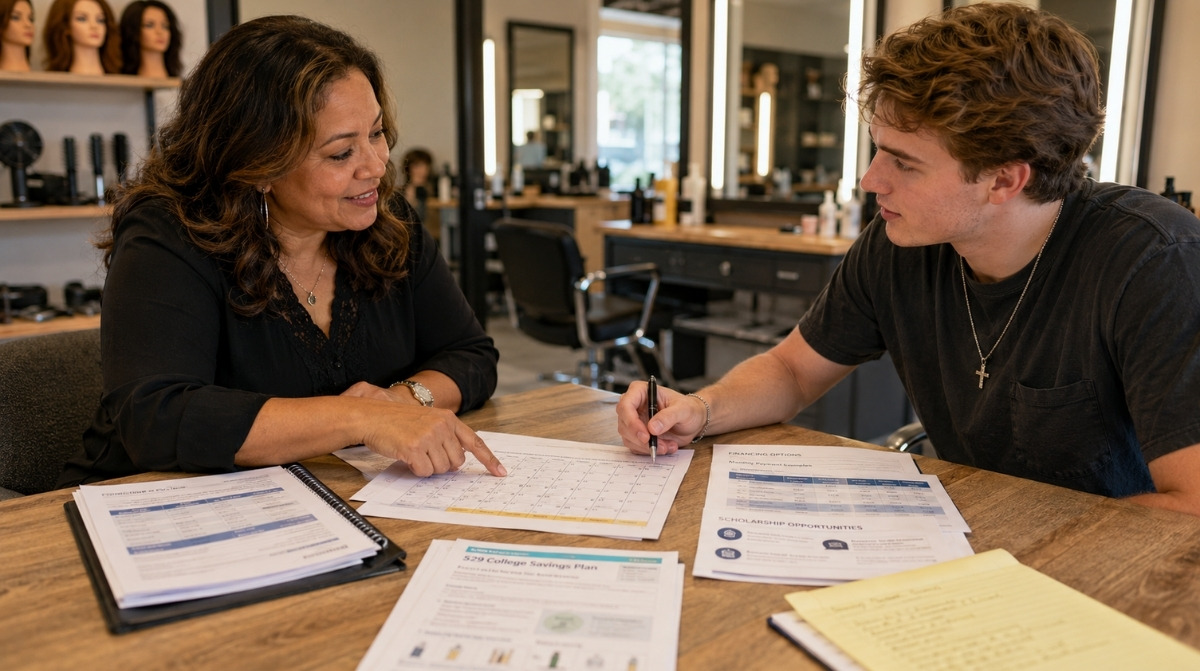
If federal grants do not completely clear your balance, or if you do not qualify for need-based programs, alternative financial strategies can bridge the remaining difference. For instance, families often ask: can 529 be used for cosmetology school? According to the latest Chase Investment Insights on 529 Rules, 529 funds can be used for tuition, student fees, books, and required supplies at authorized trade schools. Federal updates also allow families to use these educational accounts for qualified postsecondary credentialing expenses, which includes professional testing fees and costs required to earn or maintain specific industry certifications.
Just keep in mind that state tax regulations can sometimes differ from federal guidelines when it comes to tax-free status. The team at Saving for College notes that some states define qualified expenses slightly differently. It is smart to save all of your receipts, make sure your withdrawals line up with your expenses within the same tax year, and double-check your specific state regulations before using 529 savings for licensing costs.
If you are working out how to pay for cosmetology school without financial aid entirely, you do not necessarily need to have a mountain of cash saved up before your first day of class. A frequent source of anxiety for new students is wondering, do you have to pay for cosmetology school upfront? Many beauty academies offer internal monthly installment plans that distribute your remaining balance across the time you are in school. Some of these payment tracks may be interest-free, while others may include administrative fees, late penalties, or strict rules if you miss a payment. This allows you to pay as you go while keeping a regular job, but you should always review the fine print of the enrollment agreement before signing.
You might also be able to recover a portion of your out-of-pocket costs when tax season rolls around. If you meet the IRS criteria and attend an eligible institution, you can claim cosmetology school on taxes using the federal Lifetime Learning Credit. The official IRS Lifetime Learning Credit guidelines clarify that this benefit allows you to claim 20% of the first $10,000 you spend on qualified educational expenses, up to a maximum of $2,000 per tax return. Because this is a non-refundable tax credit rather than a basic deduction, it directly lowers your actual tax bill but will not generate a cash refund if your tax bill is already down to zero. This tax credit is another major reason why picking a fully eligible academy matters for your long-term wallet.
Be Careful With “Free Beauty School” Claims
While you are looking into your funding choices, you will almost certainly run into online articles or flashy ads promising ways to attend cosmetology school for free. It is incredibly important to approach these claims with a healthy amount of caution. Unaccredited online entities frequently use these massive headlines as clickbait to collect your personal contact information, and they usually hand out meaningless certificates that do not legally qualify you to take your state board exam.
Achieving a true, zero-out-of-pocket education requires you to stack multiple legitimate funding sources together. A student might blend a federal Pell Grant with private beauty scholarships, state workforce training assistance, veteran benefits, or an internal school payment plan to wipe out the final balance. The perfect mix depends completely on your household income, military background, where you live, and your specific application deadlines.
Instead of chasing sketchy shortcuts, putting your time and energy into high-quality, professional training is the single best path to long-term career stability. The demand for licensed beauty pros remains rock solid. According to tracking data from the U.S. Bureau of Labor Statistics, employment for hairstylists, barbers, and cosmetologists is set to grow 5% over the coming decade, which is faster than the average across most occupations.
The incredible variety of career directions available after your training makes the initial investment completely worth it. Industry market trackers like the Boulevard 2026 Cosmetology Career Outlook highlight the massive range of options out there, from traditional salon environments and wedding styling to beauty entrepreneurship, runway or film makeup, or specialized color design. Some graduates choose to move into advanced skincare or spa roles down the line, but those services can be regulated differently depending on state rules, license type, and scope of practice. Because a beauty background is incredibly versatile, reviewing Aiken’s Master Cosmetologist program can help you see how broad hands-on training may support several beauty service areas. Going to a licensed, accredited school ensures you get the legal foundation required to build a lasting career within your state's scope of practice.
If you want to see where this license can take your career in the long run, checking out this guide on the many paths you can take with a cosmetology license can give you some creative inspiration for your future career.
Ready to Take Your Next Step?
Investing in your beauty education is about way more than managing a tuition bill; it is about picking a program that molds your unique creativity into a rewarding, lifelong career. At Aiken School of Cosmetology and Barbering, we are focused on helping students understand their available financial pathways while providing hands-on training designed to help them become salon ready.
You will train alongside experienced instructors, work with professional product lines, and get the preparation you need to approach your state board exams with confidence. To find out more about how you can join our community, take a look at our Enrollment page.
Have questions about scheduling, financial strategies, or what to expect on campus? Drop your details in the contact form below. Our admissions team will reach out to help you map out your goals, book a campus tour, and set up your future for success.
Frequently Asked Questions
Can I hold down a full-time job while going to beauty school?
Yes, but it depends on the schedules your school offers and your daily energy levels. Many schools offer flexible class times, including day or evening tracks, so you can keep working while earning your state-required hours. Just remember that because clock-hour programs depend entirely on attendance, you need to pick a schedule you can realistically stick to without missing required hours.
What happens to my financial aid if I have to take a leave of absence?
Because trade schools run on clock hours rather than calendar semesters, taking a formal leave of absence pauses your progress and stops your financial aid disbursements. If you have to withdraw completely, the financial aid office uses federal rules to calculate exactly how much aid you actually earned based on the hours you completed. Leaving early means you might owe a sudden balance directly to the school or have to return unearned aid funds.
Does financial aid pay for my state licensing exam fees?
It can, but you need to check with your school's financial aid office to see how they handle it. The Federal Student Aid Handbook explains that for programs requiring a professional license or certification to work, the official cost of attendance budget must include an allowance for exam fees and application costs. However, timing is everything, and every school handles the payment and paperwork tracking a bit differently. You can also look into using 529 funds for these testing costs if they qualify under your state's tax rules.
Are beauty school scholarships super competitive?
While national beauty awards get a lot of entries, tons of local and industry-specific scholarships get way fewer applications than you would think because students assume they will lose and never apply. Knowing your ultimate career goals gives you a huge leg up when writing your essays. Private beauty judges care deeply about your creative drive, work ethic, community goals, and salon ambitions, not just your old high school grades.