


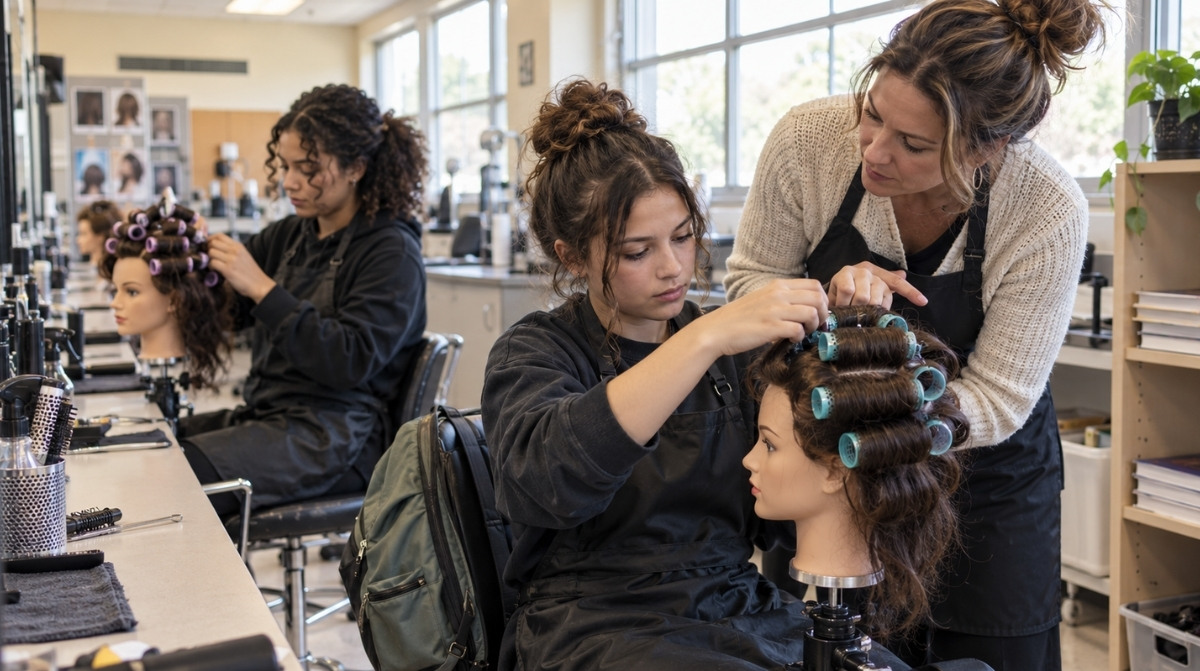
What High School Students Should Know
- Training Can Sometimes Begin Before Graduation: Depending on the state and program, students may be allowed to start cosmetology education while completing high school. Minimum age, education, and licensing conditions vary by jurisdiction.
- CTE Pathways Can Lower Certain Costs: Career and Technical Education and concurrent-enrollment arrangements may cover tuition or allow students to complete recognized training hours earlier. Funding, expenses, and accepted clock hours depend on the individual partnership.
- Enrollment and Licensure Are Separate Milestones: Being old enough to enter a training program does not necessarily mean a student is old enough or otherwise eligible to take the required examinations or obtain a professional license.
- Cosmetology Includes Several Areas of Beauty: A general cosmetology program usually covers hair services, introductory skin and nail care, sanitation, client protection, and salon practices. Students focused mainly on skin or nail services should also compare specialized esthetics and nail technology programs.
Starting your career preparation early can make a meaningful difference when you already know that your interests lie in hairstyling, skin care, or the beauty industry. Many teenagers assume they must receive a high school diploma before entering any beauty classroom, but some state-approved pathways allow eligible high school students to begin completing recognized training hours sooner.
Before choosing a program, find out how its training hours are recorded, whether the state cosmetology board recognizes them, and how the schedule will fit alongside your remaining high school graduation requirements.
Minimum Ages and Education Rules for Cosmetology Students
There is no nationwide minimum age or education standard for entering cosmetology school. State boards establish requirements for education, training, examinations, and licensing, while individual schools may adopt admission standards that are stricter than the state minimum.
These distinctions matter because school admission, beginning training, registering as an apprentice, taking licensing examinations, and receiving a license are separate stages. A state might allow a student to begin training at 16 but require additional education, completion of all required hours, and satisfaction of other qualifications before that person can receive a license.
In many states, the applicable minimum age falls between 16 and 18. Some jurisdictions accept completion of the 10th grade as part of their licensing qualifications rather than requiring a high school diploma. For example, the South Carolina Board of Cosmetology requires cosmetologist applicants to be at least 16 years old, possess at least a 10th-grade education or its equivalent, and complete 1,500 hours at a board-approved cosmetology school. Applicants must also pass the required written and practical examinations.
The Alabama Board of Cosmetology and Barbering requires examination candidates to be at least 16 and submit documentation showing completion of the 10th grade or higher. Cosmetology candidates must also complete the required school or apprenticeship hours before applying for their examinations.
California uses a different framework. According to the California Board of Barbering and Cosmetology, cosmetology examination applicants generally must be at least 17 and have completed the 10th grade. However, its apprenticeship pathway may begin at age 16 after the student has completed the 10th grade or its equivalent. This difference demonstrates why students should not assume that the minimum age for training is also the minimum age for licensure.
For a closer look at common admission standards, read our explanation of who can qualify for cosmetology school. The Natural Healers Cosmetology Licensing Guide also provides a broad overview, but students should confirm every current requirement with the official board in the state where they intend to train and become licensed.
State-specific laws provide additional examples. Under Arkansas cosmetology law, a student generally must be at least 16 and have completed two years of high school or its equivalent. Regulations and application procedures may change, so applicants should verify current information through the Arkansas Department of Health Cosmetology Section and their chosen school.
Georgia also distinguishes between learning cosmetology and qualifying for a professional credential. Under Georgia Code § 43-10-14, an individual who is at least 16 may study cosmetology under a qualified instructor at a cosmetology school or through a registered apprenticeship.
However, Georgia Code § 43-10-9 generally requires a master cosmetologist applicant to be at least 17, hold a high school diploma, state-approved high school equivalency diploma, or postsecondary or college degree, complete the required school course or apprenticeship, and pass both the required written and practical examinations. Schools may establish admission requirements above Georgia’s minimum age for beginning instruction.
Students considering a future move can also review our overview of cosmetology licensing requirements in different states.
Is Cosmetology School Available to Students Younger Than 18?
It may be available, depending on state law and the admission policy of the particular school or high school program. State permission to begin training does not require every beauty school to accept minors.
Because students younger than 18 generally cannot enter every enrollment or financial agreement independently, schools commonly require a parent or legal guardian to sign enrollment contracts, payment agreements, consent forms, or liability documents. The required paperwork differs among schools and states.
Applicants may also need to provide proof of age and an official transcript confirming completion of the required grade level. Some private beauty schools require a high school diploma or recognized equivalent even when state law permits approved training to begin earlier.
Students should also separate permission to attend classes from eligibility to take licensing examinations. A state may let a minor accumulate approved training hours but require further education, program completion, or a different minimum age before the student can apply for licensure.
Examination structures are not uniform across the country. Applicants may need to take a written examination, practical examination, or both. California, for example, stopped requiring a practical examination for its license types effective January 1, 2022, according to the California Board’s examination information.
Ways to Begin Beauty Training During High School
Students searching for cosmetology classes during high school may find several types of programs. Possibilities include district-operated cosmetology courses, regional Career and Technical Education centers, concurrent enrollment with a technical college, private state-approved beauty schools, and registered salon apprenticeships in states where that pathway is permitted.
Some public school districts collaborate with CTE centers or technical colleges. These arrangements may allow students to divide their day between regular academic subjects and vocational instruction. A student could complete courses such as English, mathematics, and science at a traditional high school before attending a beauty lab for practical education.
The number of licensing hours available through these programs varies significantly. The Technical College of the Rockies High School Cosmetology Program, for example, is a four-semester, half-day concurrent-enrollment program that provides 1,211 hours over two school years. Its published costs for the 2026–2027 school year total more than $10,000, showing that a high school cosmetology pathway is not automatically free.
Financial arrangements depend on the state, district, technical college, and individual partnership. Public CTE or dual-enrollment funding may subsidize tuition in some programs. In other cases, students and their families may remain responsible for tuition, kits, textbooks, uniforms, registration, transportation, or licensing examination fees. Ask for a written cost breakdown before making an enrollment decision.
Private beauty schools are another possible route when their age requirements and schedules accommodate current high school students. Evening, weekend, part-time, and year-round classes are not universally available, however. Each school may establish its own admission and scheduling policies within applicable state law.
Program length also depends on the required hours and the number of hours a student attends each week. Our guide to cosmetology school schedules and graduation timelines explains how attendance formats and other factors can affect completion.
Before selecting an early-training pathway, ask:
- Is the institution and its specific cosmetology program approved by the state board?
- Will all completed hours appear on an official transcript recognized by the state?
- How many licensing hours can the student complete before receiving a high school diploma?
- Which tuition, kit, book, uniform, registration, transportation, and examination expenses must the family pay?
- Can completed student hours be transferred if the student changes schools or relocates?
- Will the schedule leave enough time to complete all high school graduation requirements?
- How much cosmetology training will remain after high school graduation?
What Modern Teen Cosmetology Education Includes
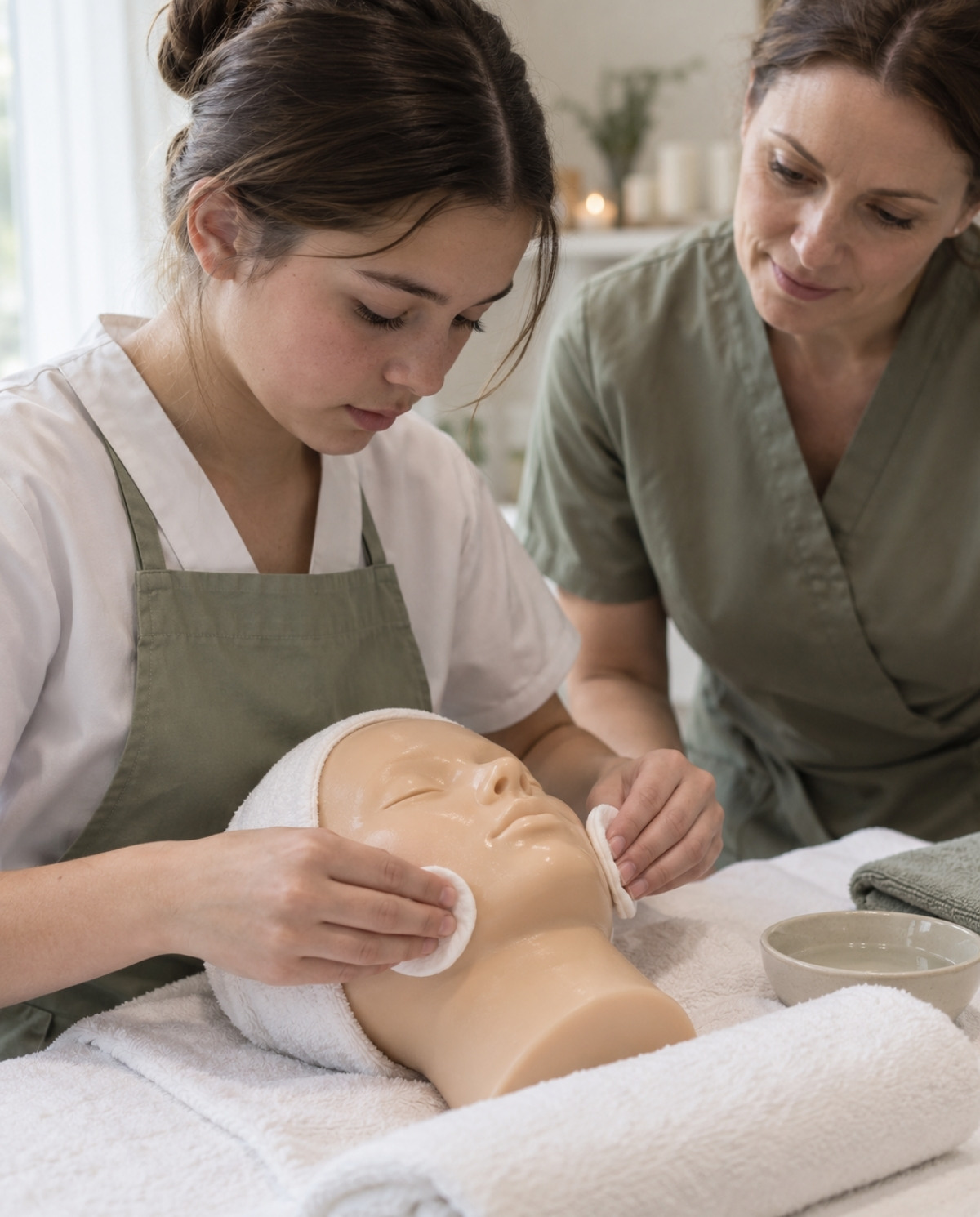
Cosmetology education extends beyond basic haircuts and color applications. Students generally study haircutting, hairstyling, chemical services, sanitation, client safety, and salon procedures, along with introductory skin and nail services. The time assigned to each subject depends on the state-approved curriculum and the individual program.
Georgia’s required curriculum offers one example of how the training may be structured. Under the Georgia State Board’s cosmetology curriculum, a 1,500-hour master cosmetology course begins with 250 hours of Level 1 instruction. Students must complete those hours before performing clinical services on clients. This stage includes theory, mannequin-based instruction, and introductory training in skin and nail care.
Someone primarily interested in facials, skin analysis, hair removal, makeup, or spa services should compare general cosmetology with a dedicated esthetician program. Georgia, for example, has a separate 1,000-hour esthetician curriculum with concentrated education in skin sciences, facial services, hair removal, makeup, client records, professional practices, and business operations.
A similar distinction applies to nail services. General cosmetology introduces nail care, whereas a nail technology program devotes more focused training to nail procedures, sanitation, products, tools, and service application.
Completing a specialty course or receiving a training certificate does not automatically enlarge a person’s legally permitted scope of practice. Advanced exfoliation, lasers, injections, medical devices, and treatments of medical conditions may fall outside a cosmetologist’s or esthetician’s license. The answer depends on the service, state law, and whether medical supervision or another professional license is required.
Beauty education may also introduce client communication, appointment scheduling, retail sales, recordkeeping, marketing, sanitation procedures, and salon management. These subjects can prepare students for entry-level salon employment and possible independent work after they have gained the necessary qualifications and experience.
Operating a salon, booth, or private suite may require more than an individual cosmetology license. Depending on the jurisdiction and business model, a professional may also need an establishment license, business registration, insurance, local permits, and compliance with facility regulations.
Employment projections help explain interest in specialized beauty occupations. According to the U.S. Bureau of Labor Statistics Skincare Specialist Report, employment of skincare specialists is projected to grow 9% from 2025 to 2035, compared with 3% for all occupations. BLS also projects approximately 14,200 openings for skincare specialists each year, on average, during that period. Many of those openings are expected to result from workers transferring to other occupations or leaving the labor force, rather than from the creation of 14,200 entirely new positions every year.
Independent work is common across the broader beauty field. A 2022 policy submission from the American Association of Cosmetology Schools, using 2020 industry data, reported that 33% of workers in personal appearance occupations were self-employed, compared with 6% of the overall workforce. Because the data covers the wider industry and is not specific to teenagers or new graduates, it should not be interpreted as evidence that one-third of recent graduates immediately become successful independent professionals.
How to Prepare Before Finishing High School
Students can use the following process to explore early training without losing sight of their high school responsibilities:
- Visit the official website of the state cosmetology board and confirm the separate requirements for entering school, beginning an apprenticeship, taking examinations, and receiving a license.
- Ask a high school guidance counselor about CTE programs, regional technical centers, shared credits, and concurrent-enrollment partnerships.
- Confirm how the beauty courses will appear on the high school transcript and whether they count toward elective, vocational, or other graduation requirements.
- Tour local state-approved beauty programs and ask whether their age requirements and available schedules accommodate current high school students.
- Request a complete list of required documents, which may include an official transcript, government-issued identification, proof of age, and parent or guardian forms.
- Verify that both the school and the specific program are approved by the cosmetology board in the state where the student will earn the hours.
- If moving to another state is possible, ask both state boards how they handle partially completed out-of-state education. Transferring student hours is different from transferring an active license through endorsement or reciprocity.
State-board approval and institutional accreditation are separate matters. Board approval determines whether a program is authorized to provide education leading toward state licensure. Accreditation may affect educational oversight and eligibility for federal financial aid, but accreditation alone does not guarantee that a licensing board or another state will accept the completed hours.
What You Should Know Before Starting

- Training May Begin Before High School Graduation: Certain states allow teenagers to enter approved cosmetology programs before receiving a diploma. Minimum age, completed grade level, and licensing conditions depend on the state and school.
- CTE Pathways Can Lower Costs or Shorten Later Training: Career and Technical Education and concurrent-enrollment partnerships may cover part of the tuition or allow students to earn recognized clock hours. The actual funding and number of accepted hours vary by program.
- Admission and Licensure Are Separate Milestones: Being old enough to enroll does not necessarily mean a student is eligible to take the licensing examinations or receive a professional license.
- Cosmetology Includes Several Areas of Beauty: Programs commonly cover hair services, basic skin and nail care, sanitation, client protection, and salon operations. Students primarily interested in skin or nail services should also compare specialized esthetics and nail technology programs.
Starting early can make a meaningful difference when you already know that your interests lie in hairstyling, skin care, or the beauty industry. Although many teenagers assume they must wait until they receive a high school diploma, some approved pathways allow students to begin training or earn licensing hours sooner.
Before choosing a program, you need to understand its admission standards, your state’s licensing rules, and how vocational training will fit alongside your remaining high school requirements. You should also confirm that the program is approved and that its hours will count toward licensure.
Minimum Ages and Education Rules for Cosmetology Students
Age and education requirements for entering cosmetology training are not uniform throughout the United States. State licensing boards establish minimum qualifications for education, examinations, apprenticeships, and professional licenses. Individual schools can then adopt admission requirements that are stricter than the state’s baseline rules.
This distinction matters because school admission, starting approved training, registering as an apprentice, taking licensing examinations, and receiving a license are separate stages. A state may allow training to begin at 16 while requiring applicants to reach another age, complete a specified level of education, and finish all required hours before becoming licensed.
In several states, the minimum age falls between 16 and 18. Some states accept completion of the 10th grade instead of requiring a full high school diploma for particular licensing pathways. For example, the South Carolina Board of Cosmetology requires cosmetologist applicants to be at least 16, possess at least a 10th-grade education or its equivalent, and complete 1,500 hours at a board-approved cosmetology school. Applicants must also pass written and practical examinations.
The Alabama Board of Cosmetology and Barbering requires examination candidates to be at least 16 and submit documentation showing completion of the 10th grade or higher.
California uses a different structure. According to the California Board of Barbering and Cosmetology, cosmetology examination applicants generally must be at least 17 and have completed the 10th grade. Its apprenticeship pathway may begin at 16 after completion of the 10th grade or its equivalent. This is one reason students should not assume that the minimum age for starting training is also the minimum licensing age.
For additional information about admission qualifications, read our guide explaining who can enroll in cosmetology school and which requirements may apply. The Natural Healers Cosmetology Licensing Guide also provides a general overview, but current requirements should always be confirmed with the official board in the state where you intend to train and work.
State-specific examples show how widely these standards can differ. Under Arkansas cosmetology law, a student generally must be at least 16 and have completed two years of high school or its equivalent. Since regulations and administrative procedures may change, prospective students should verify the latest requirements through the Arkansas Department of Health Cosmetology Section and their intended school.
Georgia also distinguishes between entering training and qualifying for professional registration. Under Georgia Code § 43-10-14, an individual who is at least 16 may learn cosmetology under a qualified instructor at a cosmetology school or through a registered apprenticeship.
However, Georgia Code § 43-10-9 generally requires master cosmetologist applicants to be at least 17, possess a high school diploma, state-approved high school equivalency diploma, or postsecondary or college degree, complete the required course of study or apprenticeship, and pass both the required written and practical examinations. A private school may enforce stricter admission standards than the state’s minimum training age.
If you may study or work in another state, review our overview of cosmetology licensing requirements across different states. Remember that transferring unfinished student hours is different from transferring an active professional license through endorsement or reciprocity.
Is Cosmetology School Available to Students Younger Than 18?
It may be possible, depending on state law and the chosen institution. Because minors generally cannot enter every enrollment or financial arrangement independently, schools commonly ask a parent or legal guardian to sign contracts, payment agreements, consent forms, or liability documents. The required paperwork varies by institution and location.
Students may need to present proof of age and an official transcript verifying completion of the required grade level. A private school may still require a high school diploma or recognized equivalent even when state rules permit training at a younger age.
Attending classes is also different from becoming eligible for licensure. A state may allow a minor to accumulate approved training hours but require further education, program completion, or a higher minimum age before licensing. Depending on the jurisdiction, applicants may need to pass a written examination, a practical examination, or both.
California is one notable exception to the practical-examination model. Effective January 1, 2022, the state stopped requiring a practical examination for its license types, according to the California Board’s examination information. Candidates currently need to pass the applicable written examination.
Ways High School Students Can Begin Beauty Training
Students looking for cosmetology classes during high school may encounter several types of programs. Possibilities include district-operated cosmetology courses, regional Career and Technical Education centers, concurrent enrollment with a technical college, private state-approved beauty schools, and registered salon apprenticeships in states where that route is authorized.
Some public school districts work with regional CTE centers or technical colleges. Students may divide the school day between their regular academic subjects and vocational instruction. For example, they might complete English, mathematics, science, and other graduation courses at their high school before attending practical training in a cosmetology lab.
The number of licensing hours available through these pathways differs significantly. The Technical College of the Rockies High School Cosmetology Program, for example, provides 1,211 hours through a four-semester, half-day concurrent-enrollment program. Its combined published costs for the 2026–2027 school year exceed $10,000, showing that a high school cosmetology program is not automatically free.
Funding depends on the state, school district, technical college, and individual partnership. Public CTE or dual-enrollment funding may subsidize tuition in some programs. Other programs may require students and families to pay for tuition, kits, textbooks, uniforms, registration, transportation, and licensing examinations. Requesting a written cost breakdown can help families identify which expenses are covered and which remain their responsibility.
Private beauty schools may be another option when their admission requirements and schedules are compatible with high school attendance. Evening, weekend, part-time, and year-round classes are not available at every institution. Private schools may also establish their own minimum age and education requirements within applicable state law.
To understand how different schedules affect completion time, see our guide to cosmetology program hours, schedules, and graduation timelines.
Before choosing an early-training pathway, ask:
- Are both the school and the specific program approved by the state cosmetology board?
- Will every completed hour appear on an official transcript recognized by the board?
- How many licensing hours can the student finish before high school graduation?
- Who is responsible for tuition, kits, books, uniforms, transportation, registration, and examination fees?
- What happens to completed hours if the student transfers schools or moves to another state?
- Can the student still complete every academic requirement for high school graduation?
- How much additional cosmetology training will remain after high school?
What Modern Teen Cosmetology Programs Teach
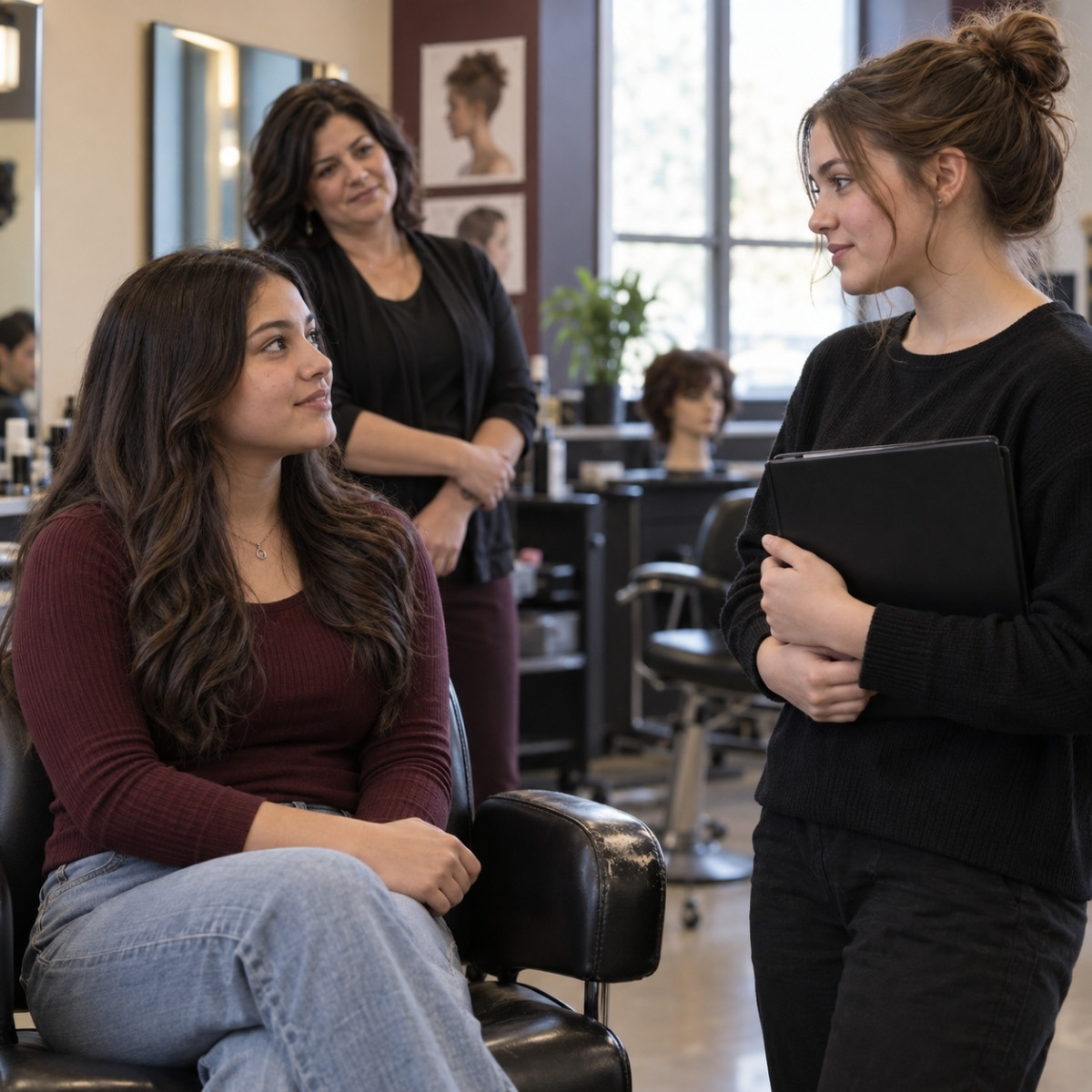
Cosmetology education extends beyond basic haircuts and single-process color. Programs commonly include hair cutting, styling, chemical services, sanitation, infection control, client safety, and salon procedures. Students may also receive introductory instruction in skin and nail services, although the number of hours devoted to each subject depends on state rules and the individual program.
Georgia’s required curriculum provides one example. Under the Georgia State Board’s cosmetology curriculum, the 1,500-hour master cosmetology course begins with 250 hours of Level 1 training. Students must complete this stage before performing clinical services on clients.
Those first 250 hours consist primarily of theory and mannequin instruction. They also include 15 hours of skin-care instruction and 10 hours of nail-care instruction, illustrating that a general cosmetology program introduces these areas without concentrating on them as extensively as a specialized program.
Students primarily interested in facials, skin analysis, hair removal, makeup, or spa services should compare cosmetology with a dedicated esthetician pathway. Georgia maintains a separate 1,000-hour esthetician curriculum focused more heavily on skin sciences, facial services, hair removal, makeup, client records, professional practices, and spa or salon operations.
A similar distinction applies to nail technology. General cosmetology training may introduce manicuring and nail care, while a dedicated nail technology program provides more concentrated instruction in nail services, product use, sanitation, and service procedures.
Completing an advanced class or receiving a specialty certificate does not automatically enlarge a person’s legal scope of practice. Services involving advanced chemical exfoliation, lasers, injections, medical devices, or medical treatment may fall outside the authority of a cosmetologist or esthetician. Applicable restrictions depend on the service, state law, and whether medical supervision or another professional license is required.
Beauty education may also introduce business skills such as client communication, appointment scheduling, retail sales, recordkeeping, marketing, and salon management. These subjects can support entry-level employment and prepare graduates to consider independent work later.
Operating a salon or private suite may require more than an individual cosmetology license. Depending on the location and business model, the owner may need an establishment license, business registration, insurance, local permits, and other approvals.
Employment projections help show why specialized beauty services continue to attract interest. According to the U.S. Bureau of Labor Statistics Skincare Specialist Report, employment of skincare specialists is projected to grow 9% from 2025 to 2035, compared with 3% for all occupations. BLS also projects approximately 14,200 openings for skincare specialists each year, on average, during that period.
Many of those openings are expected to result from workers transferring to other occupations or leaving the labor force. Therefore, the figure should not be interpreted as 14,200 entirely new positions being created every year.
Independent work is common across the broader beauty sector. A 2022 policy submission from the American Association of Cosmetology Schools, based on 2020 industry data, reported that 33% of workers in personal appearance occupations were self-employed, compared with 6% of the overall workforce.
Because those figures represent older, industry-wide data, they should not be treated as proof that a teenager or newly licensed graduate will immediately be ready for self-employment.
How to Prepare for Beauty School Before Graduating
A clear preparation process can help students explore beauty education without interfering with high school completion.
- Visit the official website of your state cosmetology board and check the separate requirements for beginning school, registering as an apprentice, taking examinations, and receiving a license.
- Meet with your high school guidance counselor to ask about CTE programs, technical centers, shared-credit arrangements, and concurrent enrollment with nearby cosmetology programs.
- Confirm how vocational courses will appear on your high school transcript and whether they satisfy elective, vocational, or other graduation requirements.
- Tour approved beauty schools and ask whether their available daytime, evening, weekend, or part-time schedules can accommodate high school attendance.
- Prepare any required official transcripts, proof of age, government-issued identification, and parent or guardian forms.
- Verify that both the institution and the selected program are recognized by the cosmetology board responsible for accepting the training hours.
- If you may move to another state, ask both boards how partially completed out-of-state student hours are evaluated.
State-board approval and institutional accreditation are not the same thing. Board approval determines whether a program qualifies students for that state’s licensing pathway. Accreditation may affect educational oversight or eligibility for federal financial aid, but accreditation by itself does not guarantee that another state will accept the completed hours.
Common Questions About Beginning Cosmetology Training Early
Will high school cosmetology hours transfer if I move?
Not automatically. The receiving state may compare your education and curriculum with its requirements, request an official transcript sent directly by the school, or require additional training hours. Contact both boards before moving and ask specifically about transferring partial out-of-state education rather than transferring an active professional license.
Can a high school student receive federal financial aid for cosmetology school?
Students who are still enrolled in high school generally cannot receive federal Title IV aid, including Pell Grants, for concurrent cosmetology-school enrollment. Other possibilities may include district CTE funding, state or local dual-enrollment assistance, institutional scholarships, or private funding. Eligibility and available support vary, so families should request a written explanation of costs and funding options.
Could beauty classes affect future four-year college admission?
Not automatically. Cosmetology or CTE courses may satisfy elective or vocational credits, but students must still complete the academic courses required for high school graduation and admission to their intended colleges. Postsecondary cosmetology credits may transfer only as electives or may not apply toward a four-year degree, so students should review their plans with a guidance counselor.
What changes when a student turns 18 during the program?
After turning 18, a student can generally sign their own enrollment and scheduling documents without a parent or guardian. Turning 18 does not automatically establish licensing eligibility. The student must still meet all applicable education, training, examination, and application requirements.
How should I evaluate a high school cosmetology program?
Compare the number of board-recognized hours with the program’s full cost, schedule, high school graduation requirements, and the training that will remain afterward. A low-cost option may provide little value if its hours are not recognized or must be repeated later.
Plan Your Next Step in the Beauty Industry
Starting your research during high school can give you more time to understand licensing requirements, compare legitimate training routes, and prepare for professional beauty education.
Aiken School of Cosmetology and Barbering currently requires applicants to be at least 18 years old and possess a high school diploma or GED. Students who have not yet met those requirements can use this time to research the profession, complete high school, and prepare the documents needed for future enrollment.
Once you meet the school’s admission requirements, visit our Enrollment page or contact our admissions team to learn about available programs, schedules, campus tours, and upcoming start dates.