How to Brand Yourself as a Nail Technician: Business Names, Instagram Bio, and Marketing Ideas

Main Points to Remember

  • Your Positioning Must Be Accurate: A distinctive business name and an appropriate professional title help prospective clients understand your services. Descriptions such as Nail Artist or Nail Care Specialist may support your branding, but they do not replace the occupational title or license recognized by your state.
  • Easy Scheduling Can Reduce Lost Bookings: A Zenoti survey found that more than 83% of regular nail-salon clients had abandoned a booking because they could not reach the business or found its online system difficult to use. A straightforward, mobile-friendly booking process can help move interested visitors toward confirmed appointments.
  • Responsible Practices Support Client Safety: Keeping uncured products away from the skin, using compatible gel systems and lamps, controlling filing dust, and observing sanitation regulations can help reduce preventable exposure, infection, injury, and acrylate sensitization.
  • Education Prepares You for Professional Practice: Formal instruction in nail structure, product chemistry, infection control, client care, and business operations provides valuable preparation for pursuing licensure and building a sustainable career.

Launching a career in the nail industry can be exciting, but technical ability alone does not guarantee a full appointment book. New professionals must also learn how to present their services, develop client trust, create convenient booking options, market within their community, and operate within the limits of their license.

This guide explains how to shape a recognizable brand, improve your online presence, attract and retain clients, price services responsibly, and make safety part of your professional identity.

Define How Clients Should Recognize Your Business

Nail technician reviewing a wall mood board containing manicure photographs, color samples, packaging textures, and blank name cards.

A successful nail brand begins with clarity. Before ordering printed materials or publishing a website, decide how you want clients to understand your work and what type of experience they should expect when booking with you.

Licensing terms differ among states. Depending on the jurisdiction, a licensed professional may be identified as a manicurist, nail technician, nail specialist, or nail care professional. The relevant licensing board and state law determine the legal title and scope of practice—not the description used in a social media profile.

Branding descriptions such as Nail Artist, Nail Sculptor, or Nail Care Specialist may still communicate a particular focus. Someone known for intricate hand-painted designs might market themselves as a Nail Artist, while a professional specializing in custom extensions might use Nail Sculptor. These are normally marketing descriptions rather than separate occupational licenses.

Use the term certified only if you have earned a legitimate certification and can name the issuing organization. A course or manufacturer certification may show that you received additional instruction, but it does not replace state licensure or authorize services beyond the scope of your license.

When developing name ideas for a nail technician business, choose something clients can easily remember, type, pronounce, and share. Complicated spellings may make it harder for someone to find your page, tag your account, or recommend you to a friend.

A personal name paired with the service can emphasize the individual professional behind the business. A location-based or specialty-focused name can tell prospective clients where you operate or what type of work you provide. If you eventually want to manage a multi-chair salon, a broader name may offer more flexibility than branding built around a single technician.

Before using a business name, investigate:

  • Your state’s business-entity and trade-name records
  • Federal and state trademark databases
  • Available website domains
  • Social media usernames
  • City or county DBA requirements
  • State restrictions involving words such as salon, academy, medical, or certified

A name alone does not authorize someone to perform nail services or operate a regulated establishment. Depending on the location and business structure, legal operation may require an individual license, salon or establishment approval, business registration, insurance, local permits, and compliance with health and licensing-board regulations.

If you are considering expansion beyond an individual workstation, review how salon ownership without a personal cosmetology license works. In many jurisdictions, owning a business and personally performing regulated services are treated as separate matters. The establishment and each service provider may have different licensing obligations.

The nail profession also offers meaningful long-term career possibilities. According to the U.S. Bureau of Labor Statistics occupational profile for manicurists and pedicurists, employment is projected to increase by 9% between 2025 and 2035, compared with 3% for all occupations.

In May 2025, the national median wage was $17.19 per hour, equivalent to $35,760 annually. The occupation accounted for approximately 201,800 jobs in 2025, and self-employed workers represented 23% of the field.

BLS wage estimates do not include self-employed professionals. Independent nail technicians must subtract expenses such as product costs, rent, insurance, licensing fees, payment-processing charges, marketing, equipment, and taxes when determining actual take-home income.

Some eligible professionals may also qualify for the temporary federal deduction for reported tips. Under the IRS guidance for the qualified-tip deduction, eligible taxpayers may deduct up to $25,000 in qualified tips for tax years 2025 through 2028. Income limits, occupation rules, filing-status restrictions, and business-income limitations apply.

This deduction does not eliminate the obligation to report tips and does not necessarily remove payroll or self-employment taxes. Nail professionals should maintain accurate records and consult a qualified tax professional when determining eligibility.

Design an Online Experience That Makes Booking Easier

A prospective client often encounters your digital profile before meeting you in person. Within a few moments, that visitor should be able to identify your location, specialty, services, price range, and booking process.

An effective nail technician bio for Instagram can include:

  • Your name and accurate occupational title
  • Your city or studio location
  • Your main services or specialties
  • Your typical working days or hours
  • A direct booking or service-menu link
  • Instructions for first-time clients

Only advertise yourself as licensed if the license is active and covers the services you offer. If you work in a salon, suite, or shared location, explain whether appointments are made through your personal system or through the establishment.

Your profile or linked booking page may also provide:

  • Deposit and cancellation requirements
  • Removal and foreign-product policies
  • Repair policies
  • Accepted payment methods
  • Parking and building-access details
  • Instructions for submitting inspiration photos

Social media content can do more than display completed sets. Educational nail technician captions for Instagram can explain service preparation, maintenance, product limitations, and responsible aftercare.

The nail plate consists of layers of keratinized cells. Aggressive filing or repeated over-buffing can make it thinner and weaker. Product lifting can result from moisture, oil, contamination, insufficient preparation, application errors, incompatible systems, trauma, or incomplete curing. Because there is not one universal cause, avoid presenting every lifting problem as proof of poor client care or improper application.

Showing why you use a particular preparation process, avoid unnecessary filing, or recommend specific maintenance practices can demonstrate professional judgment. You may also show how reusable tools are cleaned and disinfected in accordance with manufacturer directions and state regulations.

Describe sanitation procedures accurately. Cleaning removes visible soil and debris. Disinfection uses an appropriate chemical product to destroy specified microorganisms on suitable surfaces. Sterilization is a different process intended to eliminate all forms of microbial life.

Most nail establishments clean and disinfect reusable, nonporous implements using products and contact times permitted by their state rules. An autoclave is a sterilization device, but a business should not claim to sterilize its tools unless it actually operates, maintains, monitors, and validates an appropriate device for compatible instruments.

A dedicated website can provide more control than relying entirely on social media. A useful mobile-friendly nail technician website may contain:

  • Organized service descriptions
  • Estimated appointment lengths
  • Starting prices
  • Charges for removal, repairs, length, shape, or detailed art
  • Maintenance expectations
  • Booking and cancellation policies
  • A portfolio of services that clients can actually request

The website should also explain when a service may be unsuitable. Nail technicians may observe visible abnormalities, decline a service that appears unsafe, and recommend medical evaluation. Diagnosing disease or providing medical treatment generally falls outside a nail technician’s authorized scope.

Avoid claims that a cosmetic service cures fungal infections, repairs medically damaged nails, or treats a health condition. When necessary, direct the client to a qualified healthcare professional.

Use original, high-resolution photographs that accurately represent your work. Excessive editing can create unrealistic expectations if the displayed color, texture, shape, or finish no longer matches the completed service.

The Research and Markets global nail-salon report estimates that the market will grow from $14.08 billion in 2026 to $19.34 billion in 2030. The report identifies custom nail art, premium services, online appointment platforms, sustainability, and greater attention to safety and hygiene as important trends.

Booking convenience matters within this competitive environment. A Zenoti survey covering more than 1,000 U.S. salon and spa clients found that more than 83% of nail-salon regulars had skipped a booking because they could not reach the business or found online scheduling too difficult.

The survey also reported that 64% of nail-salon regulars always considered calling the easiest way to manage an appointment. This does not mean online booking should be abandoned. Instead, businesses can offer digital scheduling while maintaining a clear phone, email, or text option for clients who need assistance, want to report a repair, or are unsure which service to choose.

Use Community Visibility to Reach Nearby Clients
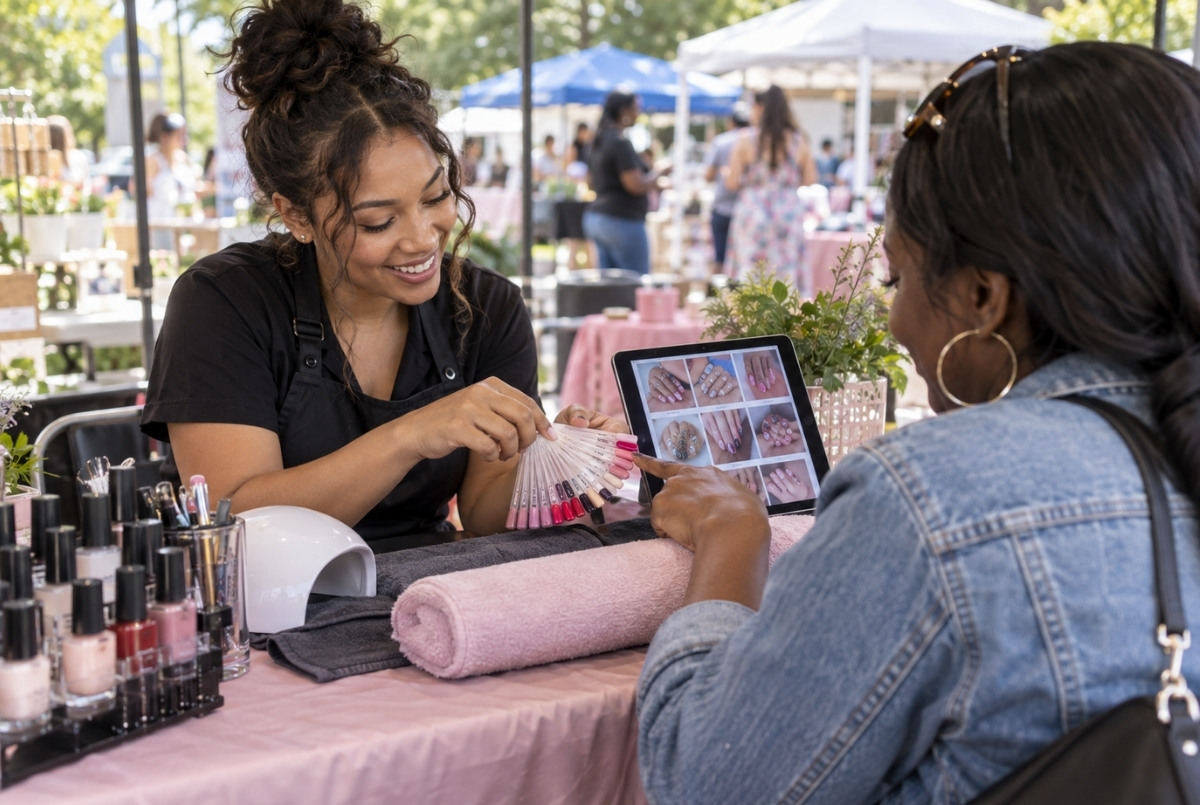
Nail technician providing a polish consultation at a community beauty pop-up with nail samples and a digital manicure portfolio.

Online marketing introduces your services to digital audiences, while local promotion builds recognition among people who already live, work, shop, or attend events near your business.

Printed nail technician business cards should be readable and durable. Include your name, occupational title, location, website, social account, and a QR code directing clients to a controlled booking or service page.

Always test a QR code on multiple devices before ordering a large print quantity. Avoid linking it to temporary promotions or pages you cannot update.

With permission, nail technician flyers may be displayed at complementary local businesses. Possible partners include:

  • Hair salons
  • Bridal boutiques
  • Wedding planners
  • Photographers
  • Clothing stores
  • Fitness studios
  • Beauty retailers

Referral arrangements should be easy to understand. A first-time visitor might receive a small nail-art accent, a cuticle-oil sample, or another modest benefit. State the eligibility requirements, limitations, and expiration date so clients do not misunderstand the offer.

A brief professional introduction can also make networking more effective. Rather than saying that you “just do nails,” explain your license, location, main service focus, and the type of experience you provide.

For example:

“I am a state-licensed nail professional specializing in structured gel services and detailed custom designs. My work focuses on thoughtful preparation, precise application, responsible product use, and clear maintenance guidance.”

This type of introduction communicates value without implying medical expertise or offering services beyond the professional’s legal scope.

Turn First Appointments Into Ongoing Relationships

Learning how to build clientele as a nail technician involves more than attracting one-time appointments. A stable schedule depends on service quality, realistic expectations, suitable pricing, consistent communication, and client retention.

During a new-client consultation, ask about:

  • Products currently worn on the nails
  • Previous service experiences
  • Known sensitivities or prior reactions
  • Work and lifestyle demands
  • Preferred length and shape
  • Maintenance habits
  • The desired appearance and service outcome

Observe the visible condition of the nails and surrounding skin, but do not attempt to diagnose an infection or medical disorder.

Explain maintenance requirements before the application begins. Extensions and structured overlays generally require ongoing care, but an appropriate maintenance interval depends on nail growth, length, product type, structure, daily activity, and manufacturer instructions. A fixed three-week schedule is not automatically appropriate for every client.

When a client is satisfied, offer to reserve the next suitable appointment before they leave. Rebooking can simplify the client’s routine while making future demand more predictable.

Authentic reviews and accurate service photographs can support trust. Obtain permission before photographing or publishing a client’s hands. Do not alter images so heavily that they misrepresent the service.

Useful business indicators may include:

  • Rebooking percentage
  • Repeat-client percentage
  • Average service ticket
  • Late-cancellation and no-show rate
  • Revenue per available appointment hour
  • Referral conversion rate
  • Client-acquisition source

These measurements can reveal whether a promotion attracts clients who return or merely generates discounted one-time visits.

A mission statement can help define the standards behind the business. A practical statement identifies the client, the benefit offered, the method used to deliver that benefit, and the intended experience.

For example:

“Our studio provides busy clients with polished, durable nail services through careful preparation, responsible product use, consistent sanitation, and attentive consultations.”

The statement should influence actual operations. If the business promises responsible care, its scheduling, consultations, sanitation procedures, product choices, pricing, and boundaries should support that promise.

Calculate Prices Around Real Business Costs

Beginner technicians sometimes charge far below the local market because they lack confidence or want to build a portfolio quickly. A temporary introductory offer may be useful, but indefinite underpricing can prevent the business from covering expenses, replacing equipment, or investing in continued education.

Review local competitors while recognizing that different business models carry different costs. An employee, booth renter, mobile professional, home-based technician, and independent suite owner may not be able to use the same pricing structure.

Service prices should account for:

  • Product consumption
  • Application and cleanup time
  • Rent or suite expenses
  • Professional and business insurance
  • License and permit costs
  • Booking and payment-processing charges
  • Laundry, disinfection products, and disposable supplies
  • Photography and advertising
  • Administrative work
  • Taxes
  • Education and professional development
  • Equipment maintenance and replacement
  • A sustainable profit margin

Time-intensive upgrades may be priced separately from the base service. These can include extended length, difficult shaping, repairs, removals, charms, sculpted elements, or detailed hand-painted designs.

Publish enough information for clients to estimate their likely total before booking. If a final quote depends on complexity, explain how the price is calculated and request an inspiration image when appropriate.

Revenue and personal income are not interchangeable. A fully booked technician may collect substantial service revenue but retain considerably less after expenses and taxes.

Make Product Safety Part of the Client Experience
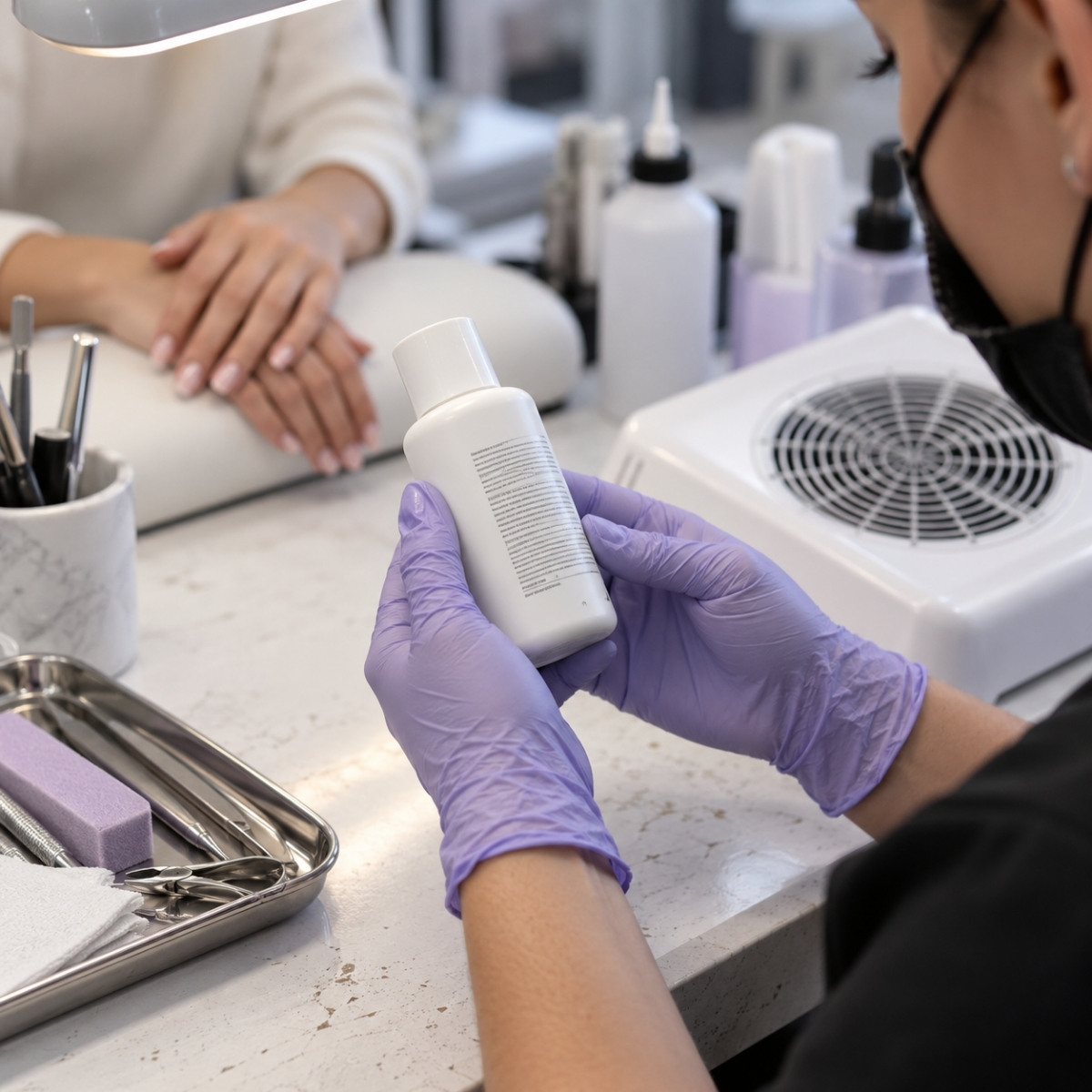
Gloved nail technician examining the ingredient information on an unbranded nail product beside clean tools and tabletop ventilation equipment.

Professional safety affects product selection, application, ventilation, dust control, workstation maintenance, and long-term occupational health.

The European Union prohibited TPO, formally known as Trimethylbenzoyl Diphenylphosphine Oxide, in cosmetic products beginning September 1, 2025. Under Commission Regulation (EU) 2025/877, TPO was placed on the prohibited-substances list after being classified as a Category 1B substance toxic to reproduction.

The European prohibition does not automatically control products sold in the United States or other jurisdictions. Nail professionals should comply with the rules that apply where they work and purchase properly labeled products from reliable professional suppliers.

Acrylates and methacrylates in enhancement systems may cause allergic contact dermatitis. According to DermNet’s guidance on nail-cosmetics allergy, ingredients connected with artificial-nail reactions include methacrylate compounds such as HEMA, or 2-hydroxyethyl methacrylate.

Repeated contact with uncured or inadequately cured material is a significant concern. Once sensitization develops, it may persist, and reactions can appear on the fingertips, surrounding skin, eyelids, face, or other areas touched by the hands.

Risk-reduction practices include:

  • Preventing uncured product from contacting the skin
  • Following the product manufacturer’s curing instructions
  • Using a lamp specified or validated for the gel system
  • Avoiding unsupported combinations of incompatible brands or systems
  • Replacing damaged or unreliable curing equipment
  • Capturing filing dust near its source
  • Maintaining appropriate ventilation
  • Using suitable protective equipment when needed
  • Reviewing labels and Safety Data Sheets
  • Stopping the service if burning, swelling, blistering, or another concerning reaction occurs

Lamp wattage alone does not establish whether a gel will cure properly. Gel systems may use different photoinitiators and require particular wavelengths, exposure periods, or lamp configurations. Using the manufacturer’s designated system is more dependable than selecting a lamp based only on advertised power.

The OSHA guidance for nail-salon workers addresses chemical exposure, ventilation, safe handling, protective practices, and access to Safety Data Sheets. These workplace precautions are directly relevant to daily salon operations.

The FDA Modernization of Cosmetics Regulation Act of 2022, or MoCRA, primarily creates obligations for cosmetic manufacturers, processors, and responsible persons identified on cosmetic labels.

MoCRA may become relevant when a nail business manufactures, packages, distributes, or markets cosmetic products under its own name. It does not replace OSHA workplace requirements or state cosmetology regulations governing salon services.

Accurate safety communication helps clients understand responsible practices without relying on exaggerated warnings or unsupported claims that a product is completely allergy-free.

Prepare for Licensure and Professional Responsibility

A lasting nail career requires more than a starter kit and online tutorials. Formal education provides structured instruction, supervised practice, safety knowledge, and preparation for state licensing requirements.

Training requirements vary by jurisdiction. Applicants should always verify current information with the licensing authority for the state where they plan to work.

South Carolina identifies the specialty as nail technology and requires education, examination, application, and licensing steps established by the South Carolina Board of Cosmetology. The state’s nail-technology curriculum is commonly structured around 600 hours of approved training. Applicants should confirm the current rules and application requirements directly through the South Carolina Board of Cosmetology before enrolling or applying.

Georgia generally requires a 525-hour approved nail-care school program or 1,050 hours of approved apprentice training. The original overview of Georgia nail technician requirements provides introductory information, but current requirements should be confirmed with the Georgia State Board of Cosmetology and Barbers.

Arkansas requires a 600-hour manicure program, followed by the licensing steps currently established by the Arkansas Department of Health’s Cosmetology Section. This Arkansas nail technician licensing overview may be used as a general introduction, but the state agency remains the final authority.

Differences among these states demonstrate why students should not assume that a license, examination, or number of training hours automatically transfers elsewhere.

A cosmetology license is also not universally interchangeable with nail technology, barbering, esthetics, or another specialty credential. Services included under one license may be limited, separately regulated, or excluded in another state. Aiken students and prospective professionals can review additional context on working in other beauty specialties with a cosmetology license, while confirming the final scope directly with the appropriate licensing board.

A state-approved nail or cosmetology curriculum may cover:

  • Nail Anatomy and Visible Conditions: Studying the nail plate, matrix, nail bed, surrounding tissue, contraindications, and visible concerns that may require a service to be adjusted, refused, or referred.
  • Enhancement Product Chemistry: Learning how gels, acrylic systems, adhesives, primers, solvents, and photoinitiators behave during application and removal.
  • Chemical Handling: Reading Safety Data Sheets, preserving labels, storing materials correctly, and following manufacturer and workplace-safety instructions.
  • Tool Processing: Removing visible debris from reusable, nonporous implements before applying an appropriate disinfectant for the required contact time.
  • Infection Prevention: Following rules for hand hygiene, blood exposure, linens, waste, workstations, and pedicure equipment.
  • Professional Limits: Recognizing visible concerns without diagnosing or claiming to treat infections, diseases, or medical conditions.
  • Client Communication: Reviewing prior services, sensitivities, maintenance needs, lifestyle considerations, and realistic expectations.
  • Business Fundamentals: Learning scheduling, inventory control, recordkeeping, pricing, licensing responsibilities, client retention, and workplace professionalism.

Formal training does not remove the need to pass examinations or complete a license application. Instead, it provides the technical knowledge, supervised experience, and professional preparation needed to pursue those next steps responsibly.

Common Questions From New Nail Professionals

When can a new technician expect a dependable client schedule?

There is no fixed timeline. Some professionals build a consistent clientele within several months, while others require a year or more.

Results depend on local demand, working hours, salon traffic, location, pricing, service quality, retention, referrals, reviews, and the technician’s existing audience. A full appointment book is only beneficial when the service timing and pricing allow the business to remain financially sustainable.

How should a beginner establish service prices?

Start by calculating product usage, service time, overhead, administrative work, taxes, and the profit needed to continue operating. Then compare providers offering similar services in the same market.

Avoid setting extremely low prices solely to attract appointments. If you introduce temporary beginner or portfolio pricing, explain the regular value and provide a clear end date for the promotion.

Is a personalized website domain required?

No. A custom domain is optional, but it can make a business easier to remember and gives the owner more control than relying entirely on a social platform or third-party booking URL.

A domain does not automatically produce strong local search rankings. Visibility also depends on factors such as accurate business information, a complete Google Business Profile, useful service and location pages, appropriate categories, legitimate reviews, and trustworthy local references.

How frequently should a nail account publish content?

There is no universal posting schedule. Consistency and relevance are generally more useful than publishing several low-quality posts each day.

A manageable starting point might be three strong posts each week, supported by stories when there is useful availability information, client-approved work, educational content, or behind-the-scenes material.

Track profile visits, booking-page clicks, inquiries, and completed appointments to determine whether the content contributes to actual business results.

What information belongs on an appointment page?

A practical booking page should explain:

  • What each service includes
  • Estimated appointment duration
  • Starting price and common additional charges
  • Deposit requirements
  • Cancellation and lateness policies
  • Removal and repair charges
  • Maintenance expectations
  • Location and arrival instructions
  • First-time client requirements

If the correct appointment length depends on the client’s current nails or requested design, ask for a photograph or consultation before the appointment is confirmed.

May a nail technician work on infected or medically damaged nails?

A licensed nail technician may perform cosmetic services that fall within the scope established by their state. The technician may observe a visible concern, refuse or postpone an unsafe service, and recommend medical evaluation.

They should not diagnose fungal infections, prescribe treatment, or claim that a cosmetic service cures disease. Unexplained discoloration, pain, swelling, drainage, open skin, or suspected infection may justify postponing the appointment and referring the client to a qualified healthcare professional.

Start Building Your Future in Nail Technology

Creative talent becomes more valuable when it is supported by technical education, responsible product use, sanitation knowledge, client-care skills, and an understanding of professional boundaries.

The Nail Technician program at Aiken School of Cosmetology and Barbering introduces students to manicures, pedicures, advanced nail techniques, client relations, salon business practices, client retention, resume preparation, and job-seeking skills. The school also describes its program as including hands-on learning guided by instructors.

Students should contact the school directly for current information about schedules, program length, tuition, start dates, admissions requirements, and financial-aid availability.

Explore the Nail Technician program at Aiken School of Cosmetology and Barbering, or complete the school’s contact form to request information and arrange a campus tour.
Can You Go to Cosmetology School in High School? Age Requirements and Program Options

What High School Students Should Know

  • Training Can Sometimes Begin Before Graduation: Depending on the state and program, students may be allowed to start cosmetology education while completing high school. Minimum age, education, and licensing conditions vary by jurisdiction.
  • CTE Pathways Can Lower Certain Costs: Career and Technical Education and concurrent-enrollment arrangements may cover tuition or allow students to complete recognized training hours earlier. Funding, expenses, and accepted clock hours depend on the individual partnership.
  • Enrollment and Licensure Are Separate Milestones: Being old enough to enter a training program does not necessarily mean a student is old enough or otherwise eligible to take the required examinations or obtain a professional license.
  • Cosmetology Includes Several Areas of Beauty: A general cosmetology program usually covers hair services, introductory skin and nail care, sanitation, client protection, and salon practices. Students focused mainly on skin or nail services should also compare specialized esthetics and nail technology programs.

Starting your career preparation early can make a meaningful difference when you already know that your interests lie in hairstyling, skin care, or the beauty industry. Many teenagers assume they must receive a high school diploma before entering any beauty classroom, but some state-approved pathways allow eligible high school students to begin completing recognized training hours sooner.

Before choosing a program, find out how its training hours are recorded, whether the state cosmetology board recognizes them, and how the schedule will fit alongside your remaining high school graduation requirements.

Minimum Ages and Education Rules for Cosmetology Students

There is no nationwide minimum age or education standard for entering cosmetology school. State boards establish requirements for education, training, examinations, and licensing, while individual schools may adopt admission standards that are stricter than the state minimum.

These distinctions matter because school admission, beginning training, registering as an apprentice, taking licensing examinations, and receiving a license are separate stages. A state might allow a student to begin training at 16 but require additional education, completion of all required hours, and satisfaction of other qualifications before that person can receive a license.

In many states, the applicable minimum age falls between 16 and 18. Some jurisdictions accept completion of the 10th grade as part of their licensing qualifications rather than requiring a high school diploma. For example, the South Carolina Board of Cosmetology requires cosmetologist applicants to be at least 16 years old, possess at least a 10th-grade education or its equivalent, and complete 1,500 hours at a board-approved cosmetology school. Applicants must also pass the required written and practical examinations.

The Alabama Board of Cosmetology and Barbering requires examination candidates to be at least 16 and submit documentation showing completion of the 10th grade or higher. Cosmetology candidates must also complete the required school or apprenticeship hours before applying for their examinations.

California uses a different framework. According to the California Board of Barbering and Cosmetology, cosmetology examination applicants generally must be at least 17 and have completed the 10th grade. However, its apprenticeship pathway may begin at age 16 after the student has completed the 10th grade or its equivalent. This difference demonstrates why students should not assume that the minimum age for training is also the minimum age for licensure.

For a closer look at common admission standards, read our explanation of who can qualify for cosmetology school. The Natural Healers Cosmetology Licensing Guide also provides a broad overview, but students should confirm every current requirement with the official board in the state where they intend to train and become licensed.

State-specific laws provide additional examples. Under Arkansas cosmetology law, a student generally must be at least 16 and have completed two years of high school or its equivalent. Regulations and application procedures may change, so applicants should verify current information through the Arkansas Department of Health Cosmetology Section and their chosen school.

Georgia also distinguishes between learning cosmetology and qualifying for a professional credential. Under Georgia Code § 43-10-14, an individual who is at least 16 may study cosmetology under a qualified instructor at a cosmetology school or through a registered apprenticeship.

However, Georgia Code § 43-10-9 generally requires a master cosmetologist applicant to be at least 17, hold a high school diploma, state-approved high school equivalency diploma, or postsecondary or college degree, complete the required school course or apprenticeship, and pass both the required written and practical examinations. Schools may establish admission requirements above Georgia’s minimum age for beginning instruction.

Students considering a future move can also review our overview of cosmetology licensing requirements in different states.

Is Cosmetology School Available to Students Younger Than 18?

It may be available, depending on state law and the admission policy of the particular school or high school program. State permission to begin training does not require every beauty school to accept minors.

Because students younger than 18 generally cannot enter every enrollment or financial agreement independently, schools commonly require a parent or legal guardian to sign enrollment contracts, payment agreements, consent forms, or liability documents. The required paperwork differs among schools and states.

Applicants may also need to provide proof of age and an official transcript confirming completion of the required grade level. Some private beauty schools require a high school diploma or recognized equivalent even when state law permits approved training to begin earlier.

Students should also separate permission to attend classes from eligibility to take licensing examinations. A state may let a minor accumulate approved training hours but require further education, program completion, or a different minimum age before the student can apply for licensure.

Examination structures are not uniform across the country. Applicants may need to take a written examination, practical examination, or both. California, for example, stopped requiring a practical examination for its license types effective January 1, 2022, according to the California Board’s examination information.

Ways to Begin Beauty Training During High School

Students searching for cosmetology classes during high school may find several types of programs. Possibilities include district-operated cosmetology courses, regional Career and Technical Education centers, concurrent enrollment with a technical college, private state-approved beauty schools, and registered salon apprenticeships in states where that pathway is permitted.

Some public school districts collaborate with CTE centers or technical colleges. These arrangements may allow students to divide their day between regular academic subjects and vocational instruction. A student could complete courses such as English, mathematics, and science at a traditional high school before attending a beauty lab for practical education.

The number of licensing hours available through these programs varies significantly. The Technical College of the Rockies High School Cosmetology Program, for example, is a four-semester, half-day concurrent-enrollment program that provides 1,211 hours over two school years. Its published costs for the 2026–2027 school year total more than $10,000, showing that a high school cosmetology pathway is not automatically free.

Financial arrangements depend on the state, district, technical college, and individual partnership. Public CTE or dual-enrollment funding may subsidize tuition in some programs. In other cases, students and their families may remain responsible for tuition, kits, textbooks, uniforms, registration, transportation, or licensing examination fees. Ask for a written cost breakdown before making an enrollment decision.

Private beauty schools are another possible route when their age requirements and schedules accommodate current high school students. Evening, weekend, part-time, and year-round classes are not universally available, however. Each school may establish its own admission and scheduling policies within applicable state law.

Program length also depends on the required hours and the number of hours a student attends each week. Our guide to cosmetology school schedules and graduation timelines explains how attendance formats and other factors can affect completion.

Before selecting an early-training pathway, ask:

  • Is the institution and its specific cosmetology program approved by the state board?
  • Will all completed hours appear on an official transcript recognized by the state?
  • How many licensing hours can the student complete before receiving a high school diploma?
  • Which tuition, kit, book, uniform, registration, transportation, and examination expenses must the family pay?
  • Can completed student hours be transferred if the student changes schools or relocates?
  • Will the schedule leave enough time to complete all high school graduation requirements?
  • How much cosmetology training will remain after high school graduation?

What Modern Teen Cosmetology Education Includes

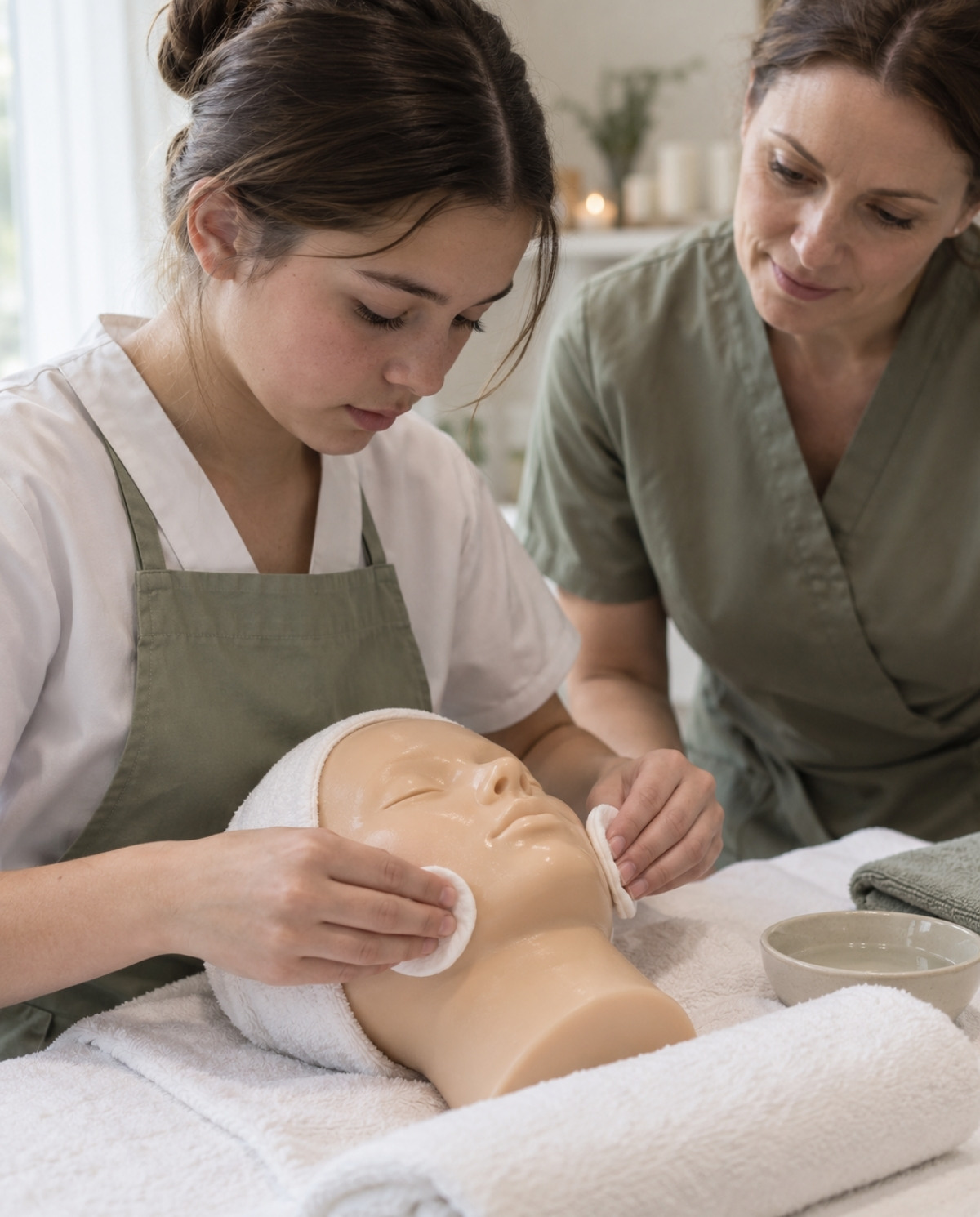
Teenage beauty student practicing gentle facial-cleansing movements on a silicone training mannequin under instructor supervision.

Cosmetology education extends beyond basic haircuts and color applications. Students generally study haircutting, hairstyling, chemical services, sanitation, client safety, and salon procedures, along with introductory skin and nail services. The time assigned to each subject depends on the state-approved curriculum and the individual program.

Georgia’s required curriculum offers one example of how the training may be structured. Under the Georgia State Board’s cosmetology curriculum, a 1,500-hour master cosmetology course begins with 250 hours of Level 1 instruction. Students must complete those hours before performing clinical services on clients. This stage includes theory, mannequin-based instruction, and introductory training in skin and nail care.

Someone primarily interested in facials, skin analysis, hair removal, makeup, or spa services should compare general cosmetology with a dedicated esthetician program. Georgia, for example, has a separate 1,000-hour esthetician curriculum with concentrated education in skin sciences, facial services, hair removal, makeup, client records, professional practices, and business operations.

A similar distinction applies to nail services. General cosmetology introduces nail care, whereas a nail technology program devotes more focused training to nail procedures, sanitation, products, tools, and service application.

Completing a specialty course or receiving a training certificate does not automatically enlarge a person’s legally permitted scope of practice. Advanced exfoliation, lasers, injections, medical devices, and treatments of medical conditions may fall outside a cosmetologist’s or esthetician’s license. The answer depends on the service, state law, and whether medical supervision or another professional license is required.

Beauty education may also introduce client communication, appointment scheduling, retail sales, recordkeeping, marketing, sanitation procedures, and salon management. These subjects can prepare students for entry-level salon employment and possible independent work after they have gained the necessary qualifications and experience.

Operating a salon, booth, or private suite may require more than an individual cosmetology license. Depending on the jurisdiction and business model, a professional may also need an establishment license, business registration, insurance, local permits, and compliance with facility regulations.

Employment projections help explain interest in specialized beauty occupations. According to the U.S. Bureau of Labor Statistics Skincare Specialist Report, employment of skincare specialists is projected to grow 9% from 2025 to 2035, compared with 3% for all occupations. BLS also projects approximately 14,200 openings for skincare specialists each year, on average, during that period. Many of those openings are expected to result from workers transferring to other occupations or leaving the labor force, rather than from the creation of 14,200 entirely new positions every year.

Independent work is common across the broader beauty field. A 2022 policy submission from the American Association of Cosmetology Schools, using 2020 industry data, reported that 33% of workers in personal appearance occupations were self-employed, compared with 6% of the overall workforce. Because the data covers the wider industry and is not specific to teenagers or new graduates, it should not be interpreted as evidence that one-third of recent graduates immediately become successful independent professionals.

How to Prepare Before Finishing High School

Students can use the following process to explore early training without losing sight of their high school responsibilities:

  1. Visit the official website of the state cosmetology board and confirm the separate requirements for entering school, beginning an apprenticeship, taking examinations, and receiving a license.
  2. Ask a high school guidance counselor about CTE programs, regional technical centers, shared credits, and concurrent-enrollment partnerships.
  3. Confirm how the beauty courses will appear on the high school transcript and whether they count toward elective, vocational, or other graduation requirements.
  4. Tour local state-approved beauty programs and ask whether their age requirements and available schedules accommodate current high school students.
  5. Request a complete list of required documents, which may include an official transcript, government-issued identification, proof of age, and parent or guardian forms.
  6. Verify that both the school and the specific program are approved by the cosmetology board in the state where the student will earn the hours.
  7. If moving to another state is possible, ask both state boards how they handle partially completed out-of-state education. Transferring student hours is different from transferring an active license through endorsement or reciprocity.

State-board approval and institutional accreditation are separate matters. Board approval determines whether a program is authorized to provide education leading toward state licensure. Accreditation may affect educational oversight and eligibility for federal financial aid, but accreditation alone does not guarantee that a licensing board or another state will accept the completed hours.

What You Should Know Before Starting

Teenage cosmetology applicant and parent reviewing education records with an admissions adviser at an office table.

  • Training May Begin Before High School Graduation: Certain states allow teenagers to enter approved cosmetology programs before receiving a diploma. Minimum age, completed grade level, and licensing conditions depend on the state and school.
  • CTE Pathways Can Lower Costs or Shorten Later Training: Career and Technical Education and concurrent-enrollment partnerships may cover part of the tuition or allow students to earn recognized clock hours. The actual funding and number of accepted hours vary by program.
  • Admission and Licensure Are Separate Milestones: Being old enough to enroll does not necessarily mean a student is eligible to take the licensing examinations or receive a professional license.
  • Cosmetology Includes Several Areas of Beauty: Programs commonly cover hair services, basic skin and nail care, sanitation, client protection, and salon operations. Students primarily interested in skin or nail services should also compare specialized esthetics and nail technology programs.

Starting early can make a meaningful difference when you already know that your interests lie in hairstyling, skin care, or the beauty industry. Although many teenagers assume they must wait until they receive a high school diploma, some approved pathways allow students to begin training or earn licensing hours sooner.

Before choosing a program, you need to understand its admission standards, your state’s licensing rules, and how vocational training will fit alongside your remaining high school requirements. You should also confirm that the program is approved and that its hours will count toward licensure.

Minimum Ages and Education Rules for Cosmetology Students

Age and education requirements for entering cosmetology training are not uniform throughout the United States. State licensing boards establish minimum qualifications for education, examinations, apprenticeships, and professional licenses. Individual schools can then adopt admission requirements that are stricter than the state’s baseline rules.

This distinction matters because school admission, starting approved training, registering as an apprentice, taking licensing examinations, and receiving a license are separate stages. A state may allow training to begin at 16 while requiring applicants to reach another age, complete a specified level of education, and finish all required hours before becoming licensed.

In several states, the minimum age falls between 16 and 18. Some states accept completion of the 10th grade instead of requiring a full high school diploma for particular licensing pathways. For example, the South Carolina Board of Cosmetology requires cosmetologist applicants to be at least 16, possess at least a 10th-grade education or its equivalent, and complete 1,500 hours at a board-approved cosmetology school. Applicants must also pass written and practical examinations.

The Alabama Board of Cosmetology and Barbering requires examination candidates to be at least 16 and submit documentation showing completion of the 10th grade or higher.

California uses a different structure. According to the California Board of Barbering and Cosmetology, cosmetology examination applicants generally must be at least 17 and have completed the 10th grade. Its apprenticeship pathway may begin at 16 after completion of the 10th grade or its equivalent. This is one reason students should not assume that the minimum age for starting training is also the minimum licensing age.

For additional information about admission qualifications, read our guide explaining who can enroll in cosmetology school and which requirements may apply. The Natural Healers Cosmetology Licensing Guide also provides a general overview, but current requirements should always be confirmed with the official board in the state where you intend to train and work.

State-specific examples show how widely these standards can differ. Under Arkansas cosmetology law, a student generally must be at least 16 and have completed two years of high school or its equivalent. Since regulations and administrative procedures may change, prospective students should verify the latest requirements through the Arkansas Department of Health Cosmetology Section and their intended school.

Georgia also distinguishes between entering training and qualifying for professional registration. Under Georgia Code § 43-10-14, an individual who is at least 16 may learn cosmetology under a qualified instructor at a cosmetology school or through a registered apprenticeship.

However, Georgia Code § 43-10-9 generally requires master cosmetologist applicants to be at least 17, possess a high school diploma, state-approved high school equivalency diploma, or postsecondary or college degree, complete the required course of study or apprenticeship, and pass both the required written and practical examinations. A private school may enforce stricter admission standards than the state’s minimum training age.

If you may study or work in another state, review our overview of cosmetology licensing requirements across different states. Remember that transferring unfinished student hours is different from transferring an active professional license through endorsement or reciprocity.

Is Cosmetology School Available to Students Younger Than 18?

It may be possible, depending on state law and the chosen institution. Because minors generally cannot enter every enrollment or financial arrangement independently, schools commonly ask a parent or legal guardian to sign contracts, payment agreements, consent forms, or liability documents. The required paperwork varies by institution and location.

Students may need to present proof of age and an official transcript verifying completion of the required grade level. A private school may still require a high school diploma or recognized equivalent even when state rules permit training at a younger age.

Attending classes is also different from becoming eligible for licensure. A state may allow a minor to accumulate approved training hours but require further education, program completion, or a higher minimum age before licensing. Depending on the jurisdiction, applicants may need to pass a written examination, a practical examination, or both.

California is one notable exception to the practical-examination model. Effective January 1, 2022, the state stopped requiring a practical examination for its license types, according to the California Board’s examination information. Candidates currently need to pass the applicable written examination.

Ways High School Students Can Begin Beauty Training

Students looking for cosmetology classes during high school may encounter several types of programs. Possibilities include district-operated cosmetology courses, regional Career and Technical Education centers, concurrent enrollment with a technical college, private state-approved beauty schools, and registered salon apprenticeships in states where that route is authorized.

Some public school districts work with regional CTE centers or technical colleges. Students may divide the school day between their regular academic subjects and vocational instruction. For example, they might complete English, mathematics, science, and other graduation courses at their high school before attending practical training in a cosmetology lab.

The number of licensing hours available through these pathways differs significantly. The Technical College of the Rockies High School Cosmetology Program, for example, provides 1,211 hours through a four-semester, half-day concurrent-enrollment program. Its combined published costs for the 2026–2027 school year exceed $10,000, showing that a high school cosmetology program is not automatically free.

Funding depends on the state, school district, technical college, and individual partnership. Public CTE or dual-enrollment funding may subsidize tuition in some programs. Other programs may require students and families to pay for tuition, kits, textbooks, uniforms, registration, transportation, and licensing examinations. Requesting a written cost breakdown can help families identify which expenses are covered and which remain their responsibility.

Private beauty schools may be another option when their admission requirements and schedules are compatible with high school attendance. Evening, weekend, part-time, and year-round classes are not available at every institution. Private schools may also establish their own minimum age and education requirements within applicable state law.

To understand how different schedules affect completion time, see our guide to cosmetology program hours, schedules, and graduation timelines.

Before choosing an early-training pathway, ask:

  • Are both the school and the specific program approved by the state cosmetology board?
  • Will every completed hour appear on an official transcript recognized by the board?
  • How many licensing hours can the student finish before high school graduation?
  • Who is responsible for tuition, kits, books, uniforms, transportation, registration, and examination fees?
  • What happens to completed hours if the student transfers schools or moves to another state?
  • Can the student still complete every academic requirement for high school graduation?
  • How much additional cosmetology training will remain after high school?

What Modern Teen Cosmetology Programs Teach

Two teenage classmates practicing a cosmetology client consultation while an adult instructor observes their communication.

Cosmetology education extends beyond basic haircuts and single-process color. Programs commonly include hair cutting, styling, chemical services, sanitation, infection control, client safety, and salon procedures. Students may also receive introductory instruction in skin and nail services, although the number of hours devoted to each subject depends on state rules and the individual program.

Georgia’s required curriculum provides one example. Under the Georgia State Board’s cosmetology curriculum, the 1,500-hour master cosmetology course begins with 250 hours of Level 1 training. Students must complete this stage before performing clinical services on clients.

Those first 250 hours consist primarily of theory and mannequin instruction. They also include 15 hours of skin-care instruction and 10 hours of nail-care instruction, illustrating that a general cosmetology program introduces these areas without concentrating on them as extensively as a specialized program.

Students primarily interested in facials, skin analysis, hair removal, makeup, or spa services should compare cosmetology with a dedicated esthetician pathway. Georgia maintains a separate 1,000-hour esthetician curriculum focused more heavily on skin sciences, facial services, hair removal, makeup, client records, professional practices, and spa or salon operations.

A similar distinction applies to nail technology. General cosmetology training may introduce manicuring and nail care, while a dedicated nail technology program provides more concentrated instruction in nail services, product use, sanitation, and service procedures.

Completing an advanced class or receiving a specialty certificate does not automatically enlarge a person’s legal scope of practice. Services involving advanced chemical exfoliation, lasers, injections, medical devices, or medical treatment may fall outside the authority of a cosmetologist or esthetician. Applicable restrictions depend on the service, state law, and whether medical supervision or another professional license is required.

Beauty education may also introduce business skills such as client communication, appointment scheduling, retail sales, recordkeeping, marketing, and salon management. These subjects can support entry-level employment and prepare graduates to consider independent work later.

Operating a salon or private suite may require more than an individual cosmetology license. Depending on the location and business model, the owner may need an establishment license, business registration, insurance, local permits, and other approvals.

Employment projections help show why specialized beauty services continue to attract interest. According to the U.S. Bureau of Labor Statistics Skincare Specialist Report, employment of skincare specialists is projected to grow 9% from 2025 to 2035, compared with 3% for all occupations. BLS also projects approximately 14,200 openings for skincare specialists each year, on average, during that period.

Many of those openings are expected to result from workers transferring to other occupations or leaving the labor force. Therefore, the figure should not be interpreted as 14,200 entirely new positions being created every year.

Independent work is common across the broader beauty sector. A 2022 policy submission from the American Association of Cosmetology Schools, based on 2020 industry data, reported that 33% of workers in personal appearance occupations were self-employed, compared with 6% of the overall workforce.

Because those figures represent older, industry-wide data, they should not be treated as proof that a teenager or newly licensed graduate will immediately be ready for self-employment.

How to Prepare for Beauty School Before Graduating

A clear preparation process can help students explore beauty education without interfering with high school completion.

  • Visit the official website of your state cosmetology board and check the separate requirements for beginning school, registering as an apprentice, taking examinations, and receiving a license.
  • Meet with your high school guidance counselor to ask about CTE programs, technical centers, shared-credit arrangements, and concurrent enrollment with nearby cosmetology programs.
  • Confirm how vocational courses will appear on your high school transcript and whether they satisfy elective, vocational, or other graduation requirements.
  • Tour approved beauty schools and ask whether their available daytime, evening, weekend, or part-time schedules can accommodate high school attendance.
  • Prepare any required official transcripts, proof of age, government-issued identification, and parent or guardian forms.
  • Verify that both the institution and the selected program are recognized by the cosmetology board responsible for accepting the training hours.
  • If you may move to another state, ask both boards how partially completed out-of-state student hours are evaluated.

State-board approval and institutional accreditation are not the same thing. Board approval determines whether a program qualifies students for that state’s licensing pathway. Accreditation may affect educational oversight or eligibility for federal financial aid, but accreditation by itself does not guarantee that another state will accept the completed hours.

Common Questions About Beginning Cosmetology Training Early

Will high school cosmetology hours transfer if I move?

Not automatically. The receiving state may compare your education and curriculum with its requirements, request an official transcript sent directly by the school, or require additional training hours. Contact both boards before moving and ask specifically about transferring partial out-of-state education rather than transferring an active professional license.

Can a high school student receive federal financial aid for cosmetology school?

Students who are still enrolled in high school generally cannot receive federal Title IV aid, including Pell Grants, for concurrent cosmetology-school enrollment. Other possibilities may include district CTE funding, state or local dual-enrollment assistance, institutional scholarships, or private funding. Eligibility and available support vary, so families should request a written explanation of costs and funding options.

Could beauty classes affect future four-year college admission?

Not automatically. Cosmetology or CTE courses may satisfy elective or vocational credits, but students must still complete the academic courses required for high school graduation and admission to their intended colleges. Postsecondary cosmetology credits may transfer only as electives or may not apply toward a four-year degree, so students should review their plans with a guidance counselor.

What changes when a student turns 18 during the program?

After turning 18, a student can generally sign their own enrollment and scheduling documents without a parent or guardian. Turning 18 does not automatically establish licensing eligibility. The student must still meet all applicable education, training, examination, and application requirements.

How should I evaluate a high school cosmetology program?

Compare the number of board-recognized hours with the program’s full cost, schedule, high school graduation requirements, and the training that will remain afterward. A low-cost option may provide little value if its hours are not recognized or must be repeated later.

Plan Your Next Step in the Beauty Industry

Starting your research during high school can give you more time to understand licensing requirements, compare legitimate training routes, and prepare for professional beauty education.

Aiken School of Cosmetology and Barbering currently requires applicants to be at least 18 years old and possess a high school diploma or GED. Students who have not yet met those requirements can use this time to research the profession, complete high school, and prepare the documents needed for future enrollment.

Once you meet the school’s admission requirements, visit our Enrollment page or contact our admissions team to learn about available programs, schedules, campus tours, and upcoming start dates.

Can You Become a Licensed Cosmetologist Without Attending Beauty School?

Main Points to Remember

  • Licensing Is Controlled by Each State: The United States does not issue a federal cosmetology license. Depending on the state, applicants may qualify through an approved school, a registered apprenticeship, or another pathway recognized by the licensing board.
  • Salon Training Can Take Longer: Apprenticeship requirements may substantially exceed school requirements. Georgia requires 3,000 apprentice hours instead of 1,500 school hours. California requires 3,200 hours of on-the-job training plus 220 hours of related instruction, compared with 1,000 hours at an approved school.
  • Testing Outcomes Are Not Consistent: Certain California reports have recorded lower written-exam pass rates for cosmetology apprentices than for school-trained applicants. These figures vary by reporting period, examination, license category, language, and candidate group.
  • Moving Between States Requires Research: Apprenticeship training does not automatically prevent license transfer, but a destination state may consider your license status, education, examinations, employment history, or documented training before granting a license.
  • Online Courses Have a Limited Role: An approved hybrid program may offer theory instruction online, but online coursework alone generally cannot replace the supervised practical training required for initial cosmetology licensure.

Starting a career involving hair, skin, and nails can be exciting, but tuition expenses and demanding schedules may make traditional training difficult for some students. It is understandable to look for a more affordable or flexible path into the beauty industry.

Training in a salon may be an option, but it does not eliminate education, supervision, or licensing requirements. Whether you can use an apprenticeship instead of attending beauty school depends on the laws of the state where you plan to become licensed.

When Beauty School Is Not the Only Legal Route

Cosmetology apprentice blow drying a client’s hair while a supervising stylist corrects the position and angle of the round brush.

Cosmetology licensing is handled separately by each state. State boards establish the services covered by each license, the required training hours, examination rules, approved education providers, and any alternative routes to eligibility.

Before committing to a program, review the applicable cosmetology license requirements by state. The licensing authority in the state where you intend to work ultimately decides whether your training qualifies you to take the required examinations.

Completing a state-approved cosmetology program remains the standard route. Some states also recognize registered apprenticeships completed under qualified supervision. Availability, registration procedures, required hours, approved occupations, and supervision standards differ considerably.

Georgia and Arkansas illustrate these differences:

Therefore, learning how to get a cosmetology license without school does not mean entering the profession without regulated training. In a state that recognizes apprenticeships, it means completing the required education and practical experience through an approved workplace-based program.

What Salon-Based Cosmetology Training Involves

A cosmetology apprenticeship allows a candidate to receive supervised training in an operating salon rather than completing most instruction in a school classroom and student clinic.

An apprenticeship should not be confused with an ordinary salon-assistant position. Depending on state rules, the apprentice, supervising professional, salon, and program sponsor may need to be registered or approved before hours can count toward licensure. Work completed before the required registration is active may not receive credit.

Apprenticeship programs can also include formal instruction away from the salon floor. The California Board of Barbering and Cosmetology, for example, requires at least 3,200 hours of on-the-job training over two years. Cosmetology apprentices must additionally complete at least 220 hours of related instruction supplied by the approved program sponsor.

Skills You Can Develop in an Operating Salon

Salon-based training provides direct exposure to the routines of a working beauty business. Apprentices may observe how appointments are organized, consultations are conducted, services are timed, products are recommended, and client concerns are handled.

Depending on the applicable regulations and the apprentice’s stage of training, approved services may be performed under the level of supervision required by the state and program.

The U.S. Department of Labor describes registered apprenticeship as a model that combines paid on-the-job training with classroom instruction. A legitimate registered apprenticeship may therefore allow participants to earn wages while developing occupational skills. Actual wages, schedules, benefits, fees, and employment conditions depend on the employer, program, and applicable laws.

Problems Prospective Apprentices Should Consider

The quality of workplace training can depend heavily on the program sponsor, curriculum, salon environment, and supervising professional. Technical talent does not automatically make someone an effective instructor, and a busy salon may not always provide lessons as predictably as a structured school.

Routine workplace duties also should not be mistaken for approved instruction. Cleaning stations, preparing supplies, and observing appointments may be part of salon operations, but licensing boards commonly require documented training across designated subjects and services.

Exam preparation is another important consideration. Candidates may need knowledge of infection control, anatomy, product safety, chemical services, hair and scalp conditions, skin and nail fundamentals, client protection, and state law. Before enrolling, applicants should determine how these subjects will be taught and how the program will prepare them for licensing examinations.

Questions to ask a prospective program include:

  • Which parties must receive approval before my training hours can begin?
  • Who maintains my practical and theory records?
  • How frequently are completed hours submitted to the licensing authority?
  • What happens to my records if the trainer leaves or the establishment closes?
  • Can documented hours continue with another approved salon or program?
  • How will sanitation, chemical safety, theory, and state regulations be taught?
  • Are textbooks, scheduled classes, or examination-preparation materials included?
  • Which wages, instructional charges, registration costs, examination fees, and tool expenses apply?
  • How much of the weekly schedule is assigned to recognized training activities?

Procedures for changing trainers or establishments vary by jurisdiction. Georgia, for example, requires a new application when an apprentice changes the supervising professional or salon. A notarized transcript of accumulated hours must also be submitted within the required period. Georgia does not allow apprentice hours to be combined with school hours.

Interpreting Apprentice Examination Statistics

Official reports from certain periods indicate that apprentices can experience different written-examination outcomes from school-trained applicants. However, the results must be read within their original scope.

In one collection of California Board apprenticeship meeting materials, cosmetology apprentices recorded lower written-exam pass rates than school-trained candidates during the periods examined. The results were not identical across years, examinations, occupations, languages, or candidate groups.

These statistics do not establish a permanent pass rate for California and cannot be treated as a national apprenticeship average. They also do not identify the reason for the difference. The data alone cannot prove that salon training caused deficiencies in theory, chemistry, sanitation, or examination preparation.

Before choosing a sponsor, ask for recent program-specific results and determine whether the reported figures cover first-time candidates, all examination attempts, or a limited group. Our cosmetology state board exam checklist provides additional information about written and practical testing.

How Online Education Fits Into Cosmetology Licensing

Students balancing employment, childcare, or other responsibilities may look for online cosmetology options. Distance learning can make parts of a program more accessible, but it should not be mistaken for a complete licensing route.

Working adult completing an online cosmetology lesson before practicing hairstyling techniques on a prepared mannequin head.

Subjects That May Be Offered Remotely

Some state-approved schools provide hybrid programs that deliver a portion of their theory curriculum online. Depending on the program and state rules, distance-learning subjects may include anatomy, infection control, chemistry, product knowledge, business practices, and professional regulations.

Online hours count only when they are part of a program accepted by the relevant licensing authority. Documentation requirements vary, but an approved school may need to monitor participation, completed coursework, assessments, attendance, or other evidence required by the state.

Before paying for a hybrid program, confirm that:

  • The school and program are approved by the appropriate licensing authority.
  • Graduates of that particular program qualify for the required licensing examinations.
  • The state permits the advertised portion of the curriculum to be delivered remotely.
  • The program provides all required supervised practical instruction.
  • The curriculum satisfies the rules of the state where you plan to apply.

Training That Still Requires Supervised Practice

Cosmetology requires practical experience with sanitation procedures, client protection, tools, hair cutting, styling, chemical applications, and other services within the state’s legal scope of practice.

A standalone online certificate should not be treated as a cosmetology license or as evidence that a candidate completed an approved licensing program. Unless a licensing authority expressly recognizes another arrangement, practical training must be completed through an approved school, registered apprenticeship, or other authorized pathway.

Online beauty courses may still provide legitimate continuing education, product instruction, business education, or test preparation. Their certificates, however, do not automatically authorize someone to perform regulated cosmetology services.

Before enrolling, ask the state board whether the exact provider and course qualify applicants for initial licensure. Marketing terms such as “accredited,” “internationally certified,” “professional certification,” or “board-ready” do not by themselves establish licensing eligibility.

Comparing the Time Needed for Each Path

Entering a salon immediately does not necessarily mean becoming licensed sooner. The time required depends on the state’s minimum hours, weekly schedule, registration rules, attendance, and any mandatory calendar period.

A full-time school program is often the more direct route because its schedule is organized around completing approved hours. Depending on the jurisdiction and weekly timetable, full-time cosmetology school may take approximately 8 to 15 months. Part-time attendance, absences, holidays, closures, scheduling changes, and transfer problems can extend that timeline.

Our guide to cosmetology school schedules and graduation timelines explains how weekly attendance affects the projected completion date.

Apprenticeship requirements are not identical nationwide. In the two examples discussed above, Georgia requires 3,000 hours over at least 18 months, while California requires 3,200 on-the-job hours over two years plus 220 hours of related instruction. Both require considerably more training time than their respective school routes.

Individual circumstances can still change the comparison. Someone attending school only a few hours per week could take longer than an apprentice following a consistent full-time schedule. Nevertheless, where school requires fewer hours, a full-time approved program is often the shorter route to examination eligibility.

What Happens When You Seek a License in Another State

Cosmetology licenses do not transfer through one uniform national system. States use terms such as reciprocity, endorsement, transfer, and examination differently, and their evaluation procedures are not identical.

A license originally earned through apprenticeship does not automatically prevent relocation. Depending on the destination state’s rules, its board may consider:

  • Whether the existing license is current and free from disciplinary restrictions.
  • The type and amount of education or apprenticeship training completed.
  • The written or practical examinations previously passed.
  • The applicant’s documented experience as a licensed cosmetologist.
  • Whether the original jurisdiction’s requirements are considered comparable.
  • Whether additional education or a state-law examination is required.

Not every state reviews these factors in the same way. Some place greater emphasis on active licensed experience, while others compare the applicant’s original training and examination requirements with their own standards.

Anyone trained through an apprenticeship should retain copies of the original registration, curriculum, hour reports, related-instruction records, examination results, employment history, and license verification.

The Cosmetology Licensure Compact is being developed to make authorized practice across participating states easier. According to the official Cosmetology Compact website, multistate licenses are not yet being issued.

Once multistate licensing becomes available, applicants are expected to need an active, unencumbered license in the compact state where they primarily reside, along with satisfaction of the applicable application conditions and fees. Each participating state continues to determine its own initial education, training, and examination standards. The Compact does not create one nationwide hour requirement or make eligibility exclusive to school-trained cosmetologists.

If relocation is likely, investigate the destination state’s current endorsement requirements before selecting either pathway.

Looking Beyond the Advertised Tuition

Prospective cosmetologist discussing school and salon apprenticeship pathways with an adviser at a quiet consultation table.

Reducing tuition is a common reason for considering apprenticeship. Although paid training may offset some expenses, an apprenticeship should not automatically be considered free.

Possible expenses include:

  • Apprentice registration and permit charges.
  • Required related instruction or online modules.
  • Books and examination-preparation materials.
  • Tools, products, uniforms, and protective supplies.
  • Testing and initial-license application fees.
  • Transportation and childcare.
  • Additional education after changing programs or relocating.

Before signing an agreement, obtain a written explanation of wages, instructional charges, tools, registration expenses, refund terms, and weekly scheduling expectations. Also verify whether the arrangement is a recognized paid apprenticeship, how compensation is calculated, and whether you will be classified as an employee.

School expenses may include tuition, application fees, kits, books, transportation, and living costs during training. Students in an eligible program at a participating institution may qualify for federal student aid, but accreditation alone does not guarantee Pell Grants or federal loans.

The institution must participate in the applicable federal-aid programs, the specific course of study must be eligible, and the student must satisfy individual eligibility requirements. The official Federal Student Aid school search can help identify institutions with federal school codes. Students should still confirm program eligibility with the school’s financial-aid office.

A standalone salon apprenticeship generally does not provide Pell Grants or federal student loans in the same manner as an eligible school program. Depending on the apprentice and program, other support could include employer assistance, workforce funding, veterans’ benefits, or scholarships.

A complete cost comparison should include:

  • Tuition or related-instruction charges.
  • Books, tools, uniforms, registration, examination, and licensing expenses.
  • Transportation and childcare costs.
  • Expected wages and the conditions attached to those wages.
  • The projected number of months before full licensure.
  • Available grants, scholarships, employer benefits, or workforce assistance.
  • Possible additional training costs after moving to another state.

Deciding Which Option Matches Your Situation

The right route depends on your state’s laws, financial circumstances, schedule, learning preferences, and access to a legitimate training provider.

A state-approved school may be suitable for students who want an organized curriculum, scheduled theory education, regular instructor access, examination preparation, and a potentially shorter full-time route.

A registered apprenticeship may suit someone whose state permits it, who has found a reputable sponsor and qualified supervisor, who needs paid employment during training, and who learns effectively in an operating salon. Applicants should still consider the longer hours, related instruction, reporting requirements, and procedures that apply when changing trainers or establishments.

Regardless of the pathway, confirm the exact program with the licensing authority before paying fees or beginning work. Statements made by a salon, school, mentor, or online provider cannot replace official licensing requirements.

If you are interested in structured instruction, practical experience, salon-business education, and instructor guidance, Aiken School of Cosmetology and Barbering offers a 1,500-hour Master Cosmetologist program designed to meet South Carolina’s education requirement for licensure. Visit the Master Cosmetologist program page to review the currently listed training information, or submit the contact form to ask the school directly about enrollment and scheduling.