Nail Technician Insurance, Taxes, and Business License Guide for Beginners

Essential Business Factors for Independent Nail Professionals

  • Insurance Protection: General liability commonly addresses accidents involving clients or their property, while professional liability concerns allegations arising from the nail service itself. Product liability may cover injuries connected to products used or sold by the business. Technicians who travel should separately verify coverage for portable equipment.
  • Business Approvals: An individual nail license authorizes professional services, but it does not necessarily authorize every business location or operating model. Salon owners, home-studio operators, and qualifying mobile businesses may also need establishment approval, local registration, zoning clearance, tax accounts, and insurance.

Working independently as a nail professional can provide creative freedom, flexible income opportunities, and room to build a loyal client base. That freedom also comes with responsibilities that are not always obvious during the early stages of a beauty career. Understanding insurance, taxes, and business licensing before accepting clients can protect your income and help you avoid expensive compliance problems.

New students can begin by reviewing a guide to manicuring and nail technology to better understand the services, skills, safety practices, and professional expectations involved in this career.

Match Your Insurance to the Risks in Your Business
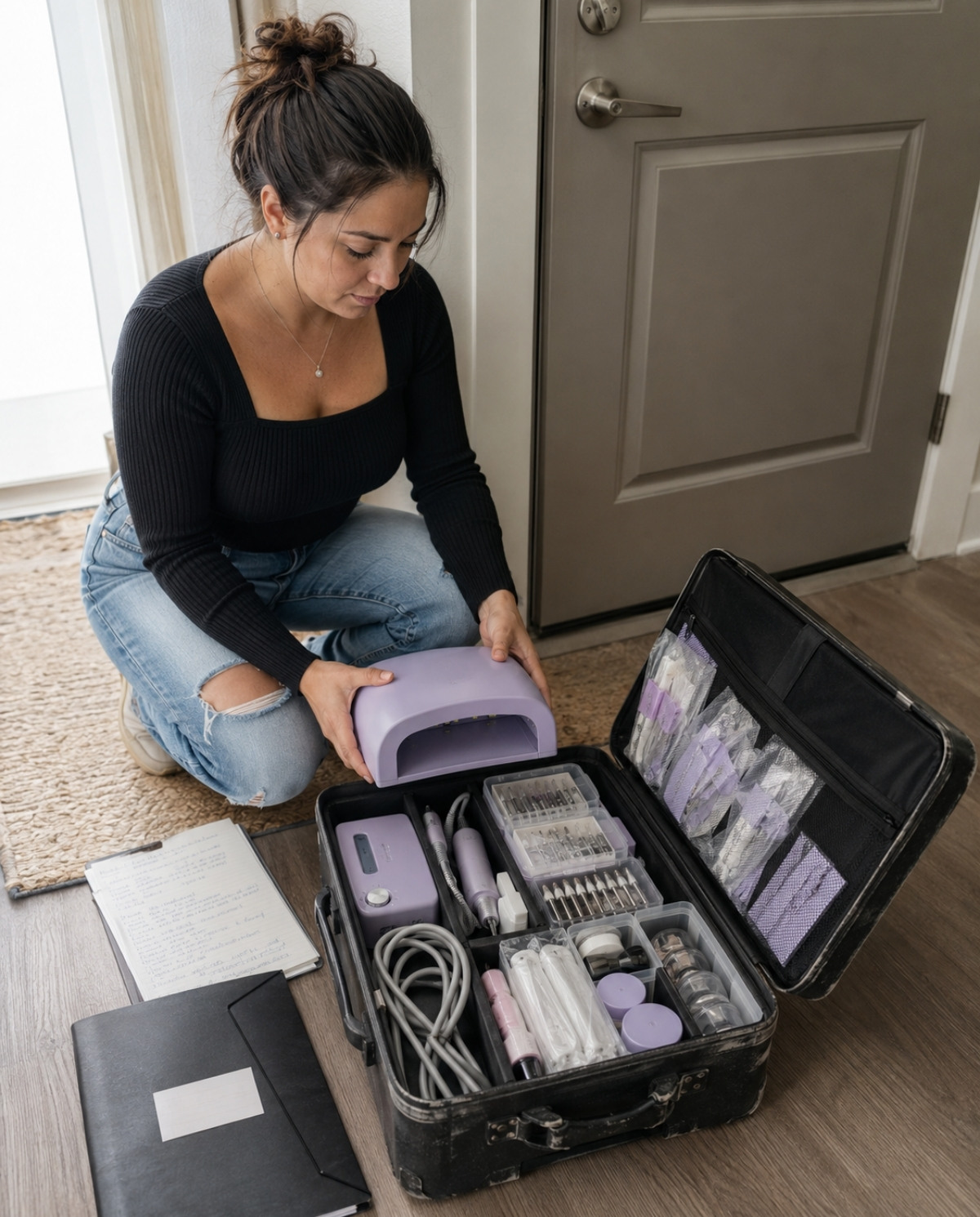
Mobile nail technician packing a worn travel case with a portable curing lamp, compact e-file, drill bits, sealed disposable tools, extension cords, product containers, an equipment inventory, and an insurance folder.

Nail services involve chemicals, electrical equipment, sharp implements, adhesives, artificial enhancements, and close physical contact with clients. Even when sanitation and service procedures are carefully followed, a customer may allege that a treatment caused a burn, allergic response, cut, infection, or damaged natural nail.

Other incidents may have nothing to do with the actual service. A client could fall near a pedicure chair, trip over an electrical cord, or claim that personal belongings were damaged inside the workspace. Insurance can help cover qualifying claims, legal expenses, settlements, or judgments according to the terms of the policy.

There is no single federal rule requiring every nail technician in the United States to carry professional liability insurance. Coverage may nevertheless be required by a salon lease, booth-rental contract, employer, landlord, event organizer, client agreement, state rule, or local regulation. Independent technicians should not assume that insurance is unnecessary simply because their licensing board does not expressly require it.

Three types of liability coverage commonly appear in beauty-professional policies:

  • General Liability: Commonly applies to qualifying third-party bodily injury or property-damage claims that are not caused directly by the professional nail service. Examples may include a customer slipping in the salon, tripping over equipment, or having personal property accidentally damaged at the business.
  • Professional Liability: Sometimes called malpractice or errors and omissions coverage, this addresses covered allegations involving negligent, improper, or incorrectly performed services. Possible examples include an avoidable cut, chemical burn, excessive filing damage, or an infection a customer attributes to the technician’s procedures.
  • Product Liability: May respond when a customer alleges that a product used, supplied, or sold by the business caused an injury. This could involve nail adhesive, primer, polish, cuticle oil, acrylic products, gel products, or another professional preparation.

These coverages are related, but they are not interchangeable. Some insurers combine them in one beauty-professional package, while others provide different limits, deductibles, exclusions, endorsements, and reporting requirements.

The membership policy offered by Associated Nail Professionals, for example, includes general, professional, and product liability protection for eligible members. It also provides occurrence-form coverage, legal defense for covered losses, and options for adding qualifying parties as additional insureds.

With occurrence-form insurance, coverage is generally determined by when the covered incident took place. A qualifying claim may therefore be reported after the policy period as long as the incident occurred while the policy was active and all other conditions are satisfied.

Claims-made insurance usually works differently. It commonly requires the policy to be active when the claim is first made, although exact conditions vary. A technician comparing policies should review the coverage form rather than selecting a plan based only on its premium.

Before purchasing insurance, prepare a complete list of the services you provide or plan to introduce. The policy should be checked for manicures, pedicures, acrylic enhancements, gel systems, e-file use, nail art, artificial tips, product sales, and appointments performed outside the regular salon.

Important questions to ask include:

  • Are professional liability and product liability both included?
  • Does coverage extend to appointments performed in clients’ homes?
  • Can the policy be used while renting space inside another salon?
  • Can a landlord or salon owner be listed as an additional insured?
  • Are legal defense expenses inside or outside the liability limit?
  • Is the policy written on an occurrence or claims-made basis?
  • Are any nail systems, advanced techniques, or products excluded?
  • Does coverage apply to every business location where services are performed?

A certificate of insurance alone does not prove that every service is covered. Read the actual policy terms and disclose your activities accurately when applying.

Estimate Coverage Costs Without Overlooking Your Equipment

Insurance should be included in the operating budget before setting service prices. Premiums can vary according to location, annual revenue, business size, coverage limits, claims history, selected services, number of workers, and the value of insured property.

Based on policy-purchase data published by Insureon, nail professionals and salon businesses purchasing policies through its marketplace have paid approximate median costs of:

  • General Liability: $48 monthly or $579 annually.
  • Professional Liability: $47 monthly or $567 annually.
  • Business Owner’s Policy: $91 monthly or $1,086 annually.

These amounts are purchasing medians, not universal prices or guaranteed quotes. An individual professional-association policy may cost less, while a larger salon with employees, substantial property, high revenue, or additional services may receive a much higher quote.

A Business Owner’s Policy, or BOP, normally combines general liability with commercial property coverage. Depending on its terms, the property portion may protect items such as manicure tables, salon furniture, lamps, computers, retail inventory, and equipment kept at the insured premises.

A basic BOP should not be assumed to include:

  • Professional liability coverage.
  • Workers’ compensation.
  • Commercial auto insurance.
  • Coverage for every item transported away from the salon.
  • Protection for all off-site services.

Technicians who visit clients have additional property risks. General liability may address qualifying accidents occurring at an off-site appointment, and professional liability may address qualifying service-related allegations. Neither one automatically protects the technician’s own lamp, e-file, gel collection, tools, or travel case against theft or physical damage.

Commercial property insurance is generally centered on property at the insured business location. By comparison, inland marine insurance is designed for movable business property that travels, remains temporarily at another location, or is stored away from the primary premises.

A mobile nail professional should ask whether equipment is protected:

  • During transportation to and from appointments.
  • While temporarily kept in a vehicle.
  • While inside a customer’s residence.
  • At pop-up events, weddings, hotels, or temporary workspaces.
  • Against covered theft, fire, vandalism, and accidental damage.

Inland marine insurance is not compulsory for every technician. It becomes relevant when the regular property policy does not adequately cover equipment outside the listed business address.

Commercial auto insurance serves a different purpose. It may insure a vehicle used for business under the conditions of that policy, but vehicle coverage should not be treated as automatic protection for every tool, product, or piece of equipment stored inside the vehicle.

Create a Reliable System for Income, Expenses, and Tax Payments
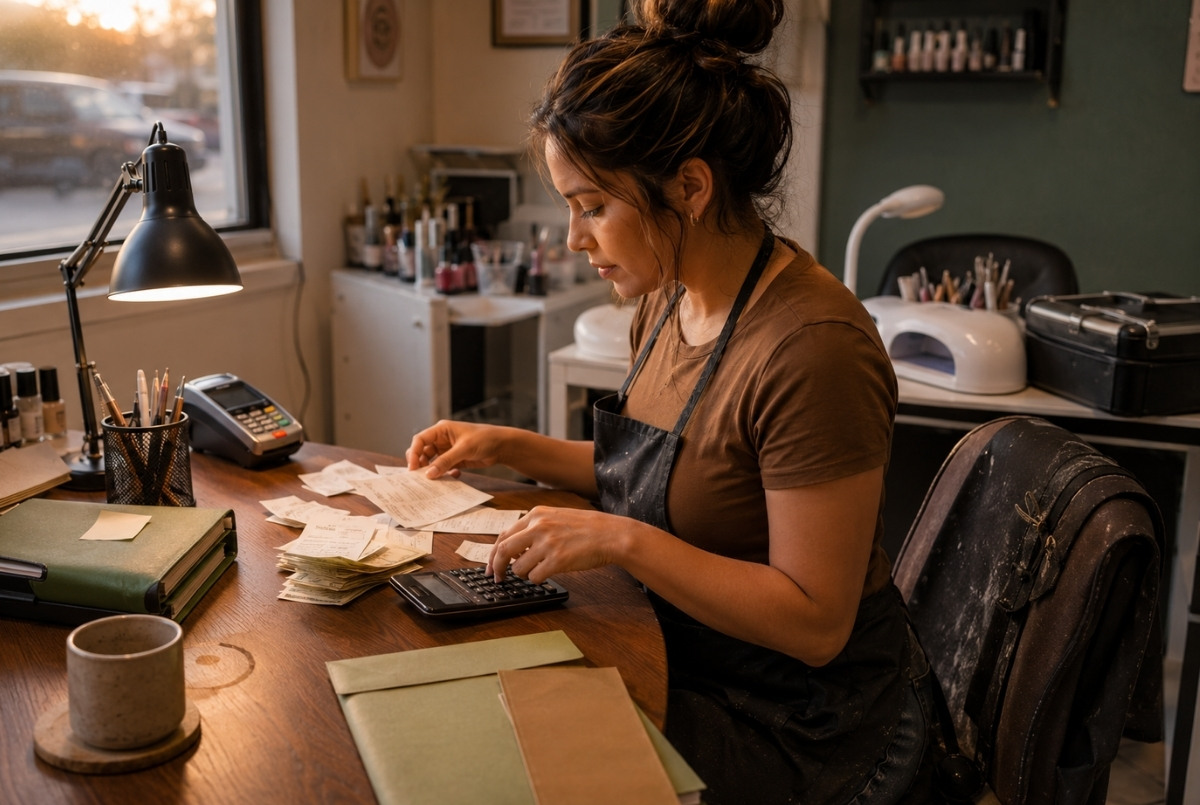
Independent nail technician reconciling card payments, cash tips, appointment records, supplier receipts, business envelopes, and a calculator at a desk after closing her manicure booth.

Independent nail professionals generally report service revenue and tips as business income. Good tax management begins with complete records rather than waiting until the annual filing deadline.

The IRS rules for recording and reporting tips require self-employed workers to include tips in their gross business receipts. For many sole proprietors, this income is reported on Schedule C together with other business revenue.

Depending on the person’s location and financial circumstances, taxes may include:

  • Federal income tax.
  • Self-employment tax.
  • State income tax.
  • Local income or business taxes.
  • Sales tax collected on taxable retail products.

Saving approximately 25% to 30% of weekly net profit can be a practical budgeting habit for some independent technicians. It is not an official tax rate, and it will not be appropriate for every taxpayer.

The amount that should actually be reserved depends on business profit, deductions, credits, filing status, state rules, household income, and other tax circumstances. Technicians can consult the IRS estimated-tax guidance and Form 1040-ES instructions or work with a qualified tax professional.

Business deductions can reduce taxable profit when expenses are ordinary, necessary, properly documented, and otherwise allowed under the applicable tax rules. Potential nail-business expenses may include:

  • Consumable Products: Gel polish, acrylic systems, nail tips, forms, gloves, wipes, files, buffers, e-file bits, disinfectants, and other supplies used for client services.
  • Tools and Property: Curing lamps, e-files, dust collectors, manicure tables, pedicure equipment, computers, storage units, and salon furniture. Some purchases may need to be depreciated or recovered through another permitted deduction method instead of being fully deducted immediately.
  • Workspace Expenses: Booth rent, studio rent, qualifying utility contributions, business insurance, license renewal charges, and payment-processing fees.
  • Marketing and Operations: Business cards, websites, scheduling platforms, professional photography, advertising, business phone costs, and qualifying software subscriptions.
  • Eligible Continuing Education: Training that maintains or improves skills used in an existing nail business may qualify. Under the IRS work-related education rules, education generally does not qualify when it satisfies minimum entry requirements or prepares the taxpayer for a new trade or business.
  • Eligible Business Travel: Travel to a professional convention, trade show, or qualifying educational event may be deductible when it meets the IRS requirements for business travel. Personal travel and normal commuting are subject to different rules.

Maintain organized copies of:

  • Purchase receipts and supplier invoices.
  • Appointment and sales records.
  • Cash-tip logs.
  • Credit-card and payment-platform reports.
  • Business bank statements.
  • Mileage and travel records.
  • License, education, insurance, and rental documents.

A deduction lowers the amount of business profit subject to tax. It does not mean the government refunds the full amount spent.

Know What the Federal Tip Deduction Does and Does Not Cover

Industry resources published by Paul Mitchell Schools and Aveda Arts have discussed the federal deduction for workers who customarily receive tips.

The current IRS explanation of the tip deduction states that eligible employees and self-employed individuals may deduct up to $25,000 in qualified tips for tax years 2025 through 2028.

The official IRS list of qualifying tipped occupations includes manicurists and pedicurists, including nail technicians.

The deduction has several important limits:

  • Only qualified voluntary tips are included. A compulsory service charge is not treated as a qualifying tip for this purpose.
  • Tips must still be recorded and reported as income.
  • The maximum deduction is $25,000 for each federal return.
  • A self-employed taxpayer cannot deduct more than the net income earned from the business connected to those tips.
  • The deduction begins to phase out when modified adjusted gross income exceeds $150,000, or $300,000 for married taxpayers filing jointly.
  • A married taxpayer must file a joint return to claim the deduction.
  • The taxpayer must have a Social Security number that is valid for employment.
  • Eligible taxpayers may claim the deduction whether they itemize or use the standard deduction.
  • The deduction does not remove applicable Social Security, Medicare, or self-employment tax from the tips.

The phrase “no tax on tips” should therefore not be interpreted to mean that tips are unreported or completely exempt from every type of tax.

Accurate income records may also help an independent professional document earnings for a rental application, auto loan, mortgage, business financing, or future salon lease. Approval is still controlled by the lender’s or landlord’s individual standards.

Self-employed technicians must separately consider self-employment tax. The basic rate is 15.3%, consisting of:

  • 12.4% for Social Security.
  • 2.9% for Medicare.

Under the IRS self-employment tax rules, the tax generally applies when net self-employment earnings reach at least $400. The calculation usually applies to 92.35% of net self-employment earnings.

The Social Security component is limited by the annual wage base. Medicare tax generally applies to all covered net earnings, and Additional Medicare Tax may apply once the relevant income threshold is exceeded. A self-employed taxpayer may generally deduct the employer-equivalent portion of self-employment tax when calculating adjusted gross income.

Separate Your Professional License From Your Business Permissions

A nail-technician license and a business license do not perform the same function. A practitioner credential authorizes an individual to provide regulated services after meeting the state’s education, examination, and application requirements.

Opening or controlling a business location can trigger additional obligations. The specific approvals depend on the state, city, county, building, business structure, and services offered.

The SBA guide to licenses and permits explains that requirements depend on business activity, location, and applicable government regulations.

A nail business may need a combination of:

  • Individual Practitioner License: Allows the licensed person to perform regulated nail services.
  • Salon or Establishment Approval: Authorizes a regulated salon, qualifying home studio, or approved mobile facility to operate.
  • City or County Registration: May be called a business license, occupational tax certificate, privilege license, or another local registration.
  • Zoning or Occupancy Clearance: May be required before customers can be received at a residential or commercial property.
  • Tax Accounts: May be necessary for business-income reporting, retail sales, payroll, or the collection of sales tax.
  • Entity Registration: May apply when forming an LLC, corporation, or partnership.
  • Trade-Name Registration: May apply when operating under a name different from the owner’s legal name.

An employee normally works under the salon owner’s establishment approval rather than obtaining the owner’s business license personally. A booth renter inside an existing licensed salon may also be able to work under that establishment’s facility license.

That does not necessarily remove the renter’s other responsibilities. The technician may still need an active individual license, tax accounts, local registration, insurance, and compliance with booth-rental or independent-contractor rules.

Before making financial commitments, review a state-focused explanation of nail-technician licensing requirements and confirm the current rules directly with the appropriate licensing agencies.

Compare the Licensing Rules That Apply to Your State

Training hours and facility regulations are established at the state level. Requirements from a neighboring state should not be used as a substitute for the rules where the technician plans to work.

Examples from South Carolina, Georgia, and Arkansas demonstrate how widely the details can differ:

  • In South Carolina, the South Carolina Board of Cosmetology requires a nail-technician applicant to complete 300 hours of classwork at a Board-approved nail school or complete comparable Board-approved training. Applicants must also satisfy the Board’s age and education conditions, pass the NIC written and practical examinations, submit an application, and pay the required fee.
  • In Georgia, the official nail-care curriculum rules require 525 hours of school training. Georgia’s nail-care apprenticeship pathway requires 1,050 hours completed over a minimum period of eight months.
  • A person opening a Georgia salon or qualifying home salon must obtain a separate salon or shop license before beginning operations. The Georgia Board’s licensing FAQ distinguishes the state salon or shop license from a city or county business license.
  • Georgia allows a salon to operate from a residence when state and local requirements are met. The state’s salon facility regulations require the professional area to be properly separated from domestic living space. Mobile units, carts, trailers, and motor homes are not licensed as freely roaming salons unless they meet Board requirements and are permanently anchored at an approved location.
  • In Arkansas, the official Cosmetology and Body Art Rule establishes a 600-hour manicure course. Salon owners must obtain the required establishment approval and complete the applicable inspection process. Arkansas also regulates mobile salons through specific licensing, equipment, sanitation, and facility standards.

South Carolina’s 300-hour requirement is especially relevant to students preparing for a nail career through Aiken School of Cosmetology and Barbering. The school’s Nail Technician program lists 300 training hours and an estimated program length of approximately four months.

Program length and eligibility for licensure are separate considerations. Finishing the required education does not by itself guarantee that every applicant has met the age, education, examination, application, fee, or background requirements imposed by the licensing authority.

Before signing a lease, renovating a residential room, or purchasing a mobile unit, confirm the rules with:

  • The state cosmetology board.
  • The city or county business office.
  • The local zoning and building department.
  • The state tax agency.
  • The property owner or residential association when applicable.

Use a Step-by-Step Launch Checklist

Beginner nail business owner arranging color-coded launch cards on a planning board beside a booth key, calculator, insurance folder, credential sleeve, tax envelope, appointment tablet, reserve jar, and completed manicure station.

The exact order of business and licensing tasks will vary, but a new nail professional can use the following sequence as a general planning framework:

  1. Enroll in and complete the training pathway recognized by the licensing state.
  2. Meet the state’s age, education, examination, and application conditions.
  3. Receive and maintain the required individual practitioner license.
  4. Select a lawful business structure and register a trade name when required.
  5. Open the necessary federal, state, and local tax accounts.
  6. Verify city or county business-registration rules.
  7. Confirm zoning and occupancy requirements for the intended workspace.
  8. Apply for establishment approval when owning or controlling a regulated salon, studio, or mobile facility.
  9. Obtain insurance that matches the services, property, and locations involved.
  10. Establish bookkeeping, tip-reporting, payment, and record-retention procedures.

This is not a single national licensing sequence. Some jurisdictions use different credential names, allow apprenticeship training, require different examinations, or prohibit certain operating arrangements.

A written business plan can help turn these regulatory tasks into a workable financial strategy. It does not need to be a lengthy document. The most useful plan explains who the business will serve, what services it will sell, how much each appointment costs to perform, and how much revenue is needed to cover overhead and taxes.

Include estimates for:

  • Booth rent, studio rent, or salon occupancy expenses.
  • License, registration, inspection, and renewal costs.
  • Insurance premiums.
  • Products and disposable supplies used for each service.
  • Equipment purchases and future replacements.
  • Scheduling and payment-processing fees.
  • Marketing and client-acquisition expenses.
  • Available appointments each week.
  • Expected cancellation and no-show losses.
  • Weekly and monthly revenue goals.
  • Funds reserved for taxes and slower business periods.

Service pricing should account for more than the visible product used during an appointment. Consider preparation time, cleanup, sanitation, product waste, payment fees, rent, insurance, administrative work, taxes, and the technician’s labor.

An active practitioner license does not automatically permit the holder to open a salon in any building, receive clients in any residence, or provide services through any mobile setup.

Operating without required approvals may result in fines, disciplinary proceedings, closure orders, or other consequences under state and local law. It may also cause an insurance dispute when a claim involves an undisclosed location, an unlicensed activity, or a service outside the policy’s stated scope.

Prepare for a Nail Career in South Carolina

Business knowledge is most useful when it is supported by strong technical training and an understanding of professional safety. Students need more than the ability to produce attractive nail enhancements. They must also learn sanitation, infection-control practices, product handling, client communication, service procedures, and the professional standards expected in a salon environment.

Aiken School of Cosmetology and Barbering offers a 300-hour Nail Technician program designed around the education requirement for South Carolina nail-technician licensure.

Students considering a wider range of beauty services can also compare cosmetology and nail technology pathways before deciding which program better matches their career goals.

To review admissions information, request details, or arrange a conversation with the school, visit the Aiken enrollment page or submit the contact form below.

Common Questions About Independent Nail Businesses

Does selling custom press-on nails from an apartment require a salon license?

Selling completed press-on nail sets without applying them to customers is generally closer to operating a retail-product business than providing an in-person nail service. In many jurisdictions, that activity may not require the same salon-establishment license used for client services.

The answer is not universal. A home-based seller may still need:

  • A city or county business registration.
  • A sales-tax permit.
  • Home-occupation or zoning approval.
  • Permission under an apartment lease.
  • Approval under homeowners association rules.

Additional requirements may apply when the business manufactures, repackages, imports, or distributes nail glue, polish, or other cosmetic products. Review the FDA information on nail-care products together with applicable labeling, consumer-product, shipping, and state tax rules.

Before selling, contact the state cosmetology board, state tax agency, and local zoning office. The seller should also review the property agreement governing business activity at the residence.

Will missing an estimated-tax installment automatically create a penalty?

A taxpayer who misses or underpays an estimated-tax installment may owe an underpayment penalty even when the remaining balance is paid with the annual return. The amount generally depends on the size of the underpayment and the length of time it remained unpaid.

Under the IRS estimated-tax penalty rules, many individuals avoid the penalty when:

  • The remaining tax owed is less than $1,000 after withholding and refundable credits are applied.
  • At least 90% of the current year’s required tax was paid on time.
  • At least 100% of the previous year’s tax was paid on time, with a 110% prior-year threshold applying to certain higher-income taxpayers.

A person who had no tax liability for the entire preceding tax year may not need to make estimated payments when all IRS conditions are met. Merely being in the first year of self-employment does not automatically create an exemption. The taxpayer may have had a prior-year tax liability from wages, investments, or another source.

Estimated-tax payment dates normally fall around April 15, June 15, September 15, and January 15 of the following year. A deadline that falls on a weekend or federal holiday generally moves to the next business day.

Must a sole proprietor open a dedicated business bank account?

Federal law does not generally require a person to open a separate bank account solely because the person operates as a sole proprietor. However, separating personal and business funds can make financial management substantially easier.

A dedicated account can help the owner:

  • Track business deposits.
  • Identify deductible expenses.
  • Reconcile card and payment-platform reports.
  • Prepare tax returns.
  • Document business revenue.
  • Pay suppliers and operating expenses.
  • Present more organized records during a financing application or audit.

The SBA business-banking guide recommends opening a business account once the owner begins accepting or spending money through the business.

Financial separation is even more important when operating through an LLC or corporation because accurate records help support the distinction between personal and business activity.

Build the Business Skills That Support Your Creative Work

Insurance, taxation, and licensing may feel less exciting than mastering nail art or enhancement techniques, but these systems help determine whether an independent business remains financially stable.

Appropriate coverage can protect against qualifying claims and property losses. Organized bookkeeping makes it easier to report income, claim eligible expenses, and plan for tax payments. Correct licensing and location approvals help prevent avoidable interruptions to the business.

Professional education provides the foundation for putting those responsibilities into practice. A focused nail program introduces students to more than application techniques. It can help them develop safe work habits, understand sanitation requirements, communicate with clients, and prepare for the licensing process required by their state.

By combining state-recognized education with realistic business planning, new nail professionals can enter the industry with stronger technical skills, clearer financial expectations, and a more responsible path toward self-employment.
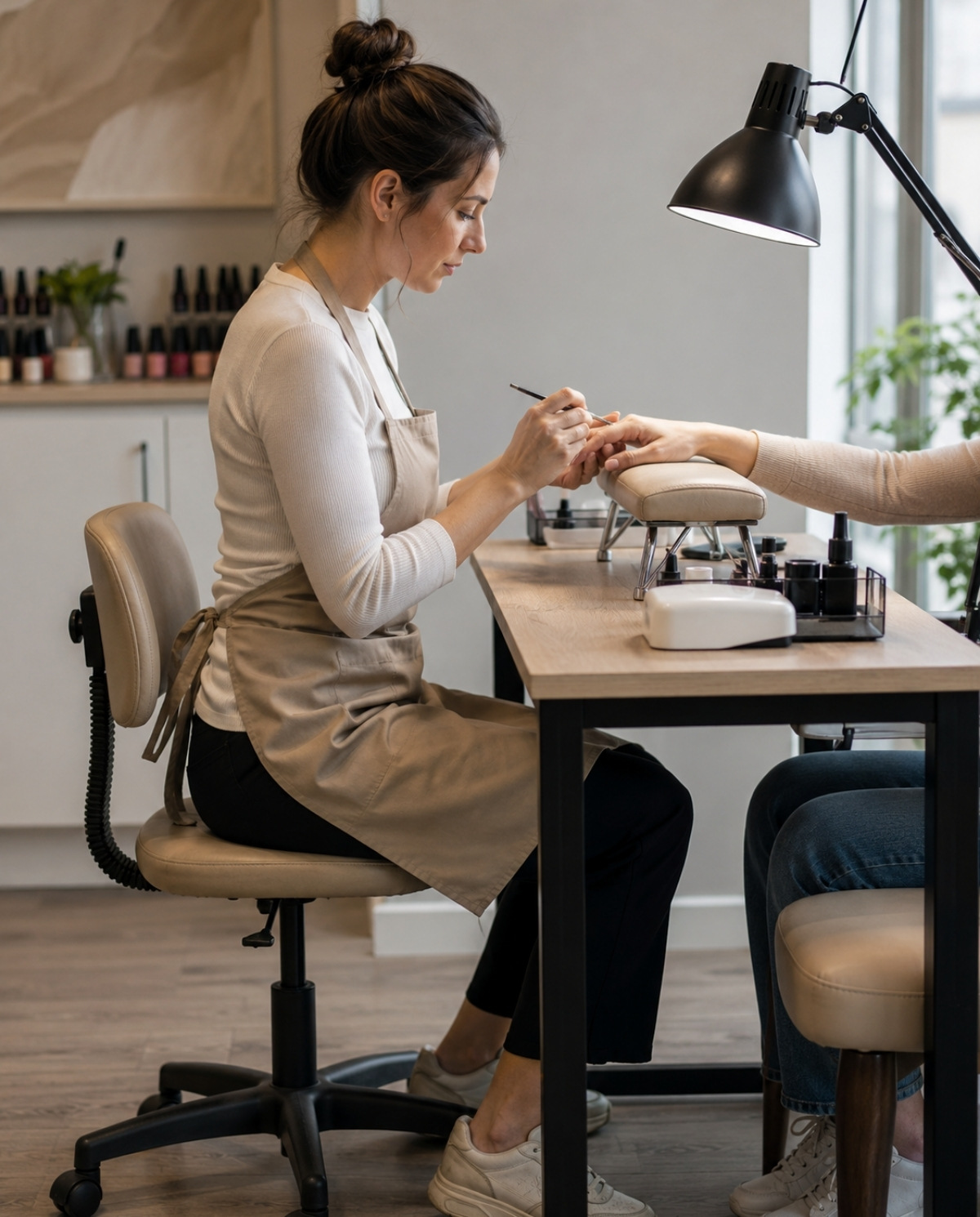
Nail Technician Station Setup Guide: Tables, Ergonomics, Ventilation & Salon Costs

What to Know Before Setting Up Your Nail Station

  • Protect Your Body: Repetitive hand work and sustained forward bending can contribute to musculoskeletal problems. In a 2022 study of 80 female nail technicians, 63.8% reported neck pain, highlighting the value of supportive seating, better client positioning, padding at hard contact points, position changes, and regular breaks.
  • Control Airborne Contaminants: A NIOSH-approved N95 respirator can filter certain airborne particles but does not protect against chemical gases or vapors. In Aiken, the adopted 2021 International Mechanical Code framework includes source-capture exhaust requirements for manicure and pedicure stations, including at least 50 CFM per station.
  • Design Around Your Routine: Placing commonly used equipment within a comfortable reach and arranging cords around your natural workflow can reduce unnecessary reaching, repositioning, and interruptions during appointments.
  • Budget Beyond Weekly Rent: Published booth-rental estimates vary broadly, with figures around $100 to $500 per week depending on the market and rental arrangement. Independent technicians may also need to account for supplies, insurance, software, payment processing, marketing, licenses, business costs, and applicable self-employment taxes.
  • Check the Rules Where You Plan to Work: Nail technology education requirements differ significantly by state. South Carolina’s nail technology school curriculum totals 300 hours, compared with 525 hours for Georgia’s complete nail care curriculum and 600 hours for Arkansas’s manicure curriculum.

Creating a professional nail workstation involves much more than choosing a stylish desk and organizing polish colors. Once you begin serving paying clients, your furniture, ventilation, sanitation practices, and daily workflow all affect how safely and efficiently you can work. Whether you are preparing to enter the industry or reviewing our guide to nail technician licensing requirements, costs, and state rules, building a thoughtful workspace can make the transition into professional nail services much easier to manage.

Create a Workstation That Works With Your Body

A nail table becomes the center of nearly every appointment, so furniture choices should support your posture as well as your equipment. Spending hours performing detailed work from the same seated position can place unnecessary strain on the neck, shoulders, arms, wrists, and back when the setup forces you to lean or reach repeatedly.

Nail technician working with a neutral spine and relaxed shoulders while the client's hand rests on an elevated cushion between ergonomically positioned adjustable chairs.

Adjust the Client and Furniture Instead of Constantly Leaning

There is no universal table height or chair position that fits every technician. The Occupational Safety and Health Administration’s nail salon ergonomics guidance recommends an adjustable chair with back support, keeping the feet supported, improving lighting, and repositioning the client’s hand or foot so the technician does not need to bend forward excessively. OSHA also recommends adding padding where a technician’s arms come into contact with hard table edges.

The physical demands of nail work are supported by occupational research. A 2022 ergonomics study involving 80 female nail technicians found that 63.8% of participants reported neck pain, which was the most commonly reported musculoskeletal complaint among the body areas examined. The study does not mean that the same percentage applies to every nail technician population, but it does demonstrate that musculoskeletal symptoms are an important occupational concern.

Furniture alone cannot eliminate these risks. Raising the client’s hands or feet to a more comfortable working level, changing positions between tasks, taking short breaks when practical, and stretching periodically can all be incorporated into a more body-conscious work routine.

Select Furniture and Storage That Match Your Services

The best table configuration depends on where and how you work. A permanent salon station may benefit from sturdy construction and integrated storage, while technicians who provide house calls, bridal services, or event appointments may need a folding table that can be transported and set up easily.

Storage also has a direct sanitation function. Under South Carolina Board of Cosmetology sanitary and safety rules, disinfected non-electrical, nonporous implements must be kept in a clean, dry, covered container such as a clean drawer or cabinet. Implements that have been used or otherwise soiled must remain in a closed receptacle labeled “soiled” or “items to be disinfected” until they are properly processed.

Your station should therefore provide enough room to keep disinfected implements physically separate from used tools and disposable materials. If you are still deciding what equipment belongs in your professional setup, review our guide to essential nail technology procedures, tools, and starter kit equipment.

Whatever table style you choose, make sure there is enough working depth for comfortable client-hand placement, a curing lamp, your e-file, and the tools required for the service without forcing you to repeatedly reach across the active work area.

Manage Filing Dust and Chemical Exposure at the Source

Professional nail services can generate more than one type of airborne contaminant. Filing and shaping may create particulate matter, while products such as removers, adhesives, primers, polishes, and artificial nail products can release chemical vapors. Because these hazards behave differently in the air, one device or protective measure should not automatically be assumed to control every exposure.

Nail technician using an electric file while the client's hand is positioned directly above a source-capture ventilation intake that draws fine nail dust away from the breathing zone.

Know What a Dust Collector Can and Cannot Do

A tabletop dust collector may help capture particles produced during filing, but that does not necessarily make it equivalent to a complete local exhaust ventilation system. Some devices capture particles through filters and return the filtered air to the room, while other ventilation systems are designed to capture contaminants near their source and exhaust the contaminated air away from the work area.

The CDC and NIOSH guidance for nail technicians identifies local exhaust ventilation controls that can include downdraft ventilated tables and portable ventilation units. The performance of any particular system depends on factors such as airflow, inlet location, filtration or exhaust design, maintenance, and how closely the capture point is positioned to the work.

For that reason, a nail table advertised with a built-in fan or extractor should not automatically be assumed to provide the same protection as a source-capture system required by an applicable mechanical code. Salon owners should review the equipment specifications and local code requirements before relying on a particular unit for ventilation compliance.

Use Masks and Respirators for the Hazards They Are Designed to Address

Standard surgical or procedure masks are not respirators and should not be treated as protection against chemical gases or vapors. A properly fitted, NIOSH-approved N95 respirator can help filter certain airborne particles, including particulate matter generated during filing or buffing, but an N95 does not provide protection against hazardous chemical gases or vapors.

The OSHA guidance on chemical hazards in nail salons emphasizes ventilation as an important way to reduce airborne chemical concentrations. When respiratory protection is required for a specific workplace hazard, the respirator must be appropriate for that hazard and used in accordance with applicable occupational respiratory-protection requirements.

Daily chemical-handling habits matter as well. Useful controls include:

  • Keeping chemical containers securely closed when products are not in use.
  • Using appropriate dispenser containers that limit unnecessary evaporation.
  • Reviewing the Safety Data Sheets for the professional products used in the salon.
  • Maintaining ventilation equipment and replacing or cleaning filters according to the manufacturer’s instructions.

These practices complement effective ventilation rather than replacing it.

Plan Ventilation Around the Codes Used in Aiken

Ventilation should be considered before a manicure table or pedicure station is permanently installed. The City of Aiken’s adopted building-code information states that the 2021 International Mechanical Code is among the mandatory codes adopted for use in South Carolina and enforced by local jurisdictions.

Under the 2021 International Mechanical Code ventilation provisions, nail salons must provide each manicure and pedicure station with a source-capture system capable of exhausting at least 50 cubic feet per minute, or CFM, per station. The related 2021 IMC exhaust requirements specify that when a manicure table or pedicure station does not have a factory-installed exhaust inlet, the exhaust inlet must be located no more than 12 inches horizontally and vertically from the point where chemicals are applied. The station exhaust system must also have controls that operate it continuously while the space is occupied.

A room’s general HVAC system or a small recirculating filing-dust fan should therefore not automatically be treated as a replacement for required source capture. Anyone planning a salon build-out, private suite, or permanent nail room in Aiken should verify the current code edition, permits, system design, and inspection requirements with the local building authority before construction or lease commitments are finalized.

Organize the Station for a Repeatable Service Routine

An efficient workstation is one that allows you to perform the same sequence of tasks without continually moving equipment around. Good organization can reduce clutter, keep cords away from the active service area, and make sanitation procedures easier to repeat between clients.

Keep High-Use Equipment Inside a Comfortable Reach

Arrange tools based on how you actually perform a service rather than trying to copy one standard layout. If you use an electric file with your dominant hand, place the control unit so the handpiece cord can move freely without crossing over the client’s hands or tangling with other equipment. Position your curing lamp where the client can enter and remove each hand without disturbing implements that are currently in use.

Frequently used tools should be close enough to reach without repeated twisting or leaning. There is no reliable evidence that one universal right-handed or left-handed station design saves a fixed number of minutes per appointment, but a consistent layout can reduce unnecessary reaching, equipment repositioning, and interruptions.

Give Clean, Used, and Disposable Materials Their Own Places

A professional setup should make it difficult to accidentally mix disinfected implements with items that have already been used. South Carolina’s sanitation rules provide a useful framework for organizing these categories:

  • Disinfected Implements: Store properly processed nonporous tools in a clean, dry, covered container, such as a clean drawer or cabinet.
  • Items Awaiting Disinfection: Place used or soiled implements in a closed receptacle labeled “soiled” or “items to be disinfected” until they can be cleaned and disinfected.
  • Porous Single-Use Materials: Porous supplies that contact a client and cannot be disinfected, including nail abrasives and buffers, must be discarded in a covered waste receptacle after use or when the service is completed.

South Carolina requires reusable non-electrical, nonporous implements to be cleaned and then treated with an appropriate EPA-registered disinfectant according to the product’s concentration and contact-time instructions. Autoclaves are subject to an additional restriction: under the state’s rules, autoclaves and autoclave packaging of tools are prohibited unless regular spore testing is performed by a contracted laboratory at least once per month, with no more than 30 days between tests.

Chemical products should also remain in clean, closed, properly labeled containers and should not be stored in a way that could contaminate disinfected implements. For a closer look at infection-control routines and client care, read our guide to nail technology hygiene, infection prevention, and aftercare.

A station that follows the same setup and breakdown routine for every appointment makes professional habits easier to maintain. It also allows technicians to focus more attention on service quality without sacrificing sanitation or workspace organization.

Plan the Financial Side Before Renting Your Own Space

Moving into a booth, suite, or private nail room can offer more control over your working environment, but it also changes the financial and legal responsibilities attached to your career. National data from the U.S. Bureau of Labor Statistics projects 7% employment growth for manicurists and pedicurists from 2024 through 2034. Building an independent business around that opportunity requires understanding the full operating cost rather than focusing only on weekly rent.

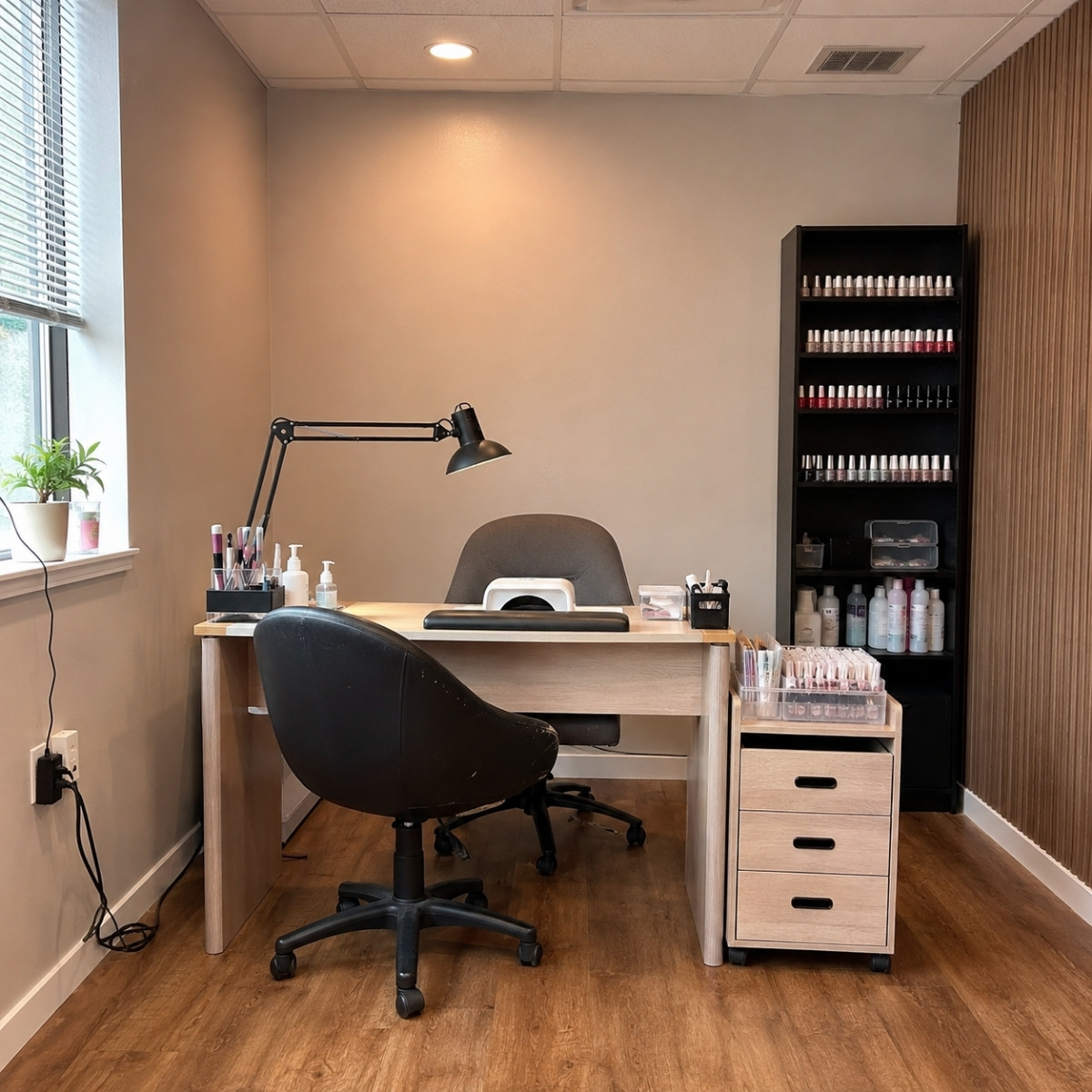
Compact independent nail booth with a manicure table, two chairs, task lamp, ventilation equipment, rolling storage cabinet, organized supplies, and open floor space.

Inspect the Space Before You Commit

When considering a nail technician room or salon suite, look closely at the physical infrastructure. Confirm that the space has suitable electrical service for your equipment, adequate task lighting, and access to required plumbing and sanitation facilities.

South Carolina’s salon and school sanitation rules require hot and cold running water as well as toilet and hand-washing facilities. Depending on the property and business arrangement, additional state, local, building, plumbing, electrical, and mechanical requirements may also apply.

Ventilation deserves particular attention. A room that looks ready for a manicure table may still require mechanical work to meet source-capture exhaust requirements. Installing ductwork and other permanent ventilation components after a space is finished can be more complicated than incorporating them during the initial design.

Before signing an agreement, determine exactly what the rent includes. Utilities, Wi-Fi, laundry, waste disposal, common-area cleaning, reception, booking services, repairs, and equipment maintenance may be included in some arrangements and charged separately in others.

Calculate Your Costs Beyond the Rental Rate

Rental prices differ widely between markets and business models. The ZipRecruiter booth rental overview gives a broad estimate of approximately $100 to $500 per week, depending on location and the salon arrangement. This should be viewed as a general range rather than a national average or a guaranteed price in any particular city.

Your total operating expenses may include:

  • Recurring Costs: Rent, insurance, software subscriptions, licenses, business registrations, advertising, and other regular fees.
  • Service-Driven Costs: Nail products, disposable supplies, laundry, payment-processing fees, and materials that increase as appointment volume grows.

Technicians who are legitimately operating as self-employed workers may also have tax obligations associated with self-employment and estimated taxes.

A practical way to evaluate a rental opportunity is to calculate how much each appointment contributes toward your overhead after service-specific product costs are deducted. Comparing that amount with your recurring monthly expenses can help estimate the number of appointments required to reach your break-even point.

Understand the Rules That Come With Independent Work

The BLS Occupational Outlook Handbook reports that 28% of manicurists and pedicurists were self-employed in 2024. However, paying booth rent does not by itself establish that someone is legally an independent contractor.

The Internal Revenue Service guidance on independent contractors explains that worker classification depends on the actual relationship and the degree of control over how the work is performed. Workers who are properly classified as independent contractors are generally considered self-employed and may be responsible for applicable self-employment and estimated taxes.

Education requirements are also specific to each state. The South Carolina State Board of Cosmetology regulations establish a 300-hour curriculum for a school of nail technology. Aiken School of Cosmetology and Barbering’s current student catalog also lists its Nail Technician program as a 300-clock-hour program.

Requirements differ elsewhere. Georgia’s complete nail care curriculum totals 525 hours, while the Arkansas cosmetology school rules prescribe a 600-hour manicure curriculum. These differences are why prospective students should verify the current requirements for the state in which they intend to become licensed.

An individual professional license may also be only one part of opening an independent workspace. Depending on the location and business arrangement, technicians may need to address salon or establishment licensing, local business registration, taxes, insurance, zoning, building and mechanical codes, and lease restrictions before serving clients independently.

Build Professional Habits Before You Work Independently

Learning nail techniques is only one part of preparing for professional salon work. Safe product handling, sanitation, workstation preparation, client positioning, and efficient breakdown procedures all become part of the daily routine once appointments begin.

Structured nail technology education gives students an opportunity to practice these habits alongside technical services. It can also help students understand the relationship between sanitation rules, workplace safety, professional procedures, and the training requirements that must be completed before pursuing licensure.

For students planning to work in South Carolina, the state’s nail technology curriculum includes 300 hours covering areas such as sanitation and safety, anatomy and physiology, nail services, artificial nails, power equipment, and state law. Building these foundations during training can make the transition from student practice to a licensed professional environment more manageable.

Explore Nail Technician Training at Aiken

A professional nail career starts with more than buying equipment and finding a table. At Aiken School of Cosmetology and Barbering in Aiken, South Carolina, the Nail Technician program includes hands-on nail training along with areas such as salon business, client relations, professional development, and career preparation.

To learn more about getting started, visit the school’s Enrollment page. You can review the enrollment process, submit your information, ask questions, and request a campus tour to explore the program in person.

Common Questions About Nail Stations and Booth Rental

How much table space do I need in a compact nail room?

There is no single table dimension required for every technician. Many compact commercial nail tables are approximately 36 to 42 inches wide and 16 to 20 inches deep, but the right dimensions depend on your equipment, available floor area, client positioning, ventilation design, and your own posture. Make sure there is enough room for the equipment used during the service without forcing you to lean forward or reach excessively.

When should a nail-table ventilation filter be changed?

Follow the maintenance instructions for the specific ventilation system because filters and equipment designs vary. For applicable ventilated tables that use charcoal filters, OSHA’s nail salon guidance recommends replacing charcoal filters at least monthly and cleaning the catch basin at least weekly. Heavier use may require more frequent maintenance. Changing a filter does not, by itself, make a recirculating dust collector equivalent to a source-capture exhaust system required by local mechanical code.

Should a new nail technician choose commission work or booth rental?

The better option depends on the specific salon agreement, your client base, and how prepared you are to manage business expenses. A commission position may reduce certain upfront responsibilities and, depending on the employer, may include access to clients, supplies, equipment, training, or other salon resources. Booth rental can provide greater independence but generally shifts more responsibility for rent, products, insurance, taxes, marketing, client acquisition, and operating expenses to the technician. Review the actual terms of either arrangement before deciding.

What insurance should an independent nail technician consider?

Independent technicians commonly consider professional liability coverage for claims connected with professional services and general liability coverage for broader risks such as certain injuries or property damage. The exact coverage you need depends on your services, business structure, location, landlord requirements, and rental agreement. Review the insurance provisions in your lease or booth agreement and select coverage based on the risks and requirements that apply to your business.

Medical Nail Technician Explained: Training, Certification, Scope, and Career Outlook

A fast-moving salon is not the right long-term environment for every beauty professional. Packed appointment books, repeated exposure to product fumes, pressure to finish services quickly, and income tied heavily to tips can eventually become difficult to sustain. For technicians who enjoy detailed work and want to place greater emphasis on safety, consultation, and client comfort, health-conscious nail care offers another direction to explore.

The need for cautious foot care is also growing. The Centers for Disease Control and Prevention estimates that 40.1 million people in the United States had diagnosed or undiagnosed diabetes in 2023. Older adults and people living with diabetes or other chronic conditions may have fragile skin, reduced sensation, circulation concerns, or a greater risk of complications from small injuries.

These clients do not necessarily need more aggressive nail services. They often need a professional who understands when a cosmetic service can be performed conservatively, when it must be adjusted, and when the safest decision is to stop and recommend medical evaluation. Understanding what is a medical nail technician can help you decide whether this private specialization fits your career goals.

What to Know Before Pursuing This Specialty

  • It Begins with a Beauty License: A Medical Nail Technician, commonly shortened to MNT, is generally a licensed nail technician or cosmetologist who completes additional private education in infection prevention, client screening, chronic-condition awareness, documentation, and appropriate referral.
  • The Credential Is Not a Healthcare License: An MNT certificate does not make its holder a doctor, nurse, podiatrist, or other medical provider. It does not authorize diagnosis, wound care, medical treatment, or any procedure outside the technician’s original state license.
  • Specialization May Strengthen a Business: Additional safety education may help a technician create a more focused service model, communicate more confidently with clients, and develop professional relationships. It does not guarantee referrals, premium prices, or a particular income.
  • State Law Remains the Final Authority: The state where the service is physically performed determines which tools, products, procedures, and sanitation methods a technician may legally use.

How Health-Conscious Nail Care Differs from a Standard Service

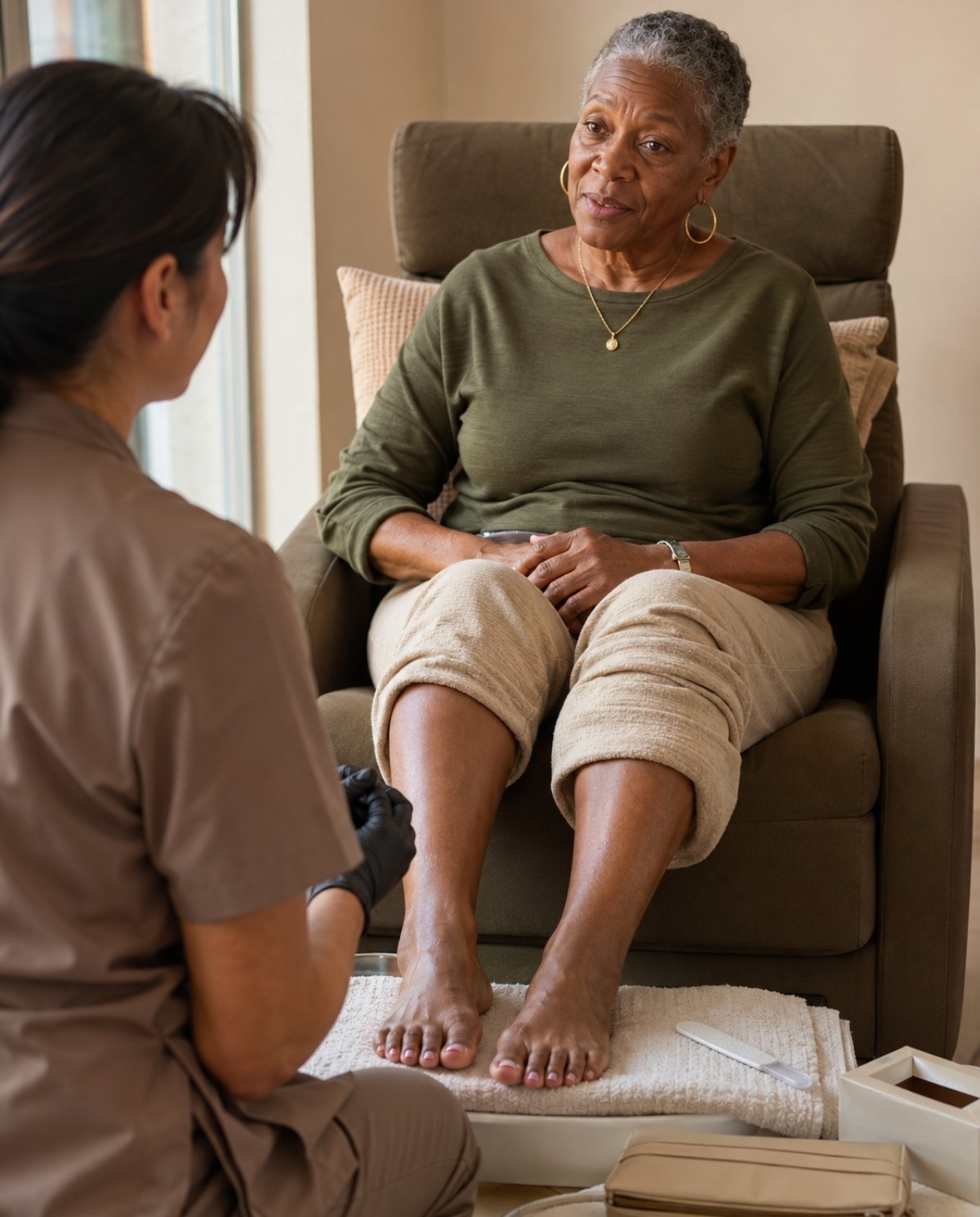
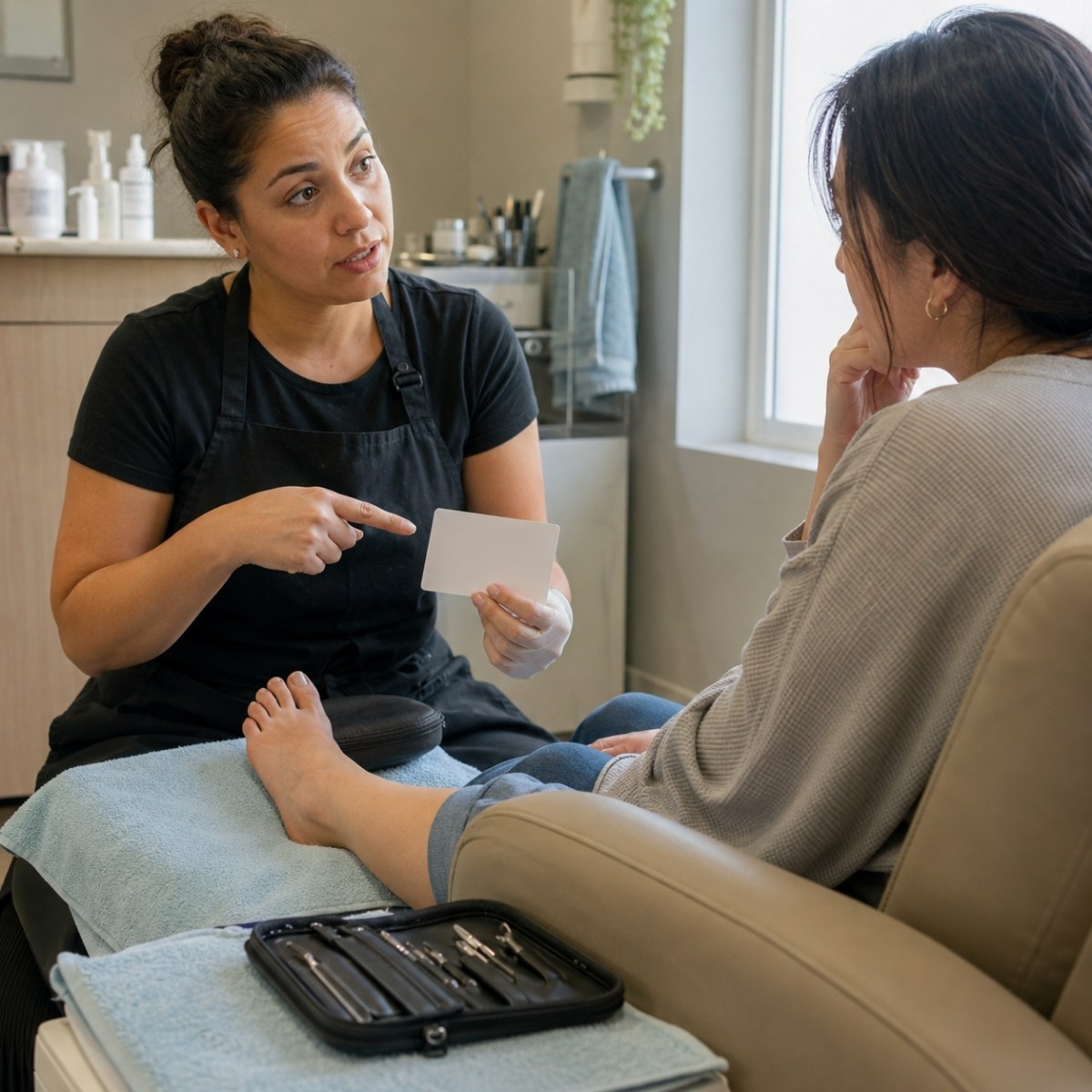
Nail technician speaks with an older Black woman while reviewing her healthy feet before opening the pedicure tool pouch.

A medical nail technician is not defined by decorative technique, speed, or the number of appointments completed in one day. The specialization centers on conservative cosmetic care, careful observation, detailed consultation, infection-control practices, and knowing when not to proceed.

The term is commonly used for a licensed beauty professional who has pursued advanced private training related to older clients, people with diabetes, and individuals whose medical conditions may affect their skin, nails, circulation, or sensation. The word “medical” describes the additional safety focus of the training. It does not place the technician within the licensed practice of medicine.

Several principles commonly shape this type of work:

  • Aseptic Working Practices: The Centers for Disease Control and Prevention defines asepsis as the prevention of contact with microorganisms. In a nail setting, that may include hand hygiene, preparing a clean work area, discarding porous single-use items, and cleaning and disinfecting reusable implements according to state regulations and product-label instructions. Asepsis is not the same as sterilization, which refers to a process designed to destroy all forms of microbial life.
  • Waterless Service Options: Some advanced providers use dry or waterless techniques to reduce risks associated with footbaths and prolonged soaking. Balance Health identifies waterless methods as a common feature of medical-pedicure services. The National Institute of Diabetes and Digestive and Kidney Diseases also advises people with diabetes not to soak their feet because soaking can make the skin too dry. Waterless care does not eliminate every possible infection risk, and it is not required by every state, but it can be one useful risk-reduction approach for appropriate clients.
  • Conservative Cosmetic Maintenance: An MNT may provide nail and skin maintenance only when the service is permitted under the technician’s state license and appropriate for the client’s visible condition. Thickening, discoloration, pain, drainage, inflammation, broken skin, or an ingrown nail may justify modifying or declining the service. Whether referral is necessary depends on the symptoms, the client’s health history, and the applicable state rules.
  • Visual Screening Without Diagnosis: Advanced education may help a technician notice open areas, swelling, redness, unusual warmth, bleeding, blisters, drainage, or changes in nail shape. The technician may record what is visible and recommend that the client contact an appropriate healthcare provider, but the technician cannot determine the medical cause.
  • Product Decisions Based on Risk: Strong exfoliants and chemical corn or callus removers may be inappropriate for clients with reduced sensation or vulnerable skin. NIDDK specifically advises people with diabetes not to use liquid corn and callus removers because these products may damage the skin and cause infection. Product selection must follow the client’s circumstances, manufacturer directions, and the technician’s legal scope.

Health-conscious care does not mean attempting services that belong in a medical office. An MNT does not diagnose fungal infections, remove infected tissue, treat ulcers, manage wounds, prescribe medication, perform surgery, or cut into living skin.

The technician’s responsibility is to provide lawful cosmetic care, reduce preventable exposure risks, document relevant observations, and recognize when a client needs medical attention. Our professional guide to nail technology hygiene and essential aftercare advice explains how sanitation and aftercare habits support safer everyday services.

Demand for routine foot maintenance exists within a much larger foot-health industry. According to Mordor Intelligence, the global podiatry services market is estimated at $4.87 billion in 2026, while routine foot care represented 46.87% of that market in 2025. These figures describe the broader podiatry market, not MNT employment or earnings, but they illustrate the importance of ongoing foot care within the larger health sector.

A podiatrist or another healthcare office may choose to employ, work with, or refer suitable clients to a safety-trained nail professional. Such an arrangement is never automatic. It depends on state law, the office’s policies, professional insurance, the technician’s experience, and the exact cosmetic services permitted under the technician’s license.

Building the Education and License You Need First

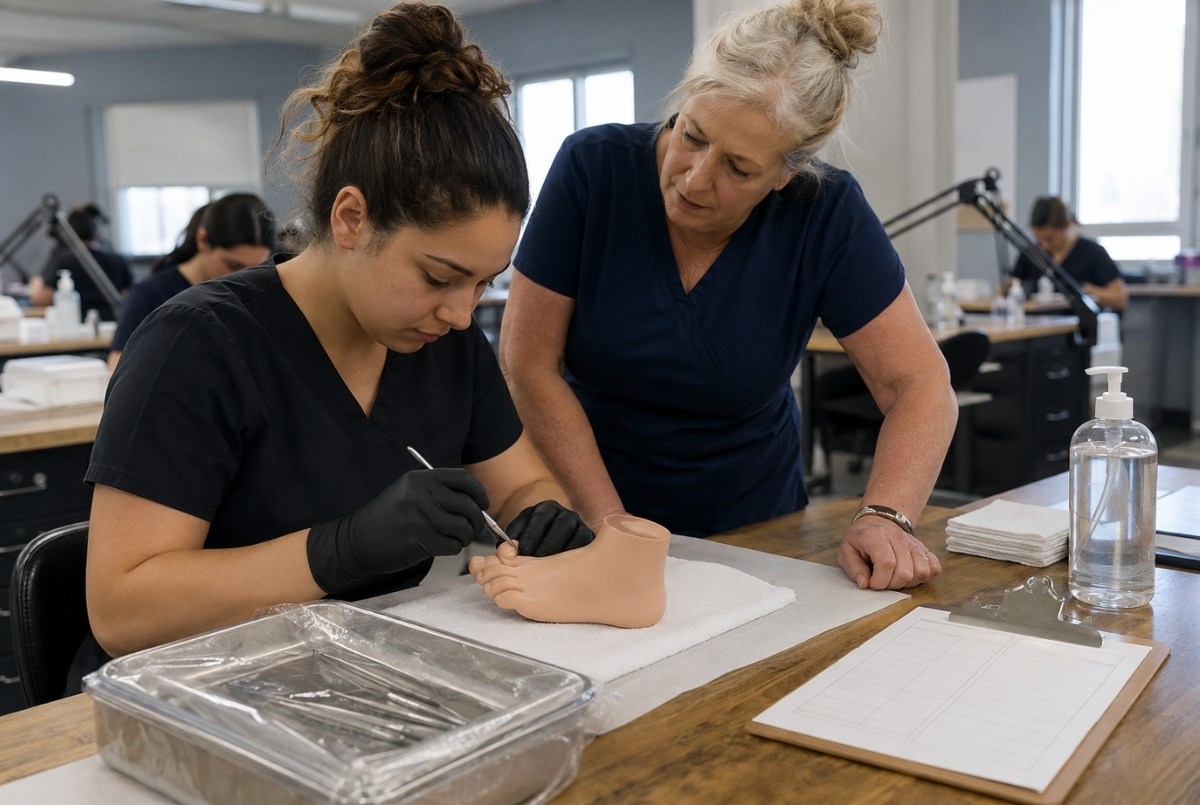
Nail technology student practices safe pedicure technique on a training foot while an instructor observes tool control and sanitation procedures.

Learning how to become a medical nail technician begins with qualifying to practice nail services legally. Most candidates complete a state-approved nail technology or cosmetology program before taking the required licensing examinations. Some states also permit alternative routes, such as a registered apprenticeship. For example, Georgia allows a nail technician apprenticeship consisting of at least eight months and 1,050 hours.

Because training routes differ, applicants must check the licensing board in the state where they plan to work. Our guide explaining whether you actually need a license to be a nail tech provides a broader look at education, licensing, timelines, and common expenses.

Required school hours also vary considerably. The Georgia State Board of Cosmetology and Barbers requires a 525-hour nail-care curriculum. The Arkansas Department of Health requires 600 hours of manicure training.

South Carolina uses a different standard. Its official nail technology curriculum contains 300 hours, including instruction in sanitation and safety, anatomy and physiology of the arms, hands, and feet, nail technology, artificial nails, power equipment, and state law.

This foundational education matters because advanced private courses assume that the technician already understands basic nail anatomy, sanitation, disinfection, product use, client consultation, and practical service procedures. Completing an ordinary nail technology program and receiving a state license, however, does not automatically qualify someone as an MNT.

Medical Nail Technician is not a nationally standardized government credential. Private providers establish their own course titles, prerequisites, assessments, and internship expectations. One commonly referenced pathway is offered by Nailcare Academy. Its complete MNT sequence includes:

  • Advanced Nail Technician, or ANT, education
  • Wellness Nail Technician, or WNT, education
  • Medical Nail Technician internship preparation
  • A documented 40-hour internship in a foot-care medical setting under the program’s supervision requirements

Within this particular system, ANT and WNT education must be completed before the internship stage. That structure should not be treated as a nationwide legal standard. Another private provider may use different prerequisites, course lengths, assessments, or supervised-experience requirements.

Before enrolling, examine the course curriculum, instructor qualifications, testing process, practical components, internship assistance, refund policies, graduate requirements, and eligibility conditions. You must also confirm that the course does not teach procedures that your state license prohibits.

Where Online Coursework Fits into the Process

A working technician may be able to complete portions of advanced education without leaving a current job. Theory topics such as anatomy, chronic-condition awareness, client screening, documentation, and infection prevention can often be taught online.

Nailcare Academy currently offers its ANT and WNT coursework online. Its complete medical nail technician online path is not entirely remote, however, because the MNT process also includes a separately documented 40-hour medical-office internship.

Other certificate providers may have different arrangements. Since no federal or national MNT regulator sets one mandatory format, applicants need to determine:

  • Which portions of the course are delivered online
  • How knowledge and practical competence are evaluated
  • Whether an internship or supervised experience is required
  • Who qualifies to supervise the practical component
  • Whether an active nail technology or cosmetology license is required before enrollment
  • Whether the techniques taught are legal in the student’s state

Clinical exposure can help a student understand how referrals are handled, how a foot-care office communicates with clients, how professional records are maintained, and what happens after a client is referred for evaluation. It does not train the nail technician to diagnose neuropathy, vascular disease, fungal infection, or another medical disorder.

Your License Sets the Boundary, Not the Certificate

Nail technician explains why a service must stop while the client’s foot remains untouched and all cosmetic tools stay closed.

An advanced certificate may increase your knowledge, but your underlying state license determines what you can legally do. The rules do not change simply because a nail technician works inside a medical office rather than a conventional salon.

An explanation from Nailcare Academy regarding ANT, WNT, and MNT scope of practice makes the same distinction: private advanced training does not expand the technician’s state-authorized scope.

State rules are not identical. For example, Georgia’s facility rules state that cosmetology services may be performed only on intact, healthy scalp, skin, and nails. That wording is specific to Georgia and should not be presented as a nationwide rule.

South Carolina regulates the issue differently. Under the state’s cosmetology regulations, a salon or school may not knowingly allow a licensee or student to work on a person with an infectious or communicable disease that may be transmitted during the service. Services are also prohibited on a patron with a known parasite infestation. South Carolina separately requires proper hand hygiene, disposal of porous items that cannot be disinfected, and disinfection of reusable nonporous implements.

Regardless of the wording used by a particular state, an MNT certificate does not authorize a technician to diagnose disease, treat infection, perform wound care, remove living tissue, or carry out procedures legally reserved for healthcare professionals.

Advanced education is most useful when it improves decision-making. Depending on the client’s condition, health history, and state rules, the following visible findings may justify modifying, postponing, declining, or referring a service:

  • Open cuts, sores, ulcers, or active bleeding
  • Blisters, drainage, or possible signs of infection
  • Unexpected redness, warmth, swelling, or inflammation
  • Severe pain or a sudden change in a foot or nail
  • An ingrown nail that has broken or entered the surrounding skin
  • Severely thickened, curved, yellowed, or distorted nails in a client with diabetes or reduced sensation
  • A client who cannot safely see, feel, or reach their own feet

These findings do not allow the technician to announce a diagnosis. They indicate that the client’s condition may require evaluation beyond the limits of a cosmetic service.

The National Institute of Diabetes and Digestive and Kidney Diseases advises people with diabetes to obtain professional assistance when they cannot safely trim their own nails. Its guidance also recommends seeking appropriate foot care when nails are thick, yellowed, curved, or growing into the skin.

Additional education does not eliminate professional liability. A technician must still comply with state law, use appropriate sanitation and disinfection procedures, maintain accurate client records, carry suitable insurance, follow product directions, and decline services that exceed the legal or practical limits of cosmetic care.

Income Potential Without Unrealistic Promises

A specialized service model may give a technician another way to compete besides speed and discount pricing. Longer consultations, careful records, consistent sanitation, and a quiet service environment may appeal to clients who value patience and attention.

There is no authoritative national salary category devoted specifically to Medical Nail Technicians. Federal employment data generally place them within the broader manicurist and pedicurist occupation.

The U.S. Bureau of Labor Statistics reports that manicurists and pedicurists earned a median wage of $16.66 per hour in May 2024. Employment is projected to grow 7% between 2024 and 2034, with approximately 24,800 openings projected each year on average.

Those figures provide useful context, but they do not predict the income of an individual MNT. BLS wage estimates also exclude self-employed workers, which is especially relevant for technicians who operate a suite, rent space, provide lawful mobile services, or own a salon.

A specialist’s financial results may be affected by:

  • Local demand and the number of competing providers
  • State restrictions on tools, services, and practice settings
  • Employee, booth-rental, independent-contractor, or owner status
  • Appointment length and the number of clients served each week
  • Service prices and client retention
  • Professional relationships and referrals
  • Rent, insurance, supplies, equipment, taxes, and payment fees
  • Time spent on sanitation, documentation, scheduling, and administration
  • The technician’s experience and professional reputation

Advanced safety education may help a technician create a more carefully structured service and explain its value to clients. Whether that supports higher prices depends on the local market and the technician’s business model. There is not enough national evidence to claim that MNTs consistently charge substantially more than conventional nail technicians.

A business may collect a healthy amount of gross revenue while still carrying significant operating expenses. Rent, equipment, insurance, licensing, products, continuing education, marketing, taxes, and unpaid administrative work must all be deducted before estimating personal income.

The most realistic business benefit of specialization is the possibility of building a recognizable niche around trust, consistency, and conservative service rather than relying entirely on rapid appointment turnover. That opportunity is meaningful, but it should not be presented as a guaranteed salary or automatic path to financial freedom.

Start with a Solid Nail Technology Foundation at Aiken

Advanced nail education is most useful after you have developed safe, reliable foundational skills. At Aiken School of Cosmetology and Barbering, students can begin building the technical knowledge needed for South Carolina’s nail technology licensing path.

Aiken’s Nail Technician program is listed as a 300-hour, approximately four-month course required for licensure in South Carolina. The program introduces students to the practical and professional skills needed to enter the nail industry, while South Carolina’s approved curriculum includes sanitation and safety, anatomy and physiology, manicuring and pedicuring procedures, artificial nails, equipment, and state law.

This foundational program is not presented as Medical Nail Technician certification. Graduates who become properly licensed and later want to pursue health-conscious nail specialization must research a separate private advanced provider, verify its requirements, and confirm that all techniques remain within South Carolina’s scope of practice.

A private MNT certificate cannot replace a South Carolina nail technician license, and it cannot authorize medical treatment. Its value lies in the additional knowledge it may provide after a technician has already established a lawful professional foundation.

Visit our Enrollment page to learn more about admissions, available programs, and the steps involved in beginning your beauty education. You may also complete the contact form below to request current schedule and enrollment information.

Common Questions About Medical Nail Technology

Does an MNT certificate make someone a medical professional?

No. A Medical Nail Technician is ordinarily a licensed nail technician or cosmetologist with additional private safety education. The certificate does not turn the technician into a nurse, doctor, podiatrist, or other healthcare provider. It does not authorize diagnosis, prescription, wound care, treatment of infection, or procedures outside the state beauty license.

Can an MNT bill a client’s health insurance?

Independent cosmetic MNT services are normally paid out-of-pocket and are not billed directly to insurance by the nail technician. That does not mean foot and nail care is never covered in a healthcare setting. According to Medicare, routine foot care is usually excluded, but medically necessary treatment and limited routine care may be covered in certain circumstances when eligibility conditions are met and the service is provided through a qualified healthcare provider or practice. Clients need to confirm coverage with their clinic and insurance plan.

How is an Advanced Nail Technician different from a Medical Nail Technician?

The answer depends on the private organization issuing the certificate. Within Nailcare Academy’s system, the ANT course focuses on advanced safety and professional practices. Students then complete WNT education, MNT internship preparation, and a documented 40-hour internship in a qualifying medical setting. Other providers may define these titles differently.

May an MNT work on fungus, ingrown nails, or diabetes-related foot conditions?

An MNT may observe visible changes and recommend medical evaluation, but the certificate does not authorize diagnosis or treatment. Whether any cosmetic service may continue depends on the client’s visible condition, health risks, and the law of the state where the service occurs. Broken skin, inflammation, drainage, severe pain, or a suspected infection may require the technician to stop or decline the service.

Will my license automatically transfer when I move?

No. A private advanced certificate may remain evidence of completed education, but it does not authorize practice in another state. The technician must satisfy the destination state’s endorsement, examination, education, and licensing rules.

The Cosmetology Licensure Compact is being developed to support interstate practice for eligible professionals in participating states. However, the official Compact website states that multistate licenses are not yet available. Eligibility may also depend on the exact license category and the professional’s home state. Until applications become available, technicians must continue using the existing licensing or endorsement process of each state.

Entry-Level Nail Technician Jobs: How to Apply With Little Experience

Starting a nail career can feel like a catch-22. You want salon experience, but many job posts seem to ask for experience before giving you a chance to earn it. If you are newly licensed and still building confidence, it is normal to wonder whether a salon owner will take you seriously when most of your practice came from school, classmates, friends, family, or practice hands.

But every skilled nail professional began as a beginner. Getting your first salon opportunity is not about pretending you have years behind the table. It is about showing what you already bring: safe work habits, coachability, customer-service awareness, basic technical control, and a willingness to keep improving. This guide walks through how to apply for a nail technician role, present your beginner experience correctly, and walk into your first interview with more confidence.

Important Points for New Nail Technician Applicants

  • The job outlook is encouraging: The U.S. Bureau of Labor Statistics projects 7% employment growth for manicurists and pedicurists from 2024 to 2034, with about 24,800 openings projected each year on average.
  • Your past work can still matter: Retail, food service, hospitality, reception, and other customer-facing jobs can show communication, time management, sales awareness, and client-care habits.
  • Safety knowledge helps you stand out: Product labels, Safety Data Sheets, disinfection, ventilation, ingredient risks, and clean tool storage all matter in a real salon setting.
  • Licensing pathways are not identical everywhere: Each state sets its own training, apprenticeship, licensing, and salon-safety rules. Georgia recognizes a nail technician apprentice pathway, while Arkansas requires a structured 600-hour manicure curriculum.

Turning Beginner Experience Into a Strong Nail Technician Resume

Beginner nail technician resume workspace with a laptop, folded cafe apron, blank notepad, polish bottles, and sanitized manicure tools.

When you do not yet have a long salon work history, your resume still needs to feel intentional. It should not read like an empty page or a list of unrelated jobs. Instead, use it to show your training, your safety habits, and your readiness to keep learning in a professional salon environment.

A beginner nail technician CV should highlight the foundation you have already built. Include your completed program, license or apprentice-license status, total training hours, clinic floor experience, sanitation training, and any focused workshops you completed, such as e-file bit safety, structured gel application, acrylic basics, or natural nail care. To help organize this section around real salon skills, you can review the professional guide to nail technology procedures essential tools and your first starter kit and use it as a practical reference for the kinds of procedures and tools salon owners expect new technicians to understand.

A portfolio link also belongs on your resume, even if it is still small. A clean Instagram page, Google Drive folder, or simple digital portfolio with well-lit photos can show your control over shape, prep, polish application, and sanitation presentation. For a new applicant, a small but organized nail technician portfolio is often more convincing than a long resume padded with unrelated filler.

Showing Transferable Skills From Past Jobs

If you have worked in retail, food service, hospitality, office support, or another people-facing role, you may already have experience that connects directly to salon work. Salon owners care about more than technical ability. They also want someone who can communicate clearly, manage time, recommend services or products appropriately, handle busy moments, and protect the client experience.

For example, if you worked as a barista, do not reduce that role to “made coffee.” You could write: “Managed high-volume customer orders under tight time constraints while maintaining strict health and safety protocols.” If you worked in retail, point out your experience with product recommendations, payment handling, customer questions, and staying calm during peak hours. These details show that you understand the service side of the beauty industry.

Your introductory resume profile should also connect your training to your attitude. A strong nail technician objective statement can mention safety, product knowledge, and your desire to grow inside a structured team. For example: “Licensed Nail Technician eager to bring strong sanitation habits, modern gel-system knowledge, and client-first hospitality to an entry-level role at a growing salon.”

Why Entry-Level Applicants Still Have Real Opportunity

Some beginners assume every opening will go to a more experienced technician. However, recent data from the U.S. Bureau of Labor Statistics shows that employment for manicurists and pedicurists is projected to grow 7% from 2024 to 2034, which is much faster than the average for all occupations.

According to the BLS, this growth is expected to create about 24,800 openings each year on average over the decade. Many openings come from workers moving into other occupations or leaving the labor force, including retirements. This does not mean every salon will hire a beginner immediately, but it does show that the field continues to create steady opportunities for trained, licensed applicants who present themselves professionally.

The BLS also lists the median hourly wage for manicurists and pedicurists at $16.66 in May 2024. Actual income can vary based on location, tips, commission structure, booth rental costs, schedule, client volume, product expenses, and whether the technician works as an employee or self-employed professional. For a beginner, the first salon role is valuable not only for income, but also for speed, confidence, repeat-client building, and professional credibility.

Writing a Cover Letter That Feels Specific to the Salon

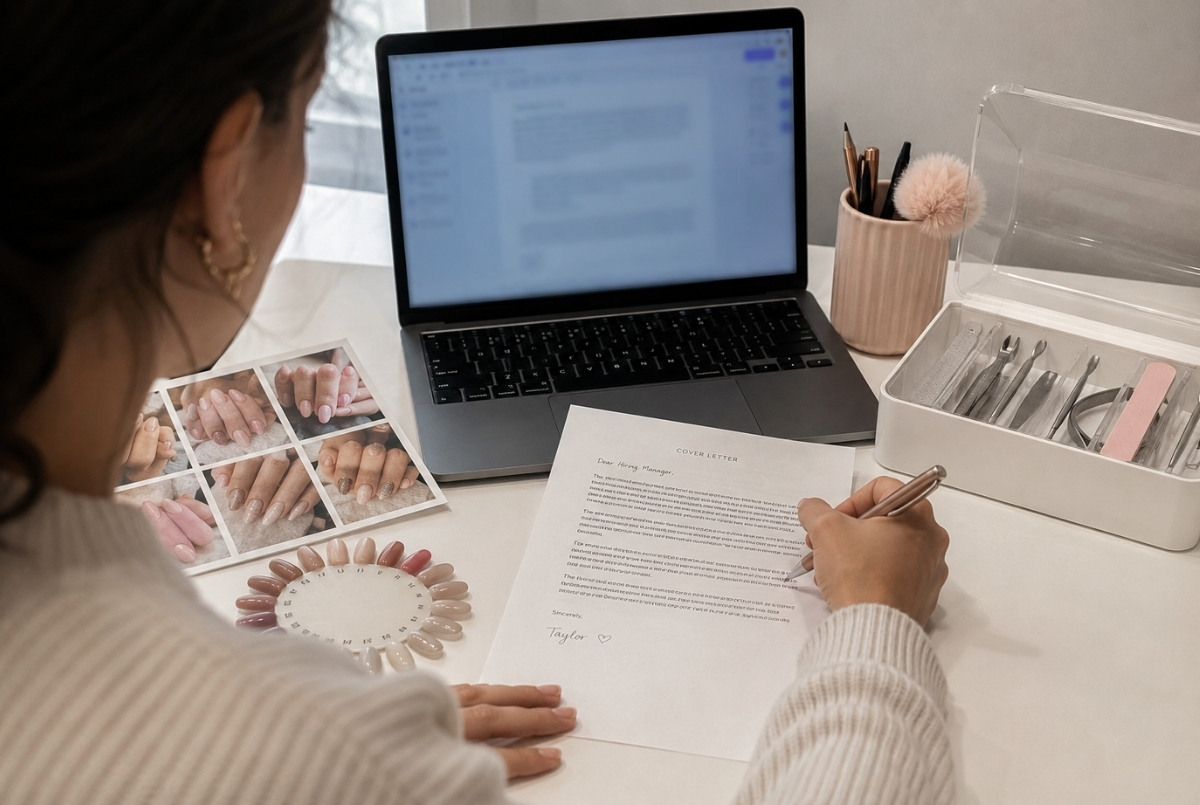
New nail technician writing a personalized cover letter beside a blurred laptop, manicure portfolio photos, polish swatch wheel, and clean tools.

A resume explains your background, but a cover letter helps a salon owner understand your attitude and your reason for applying. For an entry-level nail technician position, the goal is not to sound generic. The goal is to show that you studied the salon, understand its service style, and genuinely want to grow there.

A strong cover letter for a trainee or junior nail technician should make your beginner status feel like a strength. New technicians can be especially teachable because they are still forming professional habits. Many salons value applicants who can learn their timing standards, sanitation routines, consultation style, client-service approach, and brand expectations from the beginning.

What to Include in Your Application Intro

Start by addressing the owner or manager by name when possible. Then explain why you are interested in that specific salon. You might mention its reputation for clean work, natural nail care, creative nail art, luxury pedicures, client education, or professional service flow.

Next, show that you understand safety and scope of practice. This means you know the legal boundaries of what your license allows and the difference between appropriate professional care and invasive work that should not be performed by a nail technician. You can mention that you perform services only on intact, healthy skin and nails within your training and state rules.

This matters in states with detailed regulatory requirements. For example, the Georgia Board of Cosmetology and Barbers states that cosmetology services should only be performed on intact, healthy scalp, skin, and nails, and Georgia prohibits razor-like implements such as credo blades and razor-type callus shavers. Arkansas also has detailed requirements around personal cleanliness, pedicure-spa disinfection, labeled containers, disinfectant use, and dry covered storage for cleaned items through the Arkansas cosmetology rules.

You can also strengthen your application by showing that you understand client protection and salon hygiene before you are hired. Reviewing the professional guide to nail technology hygiene and essential aftercare advice can help you connect sanitation, aftercare, and infection-prevention habits to your application. End your cover letter by saying you are willing to complete a practical technical test on a live model or practice hand so the salon can evaluate your current skill level.

Using Chemical Safety Knowledge as a Hiring Advantage

Today’s salons have to think carefully about client safety, worker safety, and product compliance. According to the U.S. Food and Drug Administration, the Modernization of Cosmetics Regulation Act, known as MoCRA, expanded FDA authority over cosmetics and includes requirements such as serious adverse event reporting and safety substantiation for cosmetic products.

As a nail technician, you do not need to act as if you personally carry every manufacturer-level MoCRA responsibility. The stronger point is that you understand the safety environment surrounding cosmetic products. The FDA’s cosmetic registration and product listing guidance states that a responsible person must list each marketed cosmetic product with FDA, including product ingredients, and provide updates annually. This makes it even more important for salons to buy from reputable suppliers, read product labels, keep Safety Data Sheets accessible, and respond carefully to client reactions.

Current ingredient warnings are also worth knowing. For example, the FDA has warned that several cosmetic products marketed as gel nail polish removers were found to contain methylene chloride, also known as dichloromethane or methyl bichloride. FDA states that methylene chloride is prohibited in cosmetics at any level. If you can explain that you check labels, avoid suspicious imported removers, and ask for Safety Data Sheets when needed, you look like someone who helps protect both clients and the salon.

Creating a Beginner Nail Portfolio That Still Looks Professional

In the beauty industry, visual proof matters. A nail technician portfolio gives salon owners a quick way to see your control, consistency, and attention to detail. You do not need a large book of paying salon clients to build a useful portfolio.

Your first portfolio can include beauty school practice hands, classmates, friends, and family members. The goal is not to show the most complicated art possible. The goal is to show clean work, consistent shaping, neat polish control, safe preparation, and professional presentation.

Beginner nail technician standing in a modern salon waiting area with a plain folder and open manicure kit before an interview.

Choosing Work That Shows Control

When photographing your work, avoid heavy filters, cluttered tables, messy towels, open containers, used files, and distracting product bottles. Use a neutral background and bright natural light or a clean ring light.

Your portfolio should include several shapes, such as coffin, almond, and square. It should also show polish application without flooding the lateral nail folds. Include close-up images of basic manicures along with your strongest nail art. This helps show that you care about the fundamentals, not only the final decoration.

Add a short caption to each photo. Mention the service type, shape, product system, prep method, and whether the work was completed on a practice hand or live model. A beginner portfolio becomes more credible when it explains the process behind the final result.

Showing Product-Safety Awareness in Your Portfolio

A stronger portfolio does more than display pretty colors. It can also show that you understand product systems and client safety. As highlighted in a market trends analysis by Booksy Biz, salon conversations increasingly focus on cleaner positioning, ingredient awareness, and more specific product claims instead of vague “non-toxic” marketing language.

This is where accuracy matters. HEMA-free and TPO-free products are often marketed as ways to reduce exposure to specific ingredients of concern, but they do not make a service automatically risk-free. The FDA’s nail care product guidance explains that many nail products contain potentially harmful ingredients but may be safe when used according to directions. The British Association of Dermatologists has also warned about allergic reactions connected to methacrylate chemicals used in acrylic nails, gel nails, and gel polish.

In your portfolio captions or interview conversation, you can briefly mention that you follow the manufacturer’s lamp, cure-time, product-thickness, and application instructions. Avoid saying a product is completely allergy-proof. Instead, show real safety habits: avoid skin contact with uncured gel, cure correctly, avoid casually mixing incompatible lamps and gel systems, keep containers closed, and follow product directions.

Preparing for Salon Interviews and Skill Tests

A salon interview can feel intimidating, especially when it is your first one. Preparation helps you avoid freezing when questions get specific. Before the interview, practice answers that connect your training, sanitation habits, customer-service experience, and willingness to learn.

You should also prepare for questions about speed, client communication, difficult customers, cleaning procedures, product knowledge, and what you would do if you noticed a possible nail or skin issue outside your scope of practice. A strong beginner answer does not pretend to know everything. It shows that you are safe, honest, organized, and coachable.

Answering the Experience Question Without Apologizing

The interviewer may ask how you would handle a fast-paced salon if you have not worked in a commercial salon before.

Do not apologize for being new. A stronger answer would explain that during beauty school clinic floor hours, you worked under time limits to simulate real salon expectations. You learned how to prepare your station, complete a consultation, perform a clean service, and maintain sanitation protocols throughout the appointment. You can also explain that you are still building speed, but you already know how to stay organized, safe, and open to feedback under pressure.

If the salon asks for a practical audition on a model or practice hand, ask ahead of time what they want you to bring. If you bring your own kit, make sure reusable implements are properly cleaned, disinfected, dry, and stored in a clean, covered container according to state-board rules. Keep disinfected tools separate from used tools. Do not reuse porous single-use items such as certain files, buffers, orangewood sticks, or toe separators unless your state rules and product instructions clearly allow proper disinfection.

If you are interviewing in Georgia or Arkansas, remember that inspectors and salon owners care about visible sanitation habits. Georgia requires proper cleansing, disinfection, and storage of tools, while Arkansas rules require handwashing before each client, correctly labeled bottles and containers, proper pedicure-spa cleaning, and disinfectants used according to manufacturer labels. During the audition, explain your steps as you work, including how you protect the natural nail plate, avoid overfiling, prevent cross-contamination, and keep the station clean.

Treating the Workstation Like a Safety System

Repeated exposure to dust, vapors, and chemical ingredients is a major occupational health concern in nail work, especially in poorly ventilated spaces. The Occupational Safety and Health Administration advises salon workers and employers to choose safer products, read product information, use appropriate gloves, avoid relying on surgical masks for chemical protection, and use good ventilation and work practices to reduce exposure.

Ventilation may also be part of local building-code requirements. The International Code Council explains that the International Mechanical Code requires source-capture systems at manicure and pedicure stations, with a minimum exhaust rate of 50 CFM at each station and exhaust inlets located close to the point of chemical application when factory-installed inlets are not provided. Exact requirements can vary by jurisdiction and build-out, so ventilation should be treated as both a worker-safety issue and a local-code issue.

During a salon walkthrough or practical test, show respect for downdraft tables, source-capture equipment, closed product containers, clean waste handling, and ventilation maintenance. This tells the salon owner that you see nail technology as a professional trade, not just a creative hobby.

Build Your Foundation With Practical Nail Training

A rewarding nail career begins with training that helps you feel prepared for real salon expectations. At Aiken School of Cosmetology and Barbering, the nail technician program is designed to help students build practical skills through hands-on training, professional development, salon business knowledge, client retention, resume writing, and job-seeking skills.

The program also covers manicures, pedicures, artificial nails, advanced techniques, sanitation, safety, client relations, and state board preparation. That kind of foundation can help a new technician move from classroom practice into a professional salon environment with more structure and confidence.

To learn more about admission steps, visit the Enrollment section. If you have questions or want to tour the campus, you can submit your details through the contact form and request more information about your next step.

Common Questions About Starting as a Nail Technician

Do I need a formal cosmetology or nail technology license to get hired at a reputable salon?

Yes, in most situations, you need a valid state-issued license before performing manicures, pedicures, and nail enhancement services for compensation. The U.S. Bureau of Labor Statistics explains that manicurists and pedicurists must complete a state-approved cosmetology or nail technician program and pass a state exam for licensure.

However, state pathways can vary. Some states also recognize regulated apprenticeship options. For example, under the Georgia apprentice rules, nail technician apprentice training requires 8 months and 1,050 hours, and apprentice hours cannot be combined with school hours. This means applicants should always check their current state-board rules before assuming one pathway applies everywhere. Attending a dedicated beauty school remains one of the clearest ways to build the training hours, sanitation knowledge, and legal foundation required for state-board readiness.

What is the standard entry-level pay structure for an apprentice nail technician?

Entry-level pay structures generally fall into three categories: hourly base pay, commission splits, or booth rentals. For a beginner with no prior salon experience, securing hourly base pay plus tips is usually the safest path. This structure ensures you are compensated for your time while you are building a loyal clientele and learning salon operations.

Commission and booth rental can become attractive later, but they usually require an established client base, strong rebooking habits, and a clear understanding of expenses. According to the BLS, the median hourly wage for manicurists and pedicurists was $16.66 in May 2024, but real take-home income can vary widely based on location, tips, service pricing, schedule, product costs, and employment structure.

Can you work as a nail technician while pregnant or dealing with respiratory sensitivities?

Many people can work in nail care while pregnant or managing sensitivities, but they should take workplace exposure seriously and speak with a healthcare professional about their specific situation. Good ventilation, closed containers, nitrile gloves when appropriate, source-capture dust control, and careful product selection are more reliable than relying on a basic mask alone.

The OSHA nail salon chemical hazard guidance specifically warns that surgical masks do not protect workers from gases, vapors, or particulates. OSHA also explains that NIOSH-approved N95 respirators can help with particulates such as dust from buffing or filing, but they do not protect against chemical vapors or gases. If vapor protection is actually required, the employer must evaluate exposure and follow OSHA respiratory-protection requirements, including proper respirator selection, fit testing, medical evaluation, and training.