How to Tell Your Barber What You Want and Avoid a Bad Haircut

Sitting in a barber chair can feel pretty nerve-wracking the second that cape goes on and you’re turned away from the mirror. But a bad haircut isn’t always about a lack of technical skill. Sometimes, things go wrong when your expectations don’t line up with what your barber visualizes. Understanding clipper guard sizes, choosing the right fade, and using reference photos can help you communicate your preferences and feel more confident about your next haircut.

Essential Tips Before Your Next Barber Visit

  • Know Your Clipper Guard Sizes: Standard clipper guards typically increase in 1/8-inch increments. A #1 guard leaves approximately 1/8″, a #2 leaves 1/4″, and so on, although actual cutting lengths can differ depending on the clipper and blade setting.
  • Be Specific About Your Fade: Describe the bottom length (skin or shadow), where you want the fade to sit (low, mid, or high), and how much contrast you prefer.
  • Use Three Helpful Reference Photos: Bring a picture of your ideal haircut, another showing a similar hair texture, and one illustrating a style you want to avoid.
  • Communicate Before the Cut: Talk about your styling habits, hair concerns, and preferred results so your barber can suggest a haircut that works for you.
  • Understand Professional Barber Training: State-approved barbering programs provide regulated instruction in haircutting, hair and scalp knowledge, sanitation, and other essential industry practices.

Understanding Haircut Guard Sizes and Cutting Lengths
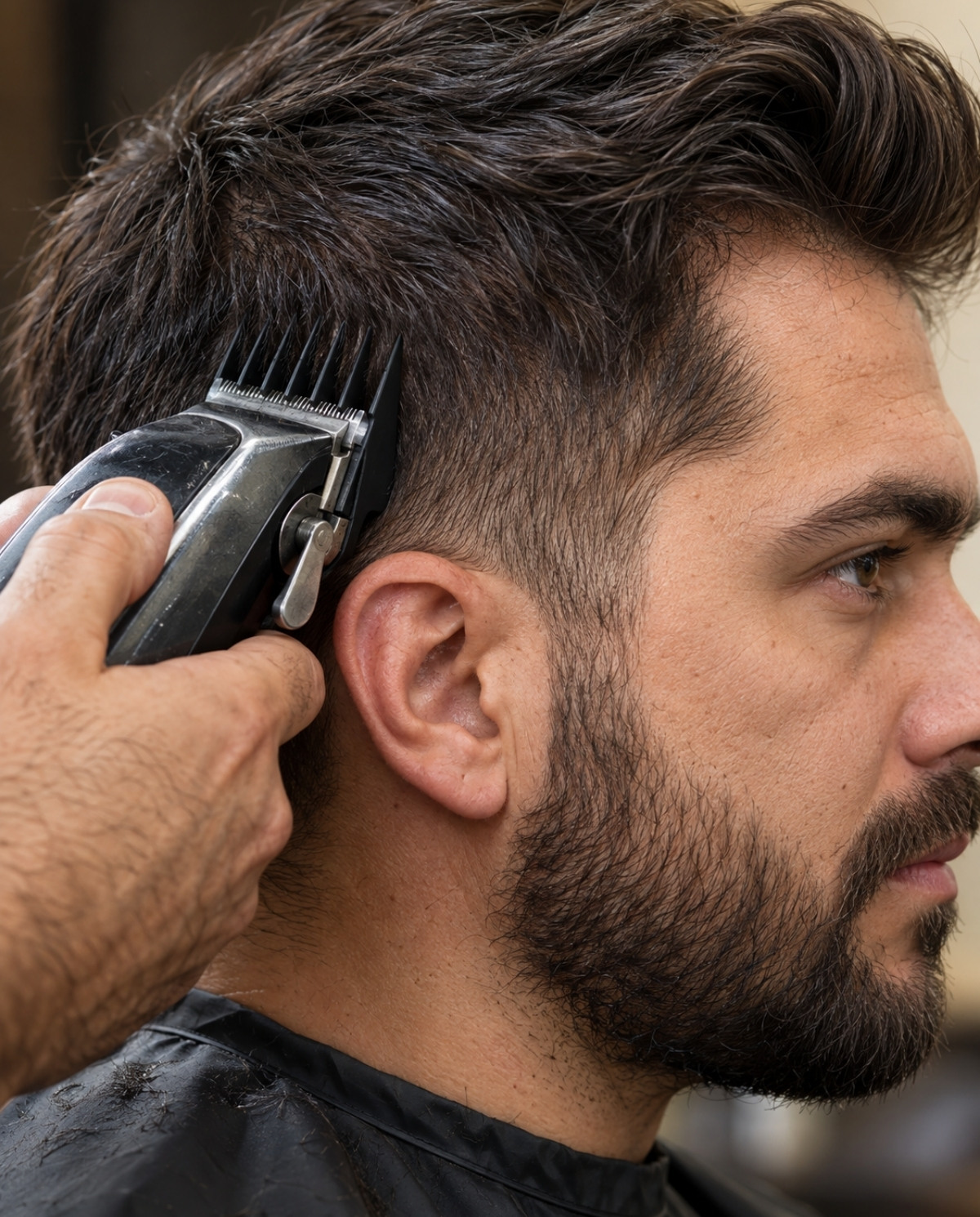
Close-up of a guarded adjustable clipper positioned against a client’s dark side hair above the ear, with the taper lever visible.

A lot of people guess their side length without knowing how barber hair length numbers work in real life. Most standard clipper guards use a simple convention: every whole-number increase generally adds another eighth of an inch to the cutting length. As noted in the Fade Buzz Cut Length Index and Wahl’s official guide comb reference, these guard attachments help control how much hair remains after cutting. Just keep in mind that these measurements are close estimates rather than exact rules across every single brand.

Understanding barber haircut numbers takes away the guessing game. On many clipper systems, a #0 guard leaves roughly 1/16 of an inch (1.5 mm), although #0 attachments and unguarded blade settings vary by manufacturer. Step up to a #1 guard and you leave about 1/8 of an inch (3 mm), creating a very short buzz where your scalp might show clearly. A #2 guard leaves 1/4 of an inch (6 mm) for a clean, classic short side, while a #3 guard leaves 3/8 of an inch (10 mm) for a softer, tailored cut. Finally, a #4 guard leaves 1/2 of an inch (13 mm), offering a moderate length that blends easily into longer hair on top.

If you are wondering what a number 1 haircut means at the barber, asking for a #1 trim typically means the clippers will leave approximately 1/8 of an inch of length. This creates a close, tight style where your scalp may show through, depending on your hair density, strand thickness, and scalp-to-hair color contrast.

One detail many clients overlook is the clipper’s adjustable lever. On many professional clippers, a closed lever produces a shorter cut, while an open lever leaves slightly more hair without changing the guard. That means two haircuts using the same #2 guard may still look slightly different depending on the clipper, blade, and lever position. If you want to repeat a previous haircut, ask your barber to remember the guard number and lever setting.

These barber cut numbers work best when matched to your natural hair characteristics. Hair density refers to the number of individual strands growing within a given area of the scalp, while strand thickness describes the diameter of each hair. Someone can have fine strands but high density, or coarse strands with relatively low density. Both characteristics affect how much scalp appears through a short haircut.

If you have sparse hair, fine strands, or a strong contrast between your hair and scalp color, a #1 guard may make your scalp more noticeable. In those cases, stepping up to a #2 or #3 guard may help maintain the appearance of fullness while softening the visibility of uneven head contours, such as natural bumps or dips along the skull. However, a longer guard does not automatically hide thinning, especially when the surrounding hair is significantly denser.

A skilled barber should also evaluate your natural hairline, crown growth direction, and any areas of thinning before recommending a guard length. For example, cutting too close around a receding temple line may draw attention to that area, while leaving some additional length can help create a more balanced shape. Discussing these characteristics before the haircut helps your barber choose a length that suits both your intended style and your natural hair.

Choosing the Right Fade for Your Haircut

When learning how to describe a fade to your barber, asking for a generic “fade” leaves far too much to chance. A fade is a gradual transition where hair blends from a shorter length near the bottom into longer hair higher up. To get the look you want, break your request down into three specific details.

First, specify your starting point or bottom guard length. A skin fade or bald fade takes the hair at the bottom down to the skin, often using a foil shaver or straight razor for a particularly close finish. Alternatively, a shadow fade leaves a visible amount of very short hair at the bottom, often using a short guard or clipper blade setting. A #0.5 or #1 guard can create a softer shadow, depending on the finish you prefer.

Second, establish the fade height, which describes how high the shorter section and its transition extend along the sides and back of the head. On a low fade, the shortest section stays close to the ears and neckline, with the blend remaining relatively low. On a mid fade, the transition rises farther up the sides, generally creating a balanced appearance between a low and high fade. On a high fade, the shorter section extends considerably higher, often approaching the parietal ridge, the area where the upper head begins curving into the sides.

These descriptions are useful starting points rather than fixed measurements. A low fade on one person may look different on someone with a longer head shape, higher temples, or a more pronounced crown. Showing your barber where you want the shortest section to end can be more precise than relying on the words “low,” “mid,” or “high” alone.

Third, consider the amount of contrast you want between the shortest and longest areas. A high-contrast skin fade makes the change from exposed skin to longer hair more noticeable, while a softer fade creates a less dramatic transition. Recent grooming trends discussed by Men Zone’s 2026 Barbershop Trends highlight interest in more natural, low-maintenance styles and softer blends.

These softer transitions may make regrowth less noticeable than very short, high-contrast fades. However, the time between haircuts depends on your hair growth, the original cut, and how sharp you prefer the finish to remain. Many clients schedule haircuts every three to five weeks, while those who prefer especially crisp skin fades may return sooner.

Another detail worth discussing is whether you want a more level fade or a drop fade. A level fade maintains a relatively consistent transition height around the head, while a drop fade curves downward behind the ears, following the contour toward the back. This changes how much length remains around the crown and back of the head. If you have a prominent crown, cowlick, or particular head shape, ask your barber which approach would preserve a balanced silhouette.

Using Haircut Pictures to Communicate Your Preferred Style
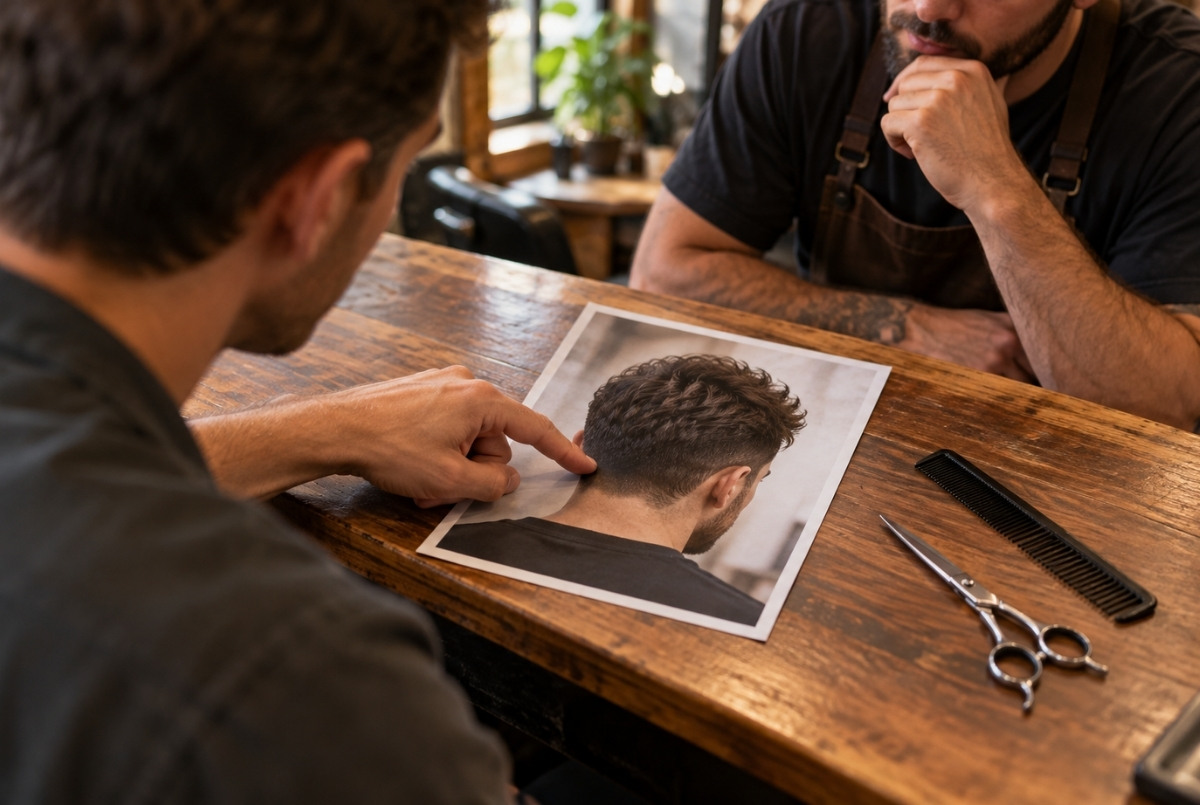
A client points to the tapered neckline in a printed haircut photograph on a wooden counter while a barber studies the reference.

Bringing a picture is one of the easiest ways to explain what you want during a barber appointment, but handing over a single phone photo of a celebrity often falls short. A photo shows an intended style, but it does not account for your personal head shape, hairline, hair density, or natural growth patterns.

To communicate clearly, try a simple three-photo system. The first picture should show your dream style to illustrate the overall shape, top length, and intended flow. The second picture should be a texture match showing someone with hair similar to your natural pattern, whether straight, wavy, coarse, or curly. The third picture should be a no-go photo showing a cut, fade height, or neckline shape you actively dislike, setting clear visual boundaries before the clippers turn on.

Before choosing a reference photo, look beyond the haircut itself. Pay attention to the person’s hairline, density, curl pattern, and natural growth direction. A straight, dense hairstyle may not produce the same silhouette on fine or tightly curled hair, even when the barber follows similar cutting lengths. Ask your barber which details of the reference can realistically be recreated and which may need adjusting.

You should also clarify whether the photographed hairstyle requires blow-drying, styling products, or daily maintenance. A heavily styled haircut may look very different once it is washed and left to air-dry. If you only have a few minutes to style your hair each morning, your barber can recommend adjustments that make the look more manageable.

Getting these details right matters beyond a single appointment. According to Zenoti’s Salon and Barbershop Metrics Guide, first-to-second-visit retention is one of the key measures barbershops can track to understand whether new clients become returning customers. These figures do not identify poor consultations as the main cause of client loss, but they reinforce the business importance of building strong relationships from the first appointment.

When students train in a quality barbering or cosmetology program, they learn to evaluate hair characteristics and discuss suitable services with clients. This includes identifying natural growth direction, cowlicks, which are areas where hair grows in a different direction from the surrounding strands, and the way a haircut interacts with facial features. A thoughtful consultation helps connect the client’s desired appearance with a haircut that can realistically work for their hair.

How to Tell Your Barber Exactly What You Want
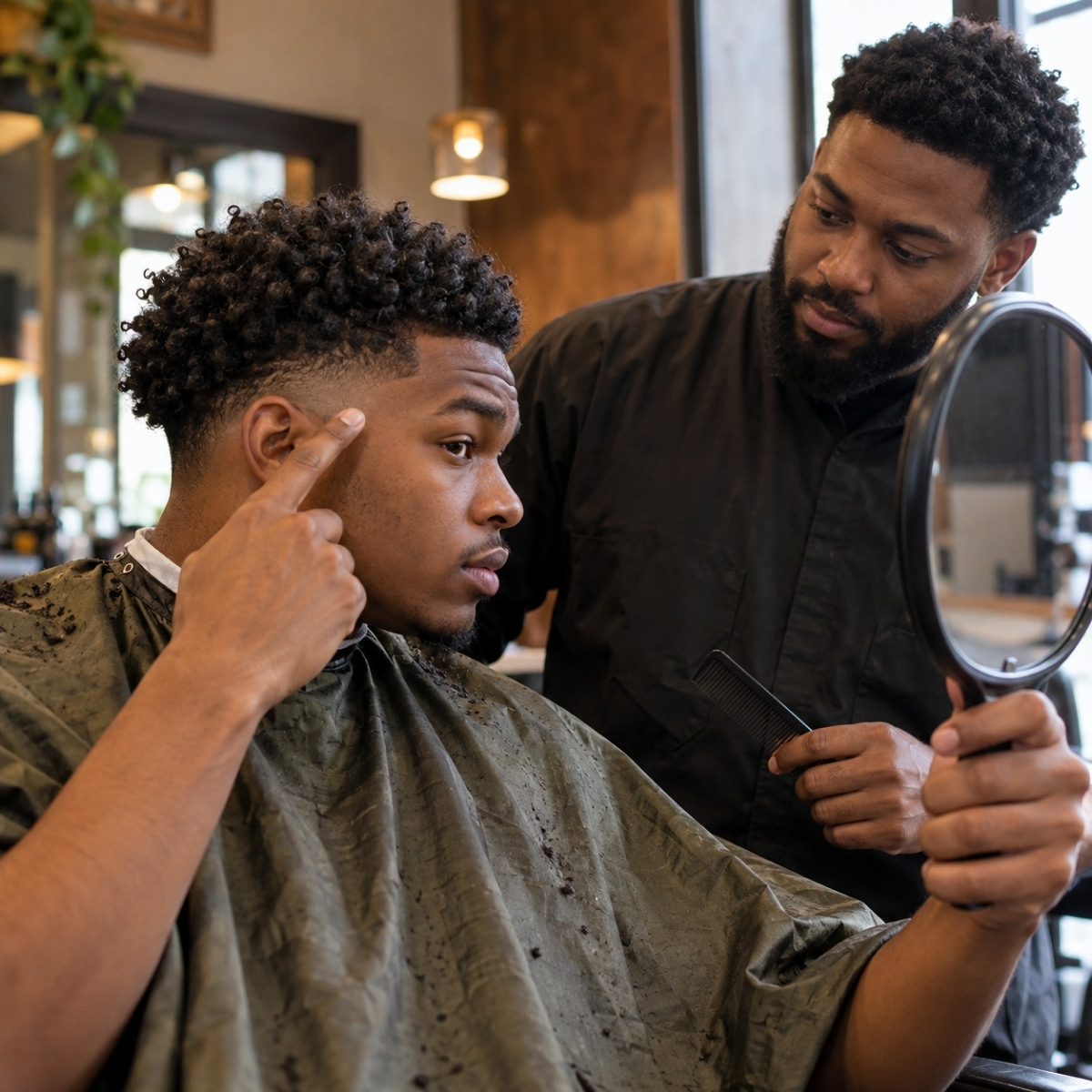
A client with tightly curled hair points to his temple while holding a hand mirror, and the barber pauses to listen with a comb.

If you sit down and freeze up when trying to figure out how to tell a barber to cut your hair, use this reliable three-part formula: top length, side guard or fade height, and neckline finish.

For example, you can explain that you would like to keep about two inches on top with some textured weight, use a mid fade starting at a #2 guard on the sides, and keep the neckline tapered naturally. This gives your barber a useful starting point for discussing the shape and length you want. Avoid vague phrases like “just make it short on the sides and take a little off the top,” which leave too much room for interpretation.

If you step inside a shop without a clear plan, you might wonder what to say when you do not have a specific look in mind. You can visit a barber without knowing exactly what you want and ask for a recommendation. The key is framing your request around your daily routine rather than technical terms. Ask what cut works best with your head shape and a two-minute morning routine, or explain where your hair gets bulky after two weeks so your barber can shape it to grow out more naturally.

You can also explain what you disliked about your previous haircut. For example, mentioning that the sides became too bulky, the top was difficult to style, or the neckline looked too sharp can give your barber practical information. These details often communicate your expectations more effectively than a haircut name alone.

Learning how to respond to client anxiety is another important part of professional customer care. As discussed in Manhattan Barbershop’s guide to barbershop anxiety, some clients feel uncomfortable because of clipper noise, close physical contact, or uncertainty about what is happening during the service. Sitting in a chair facing away from the mirror can also make it difficult to follow the barber’s progress.

A considerate barber can help build trust by explaining major steps, checking preferences before removing significant length, and allowing the client to ask questions or request a pause. If you feel uncomfortable during your appointment, it is reasonable to ask for clarification before the barber continues.

Common Questions About Barber Appointments

How Does a Taper Differ From a Fade Haircut?

A fade gradually blends hair from very short to longer lengths, often across the sides and back of the head. A traditional taper usually maintains more length overall and concentrates the shortest blending near the sideburns and neckline. However, the terminology can overlap, and different barbers may interpret these styles differently. Showing a reference photo is one of the easiest ways to clarify exactly how short and how high you want the blend.

Do You Need to Wash Your Hair Before a Barber Visit?

Arrive with reasonably clean hair and avoid heavy buildup from styling products like thick pomades or clays. Clean hair makes it easier for your barber to evaluate its natural fall, growth direction, and density. However, you do not necessarily need to wash your hair immediately before your appointment, especially if the service includes shampooing. If you have curly or textured hair, ask whether your barber prefers it in its natural state, detangled, or prepared in a specific way.

Can You Ask Your Barber to Adjust the Length During a Haircut?

Yes. Speak up as soon as you notice that the length is not what you expected. Barbers generally appreciate having an opportunity to adjust the cut before the appointment ends. Removing additional length is usually straightforward, although some changes may require extra blending or reshaping. If the hair appears too short, explain your concern before more is removed, since cut hair cannot be immediately restored.

Why Client Consultation Is an Essential Barbering Skill

For future stylists and barbers, mastering haircut terminology and client communication is just as important as building technical dexterity with shears and clippers. Professional success depends on more than delivering a technically clean cut. Understanding client expectations, recommending realistic styles, and maintaining positive relationships can all contribute to a stronger reputation and repeat business.

Industry data reinforces the value of maintaining client relationships. According to Zenoti’s 2026 Barbershop Trends report, new guest visits among barbershops in its North American benchmark dataset declined 17% in 2025 on a same-store basis, while existing guest visits increased 2%. These findings highlight the importance of serving returning clients, although the report does not establish that consultations directly cause higher retention.

Professional barber education also involves meeting state-established training and licensing requirements. In South Carolina, the South Carolina Board of Barber Examiners requires aspiring registered barbers to complete 1,500 hours at a Board-approved barber college or school, or 1,920 hours of supervised on-the-job training as an alternative pathway. Applicants must also pass the required National Interstate Council (NIC) theory and practical examinations. These requirements help establish consistent educational and professional standards for individuals entering the barbering industry.

Beyond preparing students for licensing requirements, formal barbering education can introduce them to hair and scalp structure, hair growth patterns, infection control, and the business responsibilities involved in serving clients. These skills help professionals make informed haircut recommendations and communicate the reasons behind their choices rather than relying on guesswork.

For those considering the profession, the career outlook offers opportunities alongside real earning differences. According to the U.S. Bureau of Labor Statistics, the median hourly wage for barbers was $18.37 in May 2025, including tips, while barber employment is projected to grow 3% from 2025 to 2035. Individual earnings depend on experience, location, clientele, employment arrangement, and business performance.

For aspiring professionals interested in developing these skills, the Barbering program at Aiken School of Cosmetology and Barbering offers hands-on instruction in haircutting, trimming, shaving, grooming, and styling. The school also highlights training related to salon business, client retention, resume writing, and job-seeking skills. Combining technical ability with attentive customer service creates a stronger foundation for long-term professional growth.

Build Your Future in Professional Barbering

Turning client uncertainty into trust is one of the skills that can help barbers establish long-term relationships and grow their careers. If you want to take your passion for hair to a professional level, visit the Enrollment page at Aiken School of Cosmetology and Barbering to explore the application process, admission requirements, and opportunities to visit the campus.

Whether you are interested in barbering as a career or simply want to learn more about the training environment, you can schedule a campus tour to meet the team and ask questions about the program. Leave your contact information in the form below, and an admissions representative can help you explore your next steps.

How Much Do Barbers Make After Rent, Fees, and Taxes?

Key Points to Know About Barber Earnings

  • Use published wages as a starting reference: BLS places the median employee barber wage at $18.37 an hour for May 2025. At 2,080 hours, that translates to approximately $38,210 a year. Employee tips and commissions are included, while self-employed earnings are outside the wage survey.
  • Work out what remains after deductions: The amount customers spend is only the beginning of the calculation. Commission shares, chair rental, supplies, payment fees, and taxes affect the money available for personal use.
  • Compare rental costs with the commission you would give up: In an example where the barber keeps 60% of service sales and renting adds $400 in weekly expenses, both arrangements produce the same pretax amount at $1,000 in weekly service sales, assuming equal tips and otherwise comparable conditions.
  • Budget taxes from business profit: The standard self-employment tax rate is 15.3%, generally calculated on 92.35% of net self-employment earnings. The Social Security earnings cap and possible Additional Medicare Tax can change the final calculation.
  • Improve the economics of each working week: Repeat customers, pricing that accounts for appointment time, profitable product recommendations, and controlled expenses can support stronger earnings alongside a realistic workload.

Reading Barber Wage Statistics Without Overestimating Your Pay

Federal wage figures offer a useful reference when you are exploring barbering as a career. For anyone researching barber yearly salary, the U.S. Bureau of Labor Statistics Occupational Outlook Handbook reports a median wage of $18.37 per hour for barbers in May 2025. Applying that hourly figure to 40 hours a week over 52 weeks gives approximately $38,210 annually.

That annual calculation assumes 2,080 paid working hours. A part-time schedule, unpaid time away, or fewer hours during quieter periods will produce a different yearly total.

A median identifies the midpoint of the workers represented in the data: half earn above it and half below it. The arithmetic mean is a separate measure. Neither tells you the maximum income you could eventually earn.

Survey coverage also matters. The BLS explanation of its Occupational Employment and Wage Statistics survey states that wages include employee tips and commissions. However, the survey excludes self-employed workers and owners or partners in unincorporated firms. Barbers operating genuinely independent booth-rental businesses are therefore outside these employee wage estimates.

For a renter, customer payments are business receipts from which operating expenses must still be paid. For an employee, compensation is the wage or commission received from the shop, plus applicable tips. Comparing the renter’s total receipts with an employee’s paycheck would mix two different financial measures.

The exclusion of independent businesses also does not prove that self-employed barbers earn a particular percentage more than employees. Their results depend on customer demand, pricing, costs, and how consistently they fill appointments.

Use the government figures to understand employee pay, then prepare a separate budget for the arrangement you intend to pursue. To include education expenses in that plan, read our guide to barbering college tuition, tools, and the time needed to graduate.

Turning Appointment Prices Into a Realistic Revenue Estimate

Estimating income requires more than choosing a haircut price and multiplying it by a full calendar. You need to consider completed visits, spending per appointment, service duration, and the expenses associated with the work.

What a Higher Service Ticket Really Adds

When asking how much do barbers make per cut, distinguish the customer’s payment from the barber’s compensation. A $35 haircut creates $35 in service sales. Under commission, only the agreed share belongs to the barber. Under rental, the full payment enters the business, but rent and other expenses still have to come out.

Local competition, service complexity, and the type of shop influence pricing. Reviewing current menus from comparable nearby businesses provides a more useful planning reference than assuming one price applies nationwide.

An additional service can raise the average ticket, meaning the amount spent during a visit. For example, a hypothetical $30 haircut plus a $15 beard trim produces a $45 ticket. The extra revenue is useful only when considered alongside the additional time and cost.

A 30-minute haircut priced at $30 generates $60 per service hour before expenses. A haircut-and-beard appointment priced at $45 and lasting 45 minutes also generates $60 per service hour. Although the second client spends more, the hourly service revenue remains unchanged.

Evaluate each service by its price, duration, supplies, and contribution to profit. A larger ticket alone does not establish that an appointment is more profitable.

Estimating the Number of Visits You Can Complete

There is no universal answer to how many cuts does a barber do a day. Detailed styles, consultations, cleaning and disinfection, breaks, and booking demand all affect capacity.

Imagine an eight-hour shift with one hour allocated to breaks, cleaning, and administrative work. The remaining seven hours provide 420 minutes for appointments. At 45 minutes per visit, that allows approximately nine completed appointments.

This is a scheduling example rather than a daily production standard. Shorter services may create more openings, while more involved work may require a smaller appointment count. Make sure the schedule also allows appropriate cleaning and disinfection between clients.

Available slots and paid visits are different numbers. No-shows, cancellations, and unbooked periods reduce actual sales, so base your budget on the appointments you reasonably expect to complete.

Calculating Daily Receipts Across Your Full Shift

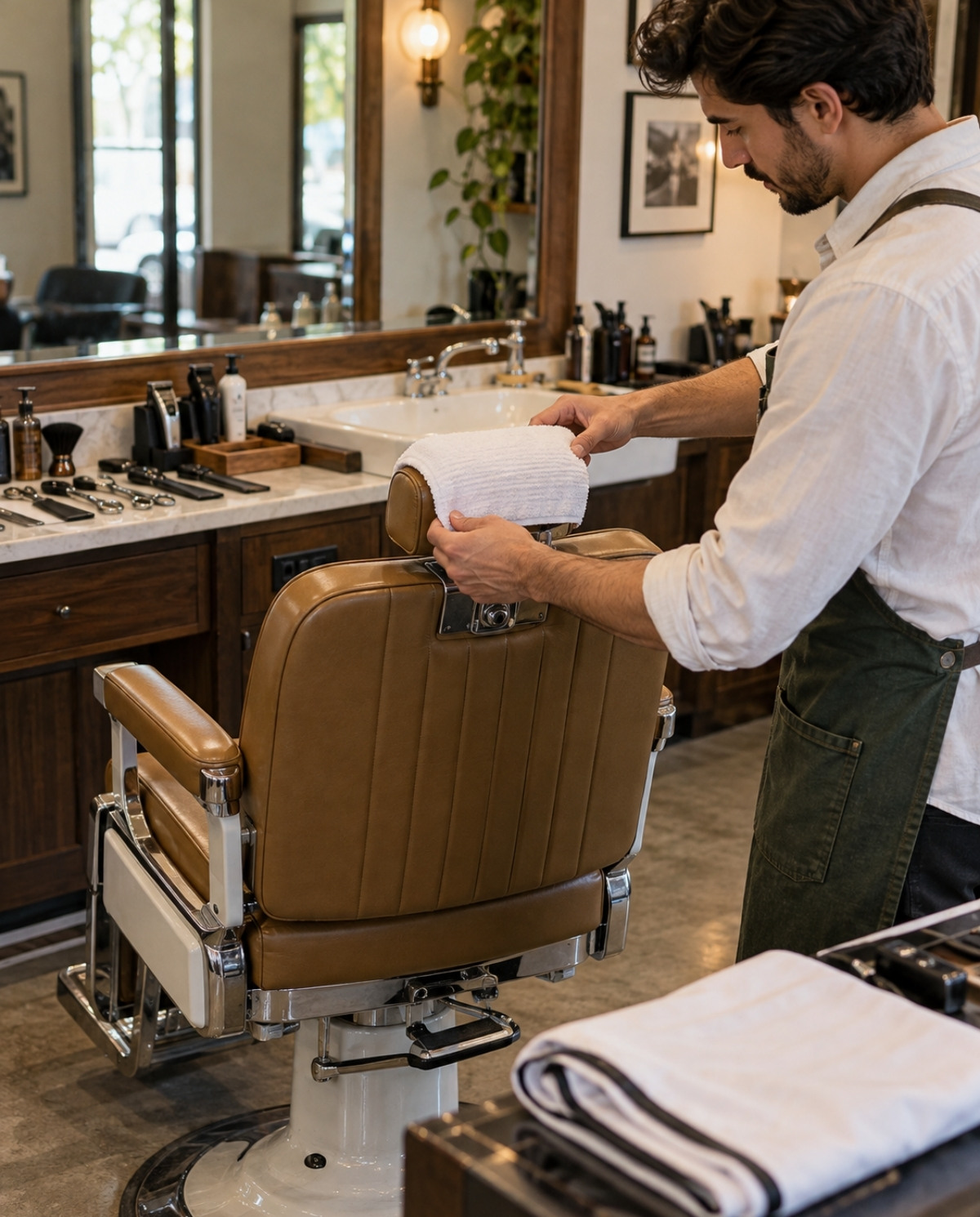
Barber fitting a fresh white covering over a tan chair’s headrest, with organized tools and a folded cape nearby.

To illustrate how much does a barber make a day, assume ten completed appointments with an average service ticket of $35. Those visits generate $350 in service revenue.

If tips total a hypothetical 15% to 20% of service sales, they add $52.50 to $70. Combined daily receipts would be $402.50 to $420 before commission deductions, operating expenses, and taxes. The tip percentage is a planning assumption, not a verified amount that every barber or client follows.

For anyone calculating how much do barbers make an hour, include the entire working shift. Over eight hours, the example produces approximately $50.31 to $52.50 an hour in gross receipts. It does not represent an hourly take-home wage.

Recording paid visits, average spending, and total working hours helps you measure what your schedule actually produces.

Finding the Income Left After Business Expenses

Service sales and product revenue show how much money enters the business. They do not show how much is available for your personal spending.

A self-employed barber starts with service receipts, tips, and retail sales, then deducts business expenses. These may include chair rental, supplies, payment processing, booking software, insurance, and equipment costs. The result is business profit before applicable personal taxes, including self-employment tax.

An employee starts with the compensation paid by the employer, whether that is hourly pay, commission, or another agreed structure, along with applicable tips. The shop’s total customer receipts are not the employee’s income.

These separate calculations make it easier to compare offers. A rental chair bringing in more customer payments can still leave less money after expenses than an employee role with dependable bookings.

Comparing Commission Work With an Independent Rental Chair

Commission compensation and chair rental are two possible arrangements. Other shops may provide hourly wages, salaries, or a combination of payment methods.

  1. Commission arrangement: In an example 60/40 service split, the barber receives $60 from each $100 in service sales, with $40 going to the shop. The agreement should identify how tips are treated and which costs the shop pays, such as products, towels, booking systems, and advertising.
  2. Independent chair rental: The barber pays an agreed fee for space and generally operates a separate business. Service payments and tips belong to that business, while responsibility for supplies, software, processing fees, insurance, and other costs depends on the rental agreement.

Receiving commission does not, by itself, establish whether someone is an employee or an independent contractor. Likewise, calling an arrangement “rental” does not settle worker classification. The IRS guidance on employee and independent-contractor status considers behavioral control, financial control, and the nature of the relationship.

Before accepting an arrangement, clarify who controls prices and schedules, which expenses are included, how clients are assigned, and how tips are handled. For the licensing steps needed before professional practice, see our guide to barbering license requirements and state board preparation.

Working Out Your Rental Crossover Point

A rental payment remains due during a slow week. Moving into that arrangement before sales become dependable can therefore reduce the amount you keep.

Start by identifying the expenses renting would add compared with the commission role. Under an example where the barber keeps 60% of service revenue, the shop’s 40% share is the amount available to offset those additional rental costs.

If the additional expenses are fixed, divide them by 0.40 to estimate the sales level where both arrangements produce the same pretax result. With an illustrative $400 in added weekly costs:

$400 ÷ 0.40 = $1,000 in weekly service sales.

At $600 in service sales, renting leaves $200 after those costs, while the 60% commission share produces $360. At $1,500 in sales, renting leaves $1,100, compared with $900 under commission.

These figures assume identical service sales and tips under both arrangements, with the $400 covering all additional rental expenses. They exclude personal taxes and other differences between the roles.

If processing fees or supply costs rise with sales, account for those variable expenses separately. Employee benefits, different tax obligations, and access to customers supplied by the shop may also affect the comparison.

There is no single sales target that makes renting the right choice for every barber. Build the decision around dependable revenue and the actual terms offered to you.

Keeping Tax Money and Operating Money Separate

Barber and shop manager reviewing an agreement at a wooden table with a calculator and an empty workstation behind them.

Self-employed barbers generally owe self-employment tax alongside applicable federal and state income taxes. According to the IRS explanation of self-employment tax, the standard rate combines 12.4% for Social Security and 2.9% for Medicare, totaling 15.3%.

Generally, 92.35% of net self-employment earnings is subject to the calculation. Net earnings are determined after subtracting ordinary and necessary business expenses, rather than applying the rate directly to total customer payments.

The Social Security portion has an annual earnings cap, while Additional Medicare Tax may apply above specified income thresholds. One-half of self-employment tax is generally deductible when calculating adjusted gross income.

Maintain records of service income, product sales, cash payments, tips, and business expenses. The IRS publication for the cosmetology and barbering industry discusses independent rental businesses, income reporting, and recordkeeping. Use current IRS guidance for applicable tax-year rules and filing requirements.

Setting money aside for taxes and future equipment purchases helps prevent business funds from being mistaken for disposable income.

Expanding Earnings Through Products and Market Awareness

More appointments are one route to additional sales, but they are not the only option. Suitable product recommendations, carefully priced specialty services, and an understanding of local demand can also improve business results.

Specialty services may require additional appointment time. Evaluate their hourly revenue and costs before assuming they increase earnings without extending the working day.

Measuring Your Return From Product Recommendations

Pomades, beard oils, and shampoos can help customers maintain their results at home. Selling an appropriate product can add revenue without scheduling another full haircut appointment.

The amount sold is still different from the amount you earn. Four products priced at $20 each generate $80 in retail sales. With a hypothetical 10% retail commission, the barber receives $8. Repeating that sales level across 20 working days produces $160 in commission.

For barbers who buy and resell their own stock, profit depends on wholesale prices, processing fees, and other selling expenses. Products that remain unsold or become damaged can reduce the return.

The Grand View Research report on men’s grooming products projects a global market value of $506.7 billion by 2033. Its coverage extends across multiple product categories and retail channels, so the forecast does not measure barbershop service income or establish what an individual barber will earn.

For practical planning, track the commission or margin from your own sales and recommend products suited to each customer’s needs.

Assessing a Location Beyond Its Haircut Prices

Higher menu prices can create an opportunity for stronger revenue, but local rent, competition, and customer demand influence how much remains. Living costs also affect the purchasing power of your personal income.

The Best Cosmetology Programs barber salary guide lists May 2025 median annual employee wages of $61,150 in Washington, $30,750 in Georgia, and $25,640 in Arkansas. Those figures refer to employed barbers, rather than the sales or profits of independent businesses.

The BLS wage tables for states and metropolitan areas provide a direct starting point for local comparisons. Keep the occupation, survey year, and wage measure consistent. A statewide median does not predict the earnings of a beginner or a particular neighborhood shop.

Before choosing where to work, examine:

  • Comparable service menus: What nearby businesses charge for similar appointments.
  • Expected paid visits: Likely customer demand after allowing for quiet periods and cancellations.
  • Expenses attached to the chair: Rental charges, supplies, payment fees, insurance, software, and marketing.
  • Convenience for returning customers: Whether clients can reach the shop easily and maintain their appointment routine.

Experience and a strong reputation may support higher prices. The useful financial measure, however, is the profit those prices produce after accounting for time and expenses.

Choosing Training That Prepares You for Shop Work

Technical skill supports the financial side of barbering. Consistent results, safe practices, effective consultations, and good time management help create the service experience customers return for.

When comparing programs, look beyond the completion date. Ask how students practice client interactions, prepare for licensing, and learn about professional responsibilities.

Our guide to becoming a barber and entering the profession explains the broader path from initial interest to career preparation.

Training areas worth reviewing include:

  • Reliable practical skills: Accurate cutting, safe equipment use, and organized work habits that allow appropriate consultations and disinfection.
  • Relationships with returning clients: Understanding preferences, producing repeatable results, and discussing suitable maintenance schedules.
  • Preparation for business decisions: Service pricing, product recommendations, work arrangements, expense records, and the boundaries of licensed practice.

Licenses do not permit identical services in every state. As one example, Georgia’s barber training regulations provide separate curricula for Master Barber and Barber II training, with chemical services included in the Master Barber curriculum.

For Georgia-specific requirements, consult the Georgia State Board of Cosmetology and Barbers licensing guide. If you plan to work elsewhere, verify the permitted services and qualifications with that state’s licensing authority.

Education provides a foundation. Your subsequent earnings will also reflect experience, local demand, returning customers, and the decisions you make about costs and working arrangements.

Questions About Income and Everyday Barbering Work

Barber trainee discussing a client’s hair length with a comb beside a mirror while an instructor observes the consultation.

How much can tips contribute to a barber’s earnings?

Tip income varies between customers and appointments. As a hypothetical example, a 15% to 20% gratuity on a $30 haircut adds $4.50 to $6. Ten appointments would generate $45 to $60 in tips if every customer tipped within that range.

Do not assume that result will repeat every day. Record tips separately, and remember that BLS employee wage figures already include them. Adding another tip percentage to those published wages would double-count that component.

What size client base supports a regularly booked schedule?

There is no dependable timetable for building a full roster. Location, access to walk-ins, availability, service quality, and repeat visits all influence progress.

A numerical target can still help with planning. Ten appointments a day over five days requires 50 weekly visits. If each regular customer returns every two weeks, approximately 100 active clients would support that volume. With four-week return intervals, the comparable roster is approximately 200 clients.

Those calculations assume appointments are distributed evenly and nobody cancels. Monitor actual return intervals, rebooking, and completed visits to see whether your client base supports the schedule you want.

What physical demands should a future barber expect?

Long periods on your feet and repeated movements of the hands, wrists, and arms are part of the work. The BLS description of the occupation identifies physical stamina as an important quality because much of the shift is spent standing.

Appropriate chair height, suitable equipment, changes in posture, and breaks can help manage strain. Persistent pain or numbness should be evaluated rather than accepted as an unavoidable part of the profession.

How do barbering and cosmetology licenses differ?

Barbering generally concentrates on haircuts, beard and mustache grooming, and shaving. Cosmetology usually includes a wider combination of hair, skincare, and nail services.

However, those general descriptions do not define the legal scope of every license. Some barber licenses permit chemical hair services, and the boundaries vary by state and license category. Check the relevant board’s rules before selecting a program or offering a new service.

Explore Your Barbering Education at Aiken

A professional barbering career begins with practice, instruction, and preparation for working with clients. At Aiken School of Cosmetology and Barbering, the school’s focus on developing “Salon Ready” graduates connects hands-on education with career preparation.

The barbering program offers practical training in haircutting, trimming, shaving, grooming, and styling. Its listed learning areas also include salon business and client retention, helping students explore responsibilities beyond performing a service.

Visit our Enrollment page to learn about the next steps and request a campus tour. You can also use the contact form below to arrange a visit, meet the team, and ask how the program fits your professional goals.

Opening a Barbershop? What to Know Before You Commit Your Money

What to Know Before Opening Your Shop

  • Business Ownership Does Not Authorize Barbering: Many states allow investors to own barbershops without a personal barber credential. The premises still need the appropriate establishment license, practitioners must be properly licensed, and any professional management requirements must be satisfied.
  • Evaluate the Numbers Before Leasing: A former salon or barbershop may lower renovation expenses, provided its infrastructure remains suitable. Get contractor bids, forecast early cash flow, and work out the revenue needed to cover your costs before committing.
  • Check Your State’s Operating Rules: Georgia requires salon/shop owners to complete an approved health, safety, and sanitation course. Arkansas requires professional supervision and management by a registered barber.
  • Contracts Alone Do Not Determine Worker Status: Independent chair renters need genuine business independence. Setting their prices, assigning shifts, or directing their service methods can create employee-classification risks.
  • Measure What Booking Software Delivers: Digital scheduling, reminders, and payment policies can support shop operations. Use completed appointments, cancellations, occupied working hours, and revenue to evaluate their actual value.

Taking the leap into commercial real estate is one of the biggest moves you can make when launching a beauty or grooming business. Too many aspiring shop owners jump straight into signing a lease without mapping out the practical and legal groundwork first. If you are also thinking about picking up the shears yourself alongside building a new business, exploring how to become a barber gives you a clear look at what training and professional milestones lie ahead.

Can You Own the Business Without Working as a Barber?

If you do not have hands-on haircutting experience, you might feel a bit out of place entering the grooming field. However, running a business and providing regulated services are two different responsibilities. The key first step is checking how your state licenses the physical location, its working barbers, and whoever is responsible for professional oversight.

Separate the Shop License From Permission to Provide Services

To build a legally compliant business, you need to understand the distinction between an establishment license and an individual practitioner license.

An establishment license authorizes operation of the shop under state rules. An individual practitioner credential authorizes a person to perform specific services within that credential’s scope of practice.

When people research how to set up a barbering shop, they often confuse these two frameworks. The New York State Division of Licensing Services explains that a Barber Shop Owner’s license does not permit its holder to practice barbering. Each person performing barbering services must hold the appropriate operator credential. New York also specifically prohibits apprentice barbers from owning a shop or renting space.

For an owner who does not provide services, responsibilities can include brand development, finance, marketing, and business administration. However, running a shop without a personal license does not remove your obligation to maintain a properly licensed facility, satisfy health and sanitation rules, and arrange any professional supervision required by state law.

If you are wondering whether you can open a barber shop without being a barber, keep in mind that ownership does not authorize you to offer regulated services such as haircutting, shaving, or line-ups. You must hold the appropriate credential for the services you provide. The legal line comes down to the actual services you perform, rather than whether you touch a tool. Understanding scope of practice, which defines the services a credential legally permits, helps protect both your clients and your venture.

If you want to know how your prospective staff earns their credentials, our guide on how to get your barbering license breaks down the training, examination, and state board process.

What Georgia and Arkansas Require of Shop Operators

State regulations vary across the country, so looking at concrete examples helps clarify what to expect:

  • Georgia Requirements: Georgia’s establishment application rules allow a person or group to apply to operate a salon or shop without requiring every owner to hold a practitioner credential. Under Georgia Board Rule 240-12-.01, the salon/shop owner must complete a board-approved health, safety, and sanitation course. The business name must include “Salon” or “Shop,” and the location must be licensed before conducting business.
  • Arkansas Requirements: Under Arkansas Code §17-20-301, published by the State Board of Barber Examiners, a barbershop must operate under the personal supervision and management of a registered barber. The statute also prohibits allowing an unlicensed person to serve as a barber manager. A non-barber investor must therefore separate business ownership from the licensed management needed to operate the shop.

These examples show why a general answer is never enough. Before signing a lease, confirm whether your state demands a designated licensed manager, which credential qualifies, and what supervision rules apply. Do not assume titles or staffing rules are identical everywhere.

Assess the Property and Financial Commitments Together

A commercial lease binds you to ongoing expenses long before your shop builds a steady client flow. Start by reviewing potential locations and comparing a former salon or barbershop against a raw retail shell. From there, figure out whether the space can satisfy licensing and building standards, estimate construction costs, and verify that the business can handle the overhead.

Making the right site selection requires balancing construction feasibility, realistic income projections, and solid lease negotiations.

Account for More Than Chairs and Interior Finishes

Setting up a retail storefront can require substantial plumbing, mechanical, and electrical work. Many new entrepreneurs budget for mirrors, waiting chairs, and wall paint while forgetting about hot water capacity, drainage, electrical upgrades, and other basic infrastructure.

Plumbing costs can climb fast if the space needs new lines or if concrete floors have to be broken open for drainage. Because no universal percentage fits every layout, get quotes based on your specific floor plan and service list.

As a rough reference, Menubly’s barbershop startup-cost guide estimates that a complete build-out can run from $15,000 to $50,000 or more, with barber chairs and station equipment budgeted separately. Treat these numbers as general guide estimates rather than fixed benchmarks or substitutes for local contractor bids.

To preserve capital, look for second-generation spaces that used to be salons or barbershops. Menubly notes that existing plumbing and electrical setups may save between $10,000 and $20,000. Actual savings will depend on whether those systems are still usable and meet the requirements for your shop.

A former pet grooming location might also look interesting, but existing sinks and drains do not automatically make it legal or functional for human grooming services. Have qualified professionals assess the layout and infrastructure before counting any savings in your budget.

Keep build-out costs separate from other startup expenses like security deposits, licensing fees, equipment, initial supplies, signage, insurance, and launch marketing. Prepare an early-stage cash-flow forecast showing when payments are due and when revenue is expected to arrive. Then budget a reserve for the period when expenses may exceed incoming revenue while your clientele develops.

Translate Monthly Expenses Into a Realistic Sales Target

Plumber crouches beside an open cabinet to inspect the supply connections and drain beneath a barbershop shampoo basin while the owner watches.

A space can be cheap to renovate and still cost too much to run month after month. Before signing on the dotted line, calculate how much client volume you need to cover your operating costs.

The U.S. Small Business Administration’s break-even calculator applies a calculation that can be expressed for a service business as:

Services needed to break even = monthly fixed expenses ÷ contribution earned per service

For an employee-based business model, contribution per service equals your average service price minus the variable costs connected to that service. Depending on how you pay staff, variable costs might include commissions, disposable supplies, and credit card processing fees.

For instance, if your shop has $6,000 in monthly fixed costs and a $20 contribution per completed service, you would need 300 services each month to reach break-even. Over 25 working days, that comes out to 12 services a day. These numbers are purely illustrative rather than industry benchmarks.

Check whether your staffed chairs and available barber working hours can realistically deliver that volume. Consider appointment lengths, opening hours, and local demand; an installed chair contributes no service capacity when nobody is available to work at it. Remember to factor owner compensation and loan payments into your broader cash-flow projections, and never count employee tips as shop revenue.

If you run a booth-rental shop, compare your total overhead against expected rental payments from occupied chairs. Test what happens to your cash flow if a chair sits empty for a month or two. Weekly chair rent can make income more predictable, but only when stations stay filled and renters pay on time.

Investigate the Space Before Accepting the Lease Terms

When looking at candidate properties, go beyond counting foot traffic. Review these practical factors before committing:

  1. Plumbing and Electrical Capacity: Have qualified professionals evaluate water supply lines, drainage, water-heating capacity, and electrical capacity for your planned equipment. Existing hookups may require repairs or upgrades.
  2. Facility and Occupancy Requirements: Confirm that your intended business use is allowed and that the floor plan can meet accessibility, building, fire, and board requirements. A previous salon layout does not guarantee automatic approval.
  3. Parking and Customer Access: Check how clients will drive or walk to the building, where they can park, and whether the entrance works well for your intended clientele.
  4. Approval Contingencies: Negotiate lease provisions covering necessary approvals, application deadlines, and exit rights if those approvals cannot be obtained. Specify how security deposits and prepaid rent are handled instead of assuming payments are refundable.
  5. Construction and Operating Terms: Spell out responsibility for code compliance upgrades, landlord build-out allowances, rent start dates, common-area charges, ongoing repairs, and any rules regarding subleasing or chair rental.

If you are looking at a Georgia location, the Board’s facility rules set out standards for physical separation, equipment condition, hot and cold running water, restroom access, and mandatory posting of licenses and inspection reports.

Go through these items while comparing properties. Discovering layout problems after signing your lease can quickly wipe out any savings you expected from an existing space.

Decide Whether to Collect Chair Rent or Employ Your Barbers

Your chosen staffing structure shapes your revenue streams, daily management tasks, and tax obligations. In a true booth-rental setup, barbers run independent businesses and pay rent for their station. In an employee-based business, the shop manages staff and pays hourly wages, commissions, or a mix of both.

Neither structure is inherently more profitable. Compare the projected income of each option against the management duties and financial liabilities that come with it.

Provide Space for Genuinely Independent Businesses

Booth renters pay a weekly or monthly fee to use a chair and designated workspace. Key markers of an independent operator include setting their own service prices, managing their own calendar, buying their own products, and handling their own business costs.

The IRS guide for the cosmetology and barber industry highlights these factors when evaluating chair renters. Its classification examples are helpful, though you should verify current tax filing rules separately.

Renting chairs can reduce payroll administration for a barber shop owner and create rental revenue. However, exercising employee-style control over a renter’s schedule, pricing, or service techniques can undermine the arrangement’s independence. Facility sanitation responsibilities and appropriate premises policies still need to be addressed.

A clear written rental agreement should detail the rented space, rent amount, included utilities or supplies, building access, insurance obligations, and termination terms. Your daily operations must align with the actual independent relationship described in the agreement.

Understand the Responsibilities That Come With Employees

Employees work for your business. That means your shop can set service prices, schedule shifts, establish lawful workplace policies, process client payments, and pay workers through hourly pay, commission, or a combined structure.

This approach gives you direct control over the client experience, but it brings payroll processing, employment taxes, detailed recordkeeping, and wage compliance duties. Generating higher service sales does not automatically equal higher profits once labor and overhead expenses are factored in.

Paying on commission does not automatically exempt employees from minimum wage or overtime protections. The U.S. Department of Labor’s guidance on commissioned retail and service employees outlines the conditions required to qualify for the federal retail-service overtime exemption. State wage laws may impose additional rules.

Always record working hours accurately and review your total compensation setup before relying on any overtime exemption.

Make Worker Classification Match Everyday Practice

Barbershop owner reviews paper records beside a laptop in a back office while a barber provides a haircut through the adjoining doorway.

A business can house both regular employees and booth renters, but every worker relationship must be structured and handled correctly. Problems arise when someone is labeled an independent contractor while the owner exercises control associated with employment.

According to IRS worker-classification guidance, the entire relationship must be evaluated. Behavioral control, financial control, and the underlying nature of the arrangement all play a role, and no single factor determines the outcome.

Setting a renter’s prices, requiring specific work shifts, or mandating how haircuts are performed can weigh toward employee status. Calling someone a 1099 contractor or having them sign a rental form does not resolve the classification question.

Misclassifying workers can trigger employment-tax liability and other obligations under wage, unemployment, and workers’ compensation laws. Additionally, renting a chair does not automatically mean you need to issue a contractor-payment tax form to the renter, as reporting depends on the payments and arrangement.

Create the Systems Your Professionals Need to Work Well

Managing licensed barbers when you do not work behind the chair yourself requires a clear focus on leadership. Concentrate on building administrative systems that keep the shop running smoothly, while ensuring any legally required professional supervision is in place.

Solid facility management, clear agreements, and useful technology help you support the team without attempting to direct technical work outside your experience.

Focus Your Leadership on Business Operations

When learning how to own a barbershop without a barber license, focus your energy on eliminating operational hiccups that slow down business:

  • Clarify Supply Responsibilities: In an employee-based shop, maintain the sanitation supplies, towels, neck strips, and other products the business provides. In a rental shop, state clearly in writing what the business supplies versus what renters purchase independently.
  • Maintain the Facility: Keep station equipment and building systems in good condition, schedule routine cleaning, and address maintenance issues promptly.
  • Support Customer Acquisition: Establish a local presence through marketing, community involvement, and accurate online listings. Coordinate shared promotions with renters according to their agreements and independent business arrangements.
  • Arrange Professional Management: Where state rules require licensed supervision or management, provide appropriate coverage and plan for the designated professional’s absence or departure.

Your administrative duties should support your core business model. Centralized scheduling and shared supplies may suit an employee shop, while booth renters may maintain their own products and appointment systems.

Pair Digital Booking With Enforceable Payment Policies

Booking and point-of-sale software can help organize appointments, client transactions, and business reports. Upmetrics’ article on barber business trends discusses digital booking, cashless payments, reminders, and shop management tools. These features do not establish a guaranteed improvement in occupancy or profit.

Choose technology that fits your specific setup. An employee shop may benefit from integrated team scheduling and commission tracking, whereas a booth-rental business should assess how shared software preserves each renter’s independence.

Cancellation protection involves more than toggling a setting in an app. Square’s cancellation and prepayment documentation distinguishes between requiring full prepayment and holding a payment card for a single appointment’s no-show protection. That appointment-specific protection does not automatically save the card for future payments; saving a card is a separate option. Square also explains that cards are charged when the business chooses to enforce its cancellation policy.

Define clear cancellation windows and fee terms, check how clients receive the policy during booking, and understand how your software handles declined cards and refunds. Holding card details for no-show protection does not mean a deposit has been collected, and neither arrangement guarantees that every cancellation will produce recoverable revenue.

Monitor completed appointments, no-shows, late cancellations, booked working hours, and revenue per available barber hour. These measures help you determine whether the system improves results for your particular shop.

Develop Commercial Skills Along With Knowledge of the Trade

Customer holds a payment card near a terminal while a receptionist checks an appointment calendar behind the barbershop counter.

Running a successful shop comes down to understanding state regulations, managing financial liabilities, and supporting the team members who take care of your clients.

While barbers need technical skills behind the chair, an owner also needs to understand budgeting, agreements, marketing, and daily business operations. Formal training can offer exposure to the industry, but it cannot replace a location-specific financial plan or verification of establishment requirements.

A report by Fortune Business Insights on the salon services market identifies growing interest in men’s grooming as a contributor to demand. Broad trends like this can inform service ideas, but local market research and realistic pricing assumptions should shape your actual business plan.

If you are looking at training options for yourself or helping a team member choose a path, checking details on the real cost of barbering college gives you a view of tuition, tool kits, and program length. Ask each school about its actual class schedules, hands-on training, state board preparation, and business-related instruction.

Answers to Common Questions From Future Owners

Which professional credential must the shop’s manager hold?

The answer depends on your state. A master barber title is not a nationwide management requirement. Arkansas requires personal supervision and management by a registered barber. Check the credential your state accepts for professional management and the supervision arrangements required for your establishment.

What determines how soon a new shop can open?

Preparing a shop can take several months, with the schedule shaped by lease negotiations, permits, construction, establishment licensing, and hiring. A second-generation space needing limited work may allow a shorter timeline than a raw shell, but its condition and required approvals still matter. Build your opening schedule around the steps necessary for the specific property.

Can an owner train as a barber while managing the shop?

You can pursue education alongside business ownership if the program schedule and your management arrangements make that practical. Ask whether part-time or evening attendance is available, how training hours are recorded, and who will oversee the shop while you attend classes.

Enrollment alone does not authorize you to offer barbering services independently. Any practice during training must follow the applicable permit and supervision requirements. South Carolina’s Board of Barber Examiners licensing guidance describes student permits and approved training pathways, including supervised on-the-job training.

Which insurance policies should a prospective owner discuss?

Common options include general liability, commercial property, and professional liability coverage. General liability generally addresses covered third-party bodily injury and property damage claims, while professional liability addresses covered claims arising from services. Coverage depends on the policy’s terms, limits, and exclusions.

A starting point for discussing your needs is Wexford Insurance’s barbershop licensing and insurance overview. Your commercial landlord may also require particular policies or coverage limits.

Workers’ compensation rules depend on state law and your workforce. According to the Georgia State Board of Workers’ Compensation, most employers with three or more regular full-time, part-time, or seasonal employees must carry coverage. Corporate officers and LLC members count toward that total even when they exempt themselves from coverage.

Take Your Next Step Toward Training and Ownership

Building a successful shop requires capital, preparation, and an understanding of the grooming trade. Before entering a commercial lease, verify the applicable licensing requirements, test your financial assumptions, and establish how the business and its team will operate.

To learn about training at Aiken School of Cosmetology and Barbering, visit our Enrollment page. You can request information about our programs, connect with admissions, and arrange a campus tour to explore your next steps.

Mortuary Cosmetology Explained: What It Takes to Work Beyond the Salon

What to Know Before Entering Mortuary Beauty Work

  • Check the Rules for Your Services: Beauty training can prepare you for hair, makeup, and nail work involving the deceased, but a cosmetology license does not authorize every funeral-home procedure. Verify your intended duties with both the beauty board and funeral-service regulator.
  • Education Routes Differ: Georgia and Arkansas each have 1,500-hour school-based cosmetology pathways. Georgia’s cosmetology apprenticeship requires a minimum of 3,000 hours and at least 18 months.
  • Work Arrangements Vary: Funeral establishments may assign cosmetic duties to employees or engage outside practitioners. Discuss scheduling, expected case volume, responsibilities, and payment before accepting an arrangement.
  • Choose Cosmetics for the Individual: Translucent and opaque mortuary products serve different purposes. Skin condition, discoloration, and the requested presentation should guide your selection.
  • Professional Connections Matter: Conversations with funeral directors can clarify local demand, credential expectations, supervision, and preparation-room procedures.

A beauty career can lead beyond the salon chair, bridal appointments, or backstage styling. One less familiar direction is desairology, the practice of providing cosmetic care for the deceased. This work centers on helping families recognize the appearance of someone they love, with careful attention to personal preferences and dignity.

A funeral-home setting also introduces responsibilities that ordinary salon experience may not cover. State regulations, workplace hazards, unfamiliar products, and local demand all deserve attention before you offer services. Understanding these practical details can help you decide whether mortuary cosmetic work fits your skills and career plans.

Helping Preserve a Familiar Appearance

Mortuary beauty services are guided by the wishes of the deceased and their family. The aim is to reflect the individual’s recognizable appearance, whether that means minimal cosmetics or recreating a distinctive hairstyle and makeup preference.

Your assignments will depend on the condition of the remains, the services you are legally permitted to perform, and the establishment’s directions. They may include:

  • Hair and Facial-Hair Grooming: Arranging, cutting, or styling hair to resemble the person’s usual look, with beard grooming where permitted and appropriate.
  • Makeup: Selecting suitable shades, correcting visible discoloration, and applying foundation, lip color, or other cosmetics consistent with the requested appearance.
  • Nail Services: Cleaning, shaping, or applying polish when requested and authorized within your role.

Reference photographs are useful, but they work best alongside a discussion of the family’s preferences. A person who usually wore little makeup may call for a restrained application, while someone remembered for a particular lipstick or manicure may require those details to be reproduced.

Ask the funeral director which photograph most closely represents the intended presentation. Also clarify any personal, cultural, or religious requests before beginning.

This specialty is among the professional directions associated with a cosmetology license. Entering an unfamiliar setting may require further instruction and authorization beyond your initial beauty education.

Checking Credentials Before Choosing a Training Route

Hair and makeup work in a funeral home does not automatically require a four-year mortuary science degree. At the same time, possessing a cosmetology license does not establish permission to undertake every aspect of preparing remains.

The answer depends on the jurisdiction and the exact procedure. For example, Florida’s Department of Business and Professional Regulation states that it does not regulate makeup or hair arranging on a deceased person in a funeral home. It refers further questions to the Division of Funeral, Cemetery & Consumer Services. That answer addresses makeup and hair arranging specifically; it does not establish permission for hair cutting, chemical services, embalming, or other preparation procedures.

Before paying for additional training, describe your proposed services to your state beauty board and funeral-service regulator. Ask which credentials are necessary, whether supervision is required, what establishment rules apply, and which procedures are restricted to authorized funeral-service personnel. Written clarification can help you evaluate your next steps.

Developing Relevant Beauty Skills

A state-approved cosmetology course can introduce techniques relevant to hair design, makeup, nail services, color selection, and sanitation. Those abilities may provide a starting point for further instruction in mortuary presentation.

Georgia’s school-based curriculum specifies 1,500 hours of training completed over a minimum of nine months. Arkansas likewise identifies a 1,500-hour training requirement for cosmetologists. Georgia also permits a separate cosmetology apprenticeship requiring at least 3,000 hours and a minimum of 18 months.

These examples concern general cosmetology education. They are not dedicated mortuary-cosmetology credentials and do not establish what every state requires for funeral-home cosmetic services.

Our overview of state cosmetology licensing requirements can help you prepare questions for the board responsible for your intended license.

When researching programs, check state acceptance separately from accreditation. A program’s accreditation status and its eligibility to satisfy a particular board’s licensing requirements are distinct considerations.

Recognizing the Limits of Your Authorization

Embalming and cosmetic styling involve different responsibilities. A beauty or barbering credential alone does not authorize embalming. A procedure also should not be treated as permissible simply because it is performed externally.

  • Beauty and Barbering Practitioners: May undertake services allowed by the applicable rules and the establishment’s policies. Their licenses have different scopes, so neither credential should be assumed to cover every hair, skin, makeup, or nail procedure.
  • Embalming Professionals: Must satisfy the licensing requirements of the relevant state, which may include accepted funeral-service education, supervised experience, and examinations.
  • Private Training Certificates: Can document completion of instruction in specialized products or practices. They do not replace a required license, legal authorization, or employer qualification.

Georgia illustrates the distinction. Its funeral-service licensing rules require embalmer applicants to graduate from an ABFSE-accredited funeral-service college or another college specifically approved by the Board. Applicants must also complete 3,120 apprenticeship hours, document assistance in embalming at least 50 bodies, and satisfy the applicable examination requirements.

The American Board of Funeral Service Education directory identifies accredited programs, including associate and bachelor’s degree options. FINE Mortuary College’s resources offer additional licensing context, but current requirements should be confirmed with the relevant state regulator.

If a request involves tissue reconstruction, invasive treatment, or another procedure outside your authorization, refer it to the establishment’s professional who is legally permitted and qualified to perform that work. A specialist title or additional course, by itself, does not establish that permission.

Selecting Products for Mortuary Cosmetic Application

Mortuary makeup begins with assessing the individual case. The skin’s condition, visible discoloration, and desired finish influence which formulation and application method are appropriate.

Post-mortem skin should not universally be described as non-porous, and liquid cosmetics should not be dismissed as unsuitable for every case. Mortuary product lines contain different formulations, with coverage selected according to the work required.

For example, Dodge’s Aquachrome instructions describe a water-based, translucent cream for normal skin. The manufacturer explains that it preserves the underlying skin tone and is not intended to conceal discoloration. The document also labels the product for professional embalming use only, so its instructions should not be interpreted as authorization for any practitioner to use it independently.

Several principles can guide your further training:

  1. Match Coverage to the Condition: Translucent cosmetics may suit normal skin when concealment is unnecessary. Opaque products may be needed for visible discoloration. Neither level of coverage should be selected automatically.
  2. Learn Each Product’s Intended Use: Formulations differ in texture, finish, and application requirements. Follow the manufacturer’s guidance and seek supervised instruction before using an unfamiliar product. Airbrushing is an available technique, rather than a requirement for every assignment.
  3. Separate Makeup from Reconstruction: Applying color to the surface and rebuilding a feature with restorative materials are different activities. Makeup experience does not establish the qualifications or permission needed for reconstruction.
  4. Review the Viewing Conditions: Evaluate the completed appearance under the lighting intended for the viewing. Use the agreed reference photographs and requested presentation when assessing whether further adjustment is necessary.

The Career Trend article on entering mortuary makeup work discusses specialized product knowledge and sanitation. For decisions about a particular formulation, rely on its technical instructions and appropriate supervised training.

Color theory remains useful, but the amount of correction should be determined by the person’s condition and the requested result. A familiar appearance may require very little product or more substantial concealment.

Learning the Safety Procedures of the Preparation Room

Funeral-home cosmetic work can involve hazards beyond those encountered in a salon. Depending on your duties and surroundings, these may include blood or other potentially infectious materials, contaminated equipment, and preparation chemicals.

An OSHA interpretation addressing funeral homes explains that bloodborne-pathogen requirements depend on reasonably anticipated occupational exposure. A separate OSHA interpretation on formaldehyde confirms that the formaldehyde standard covers occupational exposure, including exposure resulting from embalming conducted by funeral homes.

Discuss the following with the establishment before beginning an assignment:

  • Required Instruction: Identify the hazards associated with your duties and the training necessary to address them.
  • Protective Supplies: Confirm which protective equipment is appropriate and who is responsible for providing it.
  • Chemical Handling: Locate safety data sheets and learn the relevant ventilation, storage, and handling procedures.
  • Cleaning and Disposal: Understand how to manage instruments, surfaces, single-use supplies, contaminated materials, and waste.
  • Incident Reporting: Know whom to contact and what response procedures apply if an exposure occurs.

Legal obligations depend on the employment relationship and the circumstances of exposure. For practical preparation, learn the facility’s procedures before entering the workspace rather than assuming salon sanitation practices cover every hazard.

Evaluating Earnings and Contract Opportunities

Available work may be assigned to funeral-home employees or outside cosmetic practitioners. Scheduling, case volume, and compensation depend on the establishment and the responsibilities involved.

The Indeed guide to mortuary cosmetology careers describes employment and independent-contracting possibilities. These arrangements need to be assessed separately because employee salary estimates do not establish a suitable freelance fee.

As checked on October 5, 2026, ZipRecruiter’s Mortuary Cosmetologist category reported an estimated national average of $43,287 per year, approximately $20.81 per hour. Its separate Mortuary Cosmetology category reported $45,943 annually, approximately $22.09 per hour.

Those figures belong to different job categories. They should not be combined into a standard hourly range or treated as confirmed entry-level wages, contractor prices, or promised earnings.

Before agreeing to work, clarify the payment arrangement:

  • Employee Positions: Establish which duties are included, the expected schedule, whether hours are guaranteed, and how on-call or weekend availability is handled.
  • Freelance Assignments: Define the services covered by the fee, who supplies products and equipment, and whether travel, urgent requests, or additional procedures involve separate charges.
  • Positions with Multiple Responsibilities: Jobs that also include embalming, funeral directing, or other preparation tasks have different licensing and workload requirements. Their pay is not a direct comparison for cosmetic services alone.

A freelance payment represents gross revenue. Travel, setup, cleanup, consumables, administrative work, and applicable insurance or tax expenses reduce the amount retained.

Ask prospective clients how frequently they need outside cosmetic services and how those assignments are distributed. Maintaining salon work while exploring this specialty may offer flexibility, but financial stability depends on the workload and terms you actually secure.

Approaching Funeral Directors Professionally

Direct outreach can help you understand an establishment’s needs alongside any opportunities listed on job boards. A conversation may reveal who currently performs cosmetic preparation, whether outside practitioners are used, and which qualifications are expected.

A practical approach includes the following steps:

  1. Identify Your Intended Services: Verify the rules for the procedures you hope to offer. Determine whether your goals call for cosmetology education, funeral-service training, or additional supervised instruction.
  2. Prepare Suitable Examples: Build a portfolio using living models or mannequins to demonstrate natural makeup, color matching, corrective techniques, and varied hairstyles. Photographs of deceased individuals should only be used with appropriate authorization and in accordance with applicable privacy requirements.
  3. Arrange an Introduction: Request a brief meeting with a funeral director. Explain your credentials, permitted services, availability, and interest in learning the facility’s procedures.
  4. Clarify the Arrangement: Ask about supervision, training, scheduling, supplies, payment, and whether the establishment engages contractors.
  5. Gain Appropriate Experience: Seek authorized observation or supervised instruction before accepting unfamiliar work. Follow the establishment’s restrictions on what you may observe or perform.
  6. Respect Professional Boundaries: Arrive as agreed, follow safety procedures, protect sensitive information, and communicate when a request exceeds your competence or legal authorization.

Our guide to starting your beauty career after cosmetology school provides broader information about portfolios, licensing, and professional connections.

An ongoing working relationship depends on consistent performance and clear communication. Directors need confidence in your technical skills, discretion, respect for family preferences, and understanding of your responsibilities.

Common Questions About Mortuary Beauty Careers

How can I assess whether the emotional environment suits me?

People respond differently to working around death and bereavement. Some find the work meaningful, while others find the setting difficult. Speak with an experienced practitioner and, where available, arrange an authorized observation opportunity. Consider your boundaries and the support you would seek if an assignment affected you deeply.

What services might a barber provide?

A funeral establishment may consider a barber for hair cutting, beard grooming, or shaving, subject to applicable rules and facility policies. Verify each intended service rather than assuming a barber license also permits makeup, skincare, or nail procedures.

Should my funeral-home supplies be kept separate?

A dedicated kit can help you organize equipment and comply with contamination-control procedures. Ask which supplies the establishment provides before purchasing your own. Airbrush equipment is not essential for every case, and unfamiliar products should be used only after suitable instruction.

What does a private course certificate establish?

It records completion of that particular course. It does not replace any required state license, legal authorization, or employer qualification. Check the requirements for your intended duties before deciding whether a course provides relevant preparation.

What should be included in a freelance quote?

Account for the requested services, total working time, travel, setup, cleanup, consumables, and applicable business expenses. Discuss expectations with prospective funeral-home clients and record the agreed terms in writing. National salary estimates do not establish a standard charge per assignment.

Explore Your Next Step in Beauty Education

Preparing for a specialized beauty setting starts with useful technical skills, a clear understanding of local requirements, and a realistic plan for further learning.

To explore education options at Aiken School of Cosmetology and Barbering, visit our enrollment page. You can request information, arrange a campus tour, and discuss your goals with the admissions team.

Use the inquiry form on that page to ask about programs and the enrollment process as you consider your next step.